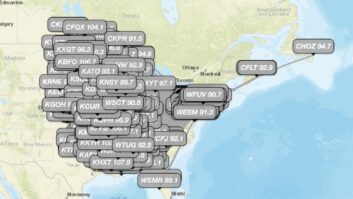
The ongoing debate over the FCC’s reallocation plans for the upper C-band will come into sharper focus this week. The FCC meets Thursday to discuss repurposing at least some of the spectrum that is used by broadcasters for their earth station operations.
During its meeting, the commission will consider a draft Notice of Proposed Rulemaking (NPRM) that explores options for reconfiguring the upper C-band (3.98 GHz to 4.2 GHz) in the U.S.
The National Association of Broadcasters met with all three FCC commissioners during the government shutdown to convey the importance of shielding critical broadcast links when dividing up the upper C-band. The NAB says it supports the commission’s goal of expanding broadband, but “it should avoid undermining systems that already connect Americans.”
According to a public draft of the notice, the FCC says it is following the lead of Congress, which directed the commission to open a large swath of upper C-band frequencies for next generation wireless use.
Under a requirement adopted in the “One Big Beautiful Bill Act,” Congress mandated the FCC to auction a minimum of 100 megahertz (3.98 – 4.08 GHz) within two years of the bill’s adoption, but the FCC could decide to grab up to 180 MHz (3.98 – 4.16 GHz) if it wants; and wireless providers are asking for even more spectrum.
[Related: “The C-band Is Back in the Crosshairs“]
The NAB in its meetings with the FCC pointed out the critical role satellite operations in the upper C-band play for program distribution and delivery of radio and TV programming. It urged that the commission account for this when determining whether to exceed the statutorily-mandated 100 MHz clearing target.
“When viewers flip on their televisions to the big game or tune their radios to their favorite syndicated radio show, they expect the signal to be delivered in pristine quality without interruption,” the NAB said in a recent filing about their meetings.
The broadcast advocacy group says C-band is unique in that it is both highly-resistant to rain fade (unlike other satellite bands, such as Ku-band) and can achieve nearly hemispheric coverage from a single satellite.
“The reallocation of a portion of the upper C-band will require many incumbents to move to other platforms,” NAB says, “including broadcasters with earth station operations.”
Asking Points
Broadcasters are very familiar with the commission’s hunger for spectrum to roll out additional 5G and other wireless services. The FCC reallocated the bottom half of the C-band for wireless use and moved broadcasters’ satellite services to the upper half just five years ago.
However, the NAB is now emphasizing that incumbent relocations out of the C-band a second time will be dramatically more expensive and lengthier than was required following Auction 107 — a process that took nearly three years.
“The commission previously committed to preserve the content distribution system in the C-band,” the NAB said, and “respectfully asks the commission to honor that commitment by ensuring that incumbent broadcasters in the upper C-band are provided comparable facilities and kept whole.”
To insure that, the NAB is asking the FCC to incorporate the following questions, guardrails and requests for comment in the draft NPRM:
- Pursue a detailed, data-driven process before contemplating any clearing beyond 100 MHz. Specifically, request technical showings from space-station operators demonstrating how existing traffic could be accommodated, including channelization plans, transponder loading, compression assumptions and contingency capacity for occasional use operations and outages.
- To the extent incumbents cannot be accommodated in the remaining upper C-band, seek comment on concrete criteria for “comparable facilities,” including reliability, availability, coverage and total cost of operation.
- Expand the scope of reimbursable costs for incumbents who are not accommodated in the remaining upper C-band spectrum to include redundant paths, geographic diversity of earth stations, monitoring/telemetry upgrades and security required to achieve C-band-equivalent reliability.
- If the commission considers accelerated clearing incentives for satellite operators, seek comment on guardrails to ensure these incentives do not result in higher prices or degraded service for broadcast customers.
- Seek detailed comment on impacts where C-band remains indispensable (e.g., Alaska, Hawaii, Gulf Coast, Caribbean Territories and border regions), including cost-sharing implications if the customer base shrinks.
- Direct technical workshops and a staff-level working group to vet feasibility, timelines and test plans before any auction schedule is finalized.
FCC Chairman Brandan Carr has said part of his mission is to restore U.S. leadership in wireless. In a post on his commission blog in October, the chairman said the U.S. “has no time to spare.”
Meanwhile, wireless carriers and the CTIA have told the commission that 180 megahertz of the band could be auctioned safely. In fact, CTIA is asking for 220 MHz.
The public draft of the proposal says the FCC hopes to clear incumbent earth station operators from the band over a five and a half-year period and, as with the prior migration to the upper C-band, the FCC proposal includes provisions that new band users reimburse incumbent earth station operators for transition costs.
Industry observers say the FCC’s Auction 107 for the lower C-band generated $81 billion in net licensing fees.
[Related: “Airwaves Battle Brews Over Upper C-Band“]