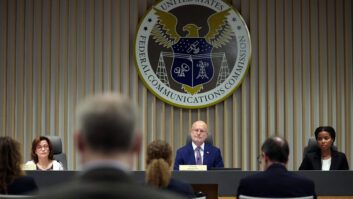
Media brokers, attorneys and other commission watchers say Chairman Brendan Carr and Commissioner Olivia Trusty — the 2–1 Republican majority on the FCC — are poised to overhaul local broadcast ownership caps.
At present, in each of the largest U.S. radio markets, a licensee can own up to eight commercial radio stations, and a subcap limits a licensee to owning no more than five on each band (FM/AM) in the market. The caps shrink as market size decreases.
If those limits are relaxed or removed, brokers expect rapid consolidation through mergers, acquisitions or station swaps, not just in large markets but also medium and smaller ones.
The FCC in September decided that as part of its quadrennial rule review, it will consider relaxing or eliminating these limits, though as of press time, the ongoing government shutdown had delayed the comment cycle in the proceeding.
The National Association of Broadcasters and some individual owners have long advocated for easing the limits. And while rule reviews often take years, experts expect Carr to move much more swiftly.
Scott Flick of Pillsbury Winthrop Shaw Pittman LLP says once the comments are in, it’s “plausible that an order might be released three to four months after that,” though it could take longer “given that the FCC will want to spend the time necessary to make the order as bulletproof as possible in the courts.”
Frank Montero, co-managing partner at Fletcher, Heald & Hildreth, said the broadcasting community “has been screaming for action” and was disappointed when the FCC’s Democratic majority kept radio caps in place in late 2023.
The commission said then that consolidation among radio operators would not allow them to better compete against digital media and that the public needed to be protected against local broadcasters getting bigger.
Montero expects the Carr commission to take final action by the end of summer 2026.
Brokers say broadcast owners are already considering their options and will be poised to act quickly if the FCC acts. They expect some broadcasters will quickly divest in some markets and invest in others.
Greg Guy, president of Tideline Partners, said, “I would expect most of the major groups to act decisively as deregulation opens the door to refocusing their portfolios, either geographically or by market size, to maximize operating efficiency.”
Given capital constraints, Guy anticipates that many of the larger groups will pursue strategic station swaps as a primary method of consolidation.
“Swaps offer substantial cost savings and allow operators to strengthen their market positions without significant balance-sheet impact,” Guy said.
The efficiency gains and margin improvement opportunities from such trades are significant, he told Radio World in an email.
Meanwhile, he said, well-capitalized operators, particularly those in in medium and small markets, are best positioned to be aggressive if the FCC eases the caps.
Doug Ferber of DEFcom Advisors says radio operators in markets of all sizes have been strategizing in conference rooms to decide if they will buy, sell, hold or swap. “Due to the condition of the industry today, few of the existing owners will be buyers. Most will be sellers or swappers.”
He said companies that are in varying degrees of financial distress like Beasley, Salem, Townsquare, iHeart and Cumulus would have an opportunity to pivot around a transaction and revitalize their capital structure.
He envisions iHeart and Audacy as leading the consolidation in large markets via swaps.
“Connoisseur will be active. Keep in mind they have a lot of stations but only in a handful of large markets,” he says. “They will be involved but they can’t take everything. Nor do they have the money or the assets that would be swap worthy to consolidate a significant number of large markets.”
He thinks Educational Media Foundation will continue to be strategic as it builds out its networks.
When the FCC opened its latest proceeding, Beasley and Cumulus thanked Carr for taking up the initiative. In 2023 Townsquare Media and Connoisseur told the commission that ownership rules hinder the ability of broadcasters to compete for audience and advertising dollars.
The NAB has proposed that in the top 75 Nielsen Audio markets, a single entity could own up to eight FM stations, with no cap on AM station ownership, instead of the current “sub-cap” restrictions. It also has asked the FCC to eliminate restrictions entirely on radio ownership in markets outside the top 75.
In previous filed comments, iHeartMedia has said that abolishing limits on AM caps entirely while raising FM limits “could exacerbate the competitive disadvantage experienced by AM radio stations relative to FM stations.”
Industry observer Jerry Del Colliano, publisher of Inside Music Media, says if the commission relaxes the ownership rules, Cumulus and Beasley could be rolled up into a larger group.
“If the cap is lifted, some companies or stations are going to be absorbed by Connoisseur, which is hell bent on buying stations and groups for low prices, even though the upside of linear media like radio is considered remote,” Del Colliano wrote in October.
George Reed of Media Services Group expects swaps from the largest broadcasters, perhaps “involving a lot of stations in a lot of markets,” as broadcasters try to rationalize their market positions and become competitive with digital competitors.
“I think that many broadcasters will see this as an opportunity to ‘go or grow,’” Reed said.
A move by the FCC to adjust ownership caps could also unlock inventory that has been effectively frozen for years, stimulating meaningful deal activity, he said.
Another expert questioned whether private equity still sees an opportunity in radio: “A mature declining industry? It doesn’t appear to me that there is enough return available to attract large-scale private investment,” this observer said.
“There will be a lot of swaps, no doubt, but swapping won’t be enough to completely consolidate the industry under the NAB’s proposal.”
One broker wrote in an email that dealmaking “will surely reward operators with scale, efficiency and local presence while pushing marginal operators to consolidate or exit the business. Owners will need to be aggressive to stay in the business and remain a going concern. It could accelerate the divide between viable and non-viable stations.”
Consolidation also could affect non-broadcast businesses that are tied to radio.
One observer said, “Ratings really won’t matter in smaller markets. Over the span of an ad campaign, a radio company will be able to deliver the entire market to advertisers if they own all or most the stations in the area. In many ways the industry will go back to selling radio on its merits, i.e., its ubiquitous reach, economic price relative to other media, and the results provided to advertisers. Sell your Nielsen stock now.”
“Long Overdue”
Larry Patrick, operating partner of Patrick Media Brokerage, is in a unique position to comment on what’s ahead if the FCC eases ownership limits. He also owns Legend Communications, which operates 22 stations in northern Wyoming.
This is a critically important time for the radio industry to ask for significant ownership deregulation. If the “smaller than 75 market rank complete deregulation” proposal is approved, little will change other than some small operators will exit and others will buy out their direct competitors. Not much of a blip on the national radio market radar.

For real market forces to work, there needs to be almost total ownership deregulation of the industry from top to bottom. Private equity and investment money is not interested in buying collections of unrated markets. They want scale and a way to enter the national market in a big way. The industry has spent a decade cutting costs, laying off personnel and hoping for a miracle. That hasn’t occurred.
For an industry that is 100 years old and facing competition from huge companies backed by public shareholders or private equity, the fact that these artificial barriers to ownership exist is contrary to basic economic theory.
Let radio build the scope of its operations and scale necessary to compete with the TV networks, Meta and Google, and dozens of new streaming and digital services. We are long overdue for a complete revamping of the ownership controls imposed by the FCC.
Localism will still exist as the benchmark of good radio. Stop crippling radio by the controls of artificial ownership caps. Let the market decide our future and be brave enough to steer our industry forward. This will result in higher multiples, the scale to survive in an over-abundant media world, and a future for the best operators and investors to thrive.