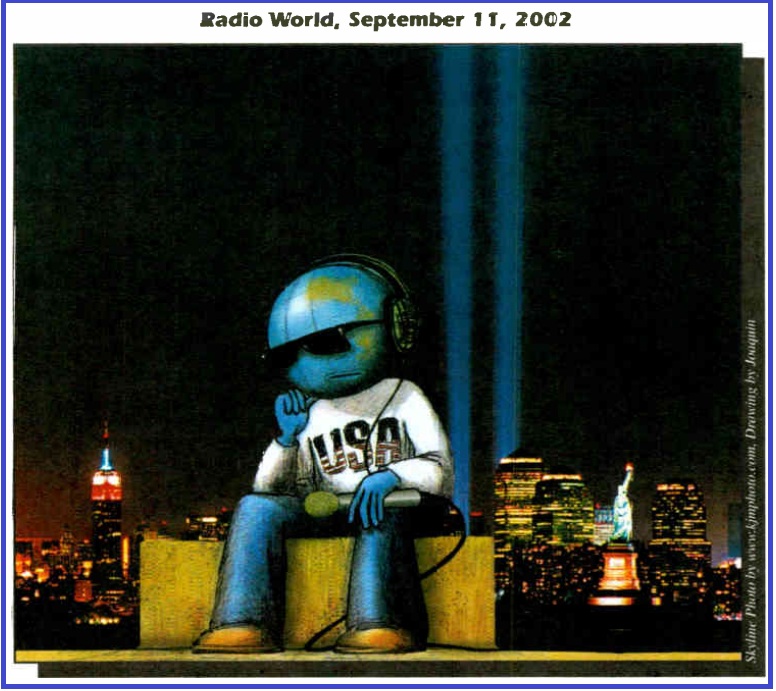
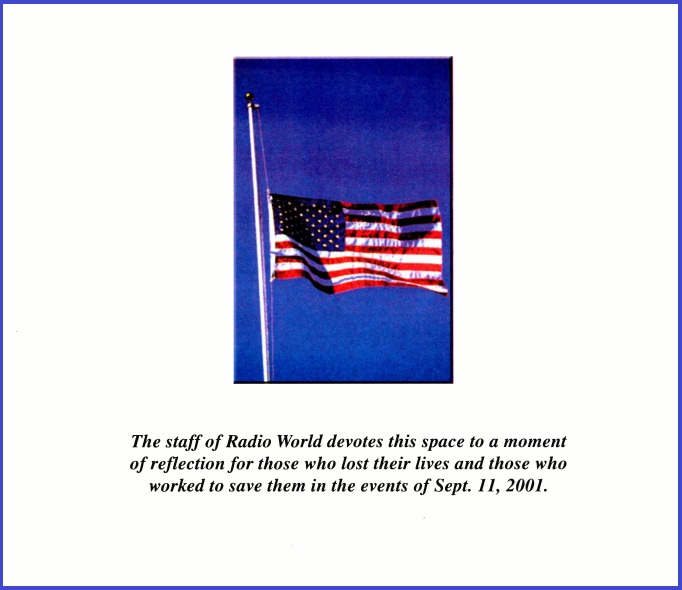
The image below appeared on page 4 of Radio World’s Sept. 24, 2001 issue.
The 25th anniversary of the Sept. 11, 2001, terror attacks is Friday. Radio World is presenting a series in which people share their memories.
This article features several people who were in the Washington, D.C., area that day.
Bailey’s Crossroads
Radio World Editor in Chief Paul McLane remembers that he had just settled at his desk at the publication’s offices in northern Virginia, five miles from the Pentagon, when his co-worker Terry Hanley, whose desk was outside his office, said, “A plane has hit the World Trade Center.”
“I had no sense of it being a big jet,” McLane said. “I envisioned something like a Piper Cub. I told her about an incident in the 1940s that I’d read about, when a military plane had hit the Empire State Building. Fourteen people died in that crash, but the building itself withstood it.”
McLane then tried to access online news sources but recalls that the internet seemed locked up.
“By the time the second plane hit in New York, we were all aware that something terrible was going on. Someone had a small TV on in the office. And soon our hallways were filled with rumors and second-hand accounts of threats to various government buildings.
“It frightens me in hindsight to realize that Flight 77, which targeted the Pentagon, was then passing almost directly over our heads in the offices of Radio World not once but twice. That plane passed over our location in northern Virginia, made a clockwise loop and aligned with Columbia Pike, a road that pointed at the Pentagon. Our office building was on that road. A person standing on our roof would have seen the jet. We did see the smoke rising a few minutes later.”
He said it’s hard to recall the exact timeline of who was saying what during those early hours.
“I remember co-workers being worried about family members who worked downtown. I remember someone saying there’d been an explosion at the State Department, which wasn’t true. Eventually we were sent home, where most of us would have been riveted to our televisions, and we learned of yet another plane that crashed in Pennsylvania. I remember being aware of how empty the blue skies were of air traffic.”
For McLane the sense of connection to New York was particularly severe.
“I was born in Manhattan, and I had visited the top of the World Trade Center several times. The New York/New Jersey metro area was my home.”
[Read Paul McLane’s emotional column published on the first anniversary of the attacks, courtesy WorldRadioHistory.com.]
At WTOP
Brian Oliger is director of engineering and technology for WTOP, WFED and 2060 Digital in Washington. Twenty-five years ago he was newsroom IT manager for WTOP and Federal News Radio.

“My most vivid memory is simply what a perfect, fall day it was in Washington, with crystal-clear blue skies and temperatures in the low 70s, and how completely incongruous the horror that we were witnessing was with such a perfect day,” he said.
“At one point we got word that another hijacked aircraft may be heading to D.C. As I was a newsroom employee, our Director of News and Programming Jim Farley told me to grab a recorder and go up to the roof of our building and let the newsroom know if I could see anything. Of course that tip turned out to be right, but the plane in question was Flight 93 that crashed in a field near Shanksville, Pa.”
Oliger’s normal workday went out the window the moment he arrived at WTOP.
“I spent most of the day trying to set up ISDN, phone or satellite feeds for other news organizations, many of them in foreign countries, who either wanted a live feed of WTOP’s broadcast, or wanted to interview our reporters.
“I clearly remember the voices of our news anchors and reporters whose job it was to inform our audience of the absolute horrors that were happening in New York City, at the Pentagon and in Pennsylvania, while trying their best to maintain their composure. And I remember us gathered around the many TVs in the WTOP newsroom and watching in disbelief as the towers came down.”
A college friend, Navy Commander Robert A. Schlegel, died at the Pentagon.
“I’d be remiss if I didn’t mention the broadcast engineers who were lost that day in the towers. While I did not know any of them personally, I hope our industry community never forgets them, their faces and the unspeakable loss their families suffered while they were doing their jobs that day.”
WAMU

John Holt was director of engineering and operations for public radio’s WAMU in Washington. He remembers his emotions as he drove to work that morning; tuning around the dial he heard WTOP carrying raw audio from WCBS in New York. “It was hard to listen to,” he recalls.
He remembers looking out the office window on 9/11 and seeing the smoke rising from the Pentagon.
“WAMU produced ‘The Diane Rehm Show,’ distributed by NPR, which aired for two hours beginning at 10 a.m. It was decided that the show would not air,” he said.
“All stations were to carry the NPR special coverage. That lasted several days and was available to all public radio stations, even those not usually carrying NPR programs. NPR shows were produced specially for this coverage, with ‘The Diane Rehm Show’ covering several hours on Saturday night.”
WETA
Mike Byrnes was chief engineer for WETA(FM) in Washington. He was at home that morning getting kids off to school and preparing to head into work.
“I’m sure that everyone will recount the shock of watching the planes hit and then the subsequent collapse of the Trade Center towers. It was surreal, beyond any Hollywood production.”
The studios of WETA, which plays classical music, are only about 3 miles from the Pentagon.
“Radio did not do spot news, only NPR news periodically, so our FM’s response was primarily to alter the music playlist to include more somber choices,” he recalled.
“WETA-TV, since it produced, and produces, the ‘PBS News Hour,’ was greatly affected.”
“Residual smoke from the attack hung heavy over the entire area for a day or two.” He also remembers viewing the damage to the Pentagon days after the attack when the Interstate-395 was reopened.
XM Satellite
Eric Hoehn was manager of the Broadcast Operations Center at XM Satellite Radio in Washington at the time.
“XM was scheduled to begin national service on Sept. 12 — if you could find a copy of USA Today for the 11th, XM was the story in the green section, but I suspect no one read it,” he remembers.

“On the morning of the 11th I worked out in a gym near my home and then drove to the office listening to ‘Morning Edition’ on NPR. There was a story about the assassination of an Afghan resistance commander on Sept. 9. No special significance at 7 a.m. that day.”
Hoehn sat down around 8:45 for the daily meeting hosted by Tony Masiello, the VP of broadcast engineering, who had joined XM a few years before after heading radio engineering at CBS. Just before 9 a.m. Masiello received a call from his wife about the news in New York.
“XM was pretty much in full operation that day in preparation for the start of service the next day, with all 100 channels in operation. We had an all-news channel as well as a full-time channel of AP radio,” Hoehn said.
“Later in the morning, I remember being on the roof of the XM building in Northeast Washington with a number of people, including one of our reporters. We were looking west at smoke rising. It was the attack on the Pentagon. Scott Walterman was using a cell phone to put the story on our news channel for the few radios that were activated that day.
“I remember the company let most people put their stations on automation and leave in the afternoon. We all took home whatever we wanted that was in the cafeteria. The next day’s launch of service was postponed. It eventually happened on Sept. 25.”
Hoehn remembers going home and then walking to George Washington Hospital to see if they needed blood donors, but they did not.
“I was pretty creeped out walking across a deserted Pennsylvania Avenue NW at 5 p.m. on a Tuesday. That night when I went to bed there was the sound of miltary jets flying the combat air patrol over the city.”
The next few days involved checking on people who were on assignment out of the office to make sure everyone was safe. “Some of our contractors had to drive back to their homes elsewhere in the country because there were no flights.
“I remember T1 lines to some New York program suppliers dropping out concurrent with the collapse of WTC-7, which was right next to the phone company building in lower Manhattan. The next few days are a bit of a blur, but everyone continued to come in so we could prepare for whatever changes were needed to launch the business on a new date.”
Hoehn retired in 2023.
The editorial cartoon below shows the Radio World mascot mourning on the first anniversary of 9/11. The drawing was conceived by Paul McLane and created by Joaquin Araya. Courtesy WorldRadioHistory.com.