Nick’s Signal Spot is a new feature in which Nick Langan explores RF signals, propagation, new equipment and related endeavors.
For long-distance signal enthusiasts, there is nothing more sacred than the logbook.
It has changed shapes and forms over the years, augmented by audio or video captures. But the very act of placing a station or contact in the log — whether it’s AM, FM or shortwave — makes what you heard official.
Paper logbooks, maybe in a notebook or a binder, were commonplace throughout the 20th century, and some DXers still use them today.
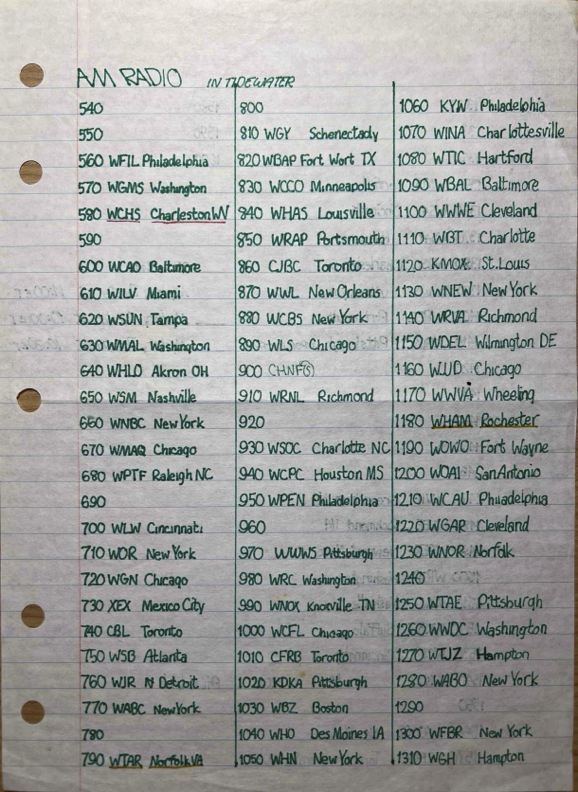
Lee Costic has seen the evolution. Growing up in the 1980s in Virginia Beach, Va., he used his admirable penmanship to keep track of stations he heard on AM.
Then, later on in the decade, Costic got his hands on a 1977 Sears Scholar typewriter. Here are his May 1986 FM logs.

Now, Costic has followed the trends and uses Google Maps to chart the FM stations he has heard in his current location of Richmond, Va.
When I first started DXing in 2005, I used a Microsoft Excel spreadsheet to keep track of my logs. Other DXers, such as I do now, make use of the logbook feature that the websites FMList and MWList offer.
We’ve established tools. But what about the actual criteria for a station to enter a logbook?
There used to be an online resource at yes.com that had receivers in every market and it archived each station’s playlist for up to a week. I sorely miss it today.
If there was an E-Skip opening to south Florida, and if I heard Carl Carlton’s “Everlasting Love” on 102.7 FM and it happened to match what WMXJ(FM) in Pompano Beach, Fla., was playing, I didn’t think much of it and put it in my log.
But quickly, I learned that each person’s criteria — to log or not to log — can be vastly different.
What counts?
Saul Chernos started DXing in 1975. From his main DX site north of Toronto — a spot he refers to as Burnt River — he has logged approximately 5,240 FM stations and 2,740 AM stations.
Like many DXers, Chernos keeps multiple logbooks, for separate locations he scans the bands from. This is something to keep in mind if you are new to the hobby: If you hear a DX station in your car 10 minutes away from your home, should you count it in your home log?
The Worldwide TV & FM DXing Association’s criteria for a logging radius is 25 miles from your home location — what is known as your QTH.
Chernos’ longevity alone is impressive — not to mention the sheer total of stations he has heard. As such, he employs a judicious approach. Be careful what you count, he’s learned.
“How would any DXer truly know if the song was aired by a syndicated show or if the song was used as abbreviated bumper music on a talk show, which online tools won’t note?” Chernos asked.

There are a few faux pas, right off the bat. It’s almost universally agreed upon never to count a station on programming format alone.
I might argue that a unique genre, such as smooth jazz — which as an ardent fan, I must admit isn’t found much on the FM band anymore — would stand out on a frequency.
But in an E-Skip opening, trying to narrow down country stations on 98.1 FM, or figure out who airs NPR News on 90.3 FM at the top of the hour, is a foolhardy exercise.
Is a station’s slogan or moniker enough?
When Chernos started DXing, Bruce Elving, the publisher of the annual FM Atlas directory of North American FM stations that was a one-of-a-kind resource, was also very active in the hobby. His approach to counting stations, Chernos recalled, was quite stringent.

Elving required either the station’s call letters, or two other factors, which might be a local advertisement or announcement, to count a station. The mere slogan — ”Magic 102.7,” would not have clinched it for Elving.
Part of that mindset likely went back to when getting your hands on a QSL card was more a part of a DXer’s ambition. You would need to prove to a broadcast engineer, or other station personnel, that the station you claimed to hear you indeed did, in order to get the prized proof of reception in return.
“With TV and FM stations, the DXer is dealing with a group of broadcasters, most of whom believe their signal is limited to 50–100 miles from their transmitter site and unaware that long distant skip is possible,” Frank Aden wrote in a 1997 Popular Communications article on QSLing TV and FM stations.
QSLing originated within the medium-wave DX community. Thanks to skywave, distant AM reception is more easily observed, but as we detailed in our AM Graveyard feature, hard-to-believe receptions happen, too.
But for your own logbook, does a reception really need that much verification?
It can depend on context. A programming element such as a local advertisement, Chernos explained, can be more reliable for identifications, but not always. “R & D Heating and Cooling might be truly local, but service providers in multiple communities might have the same name,” he explained. “Embed that into a weak or distorted long distance reception and you can fool even a highly seasoned DXer.”
A slam dunk for most FM DXers, these days, is identification via RDS. In the U.S., the four-digit hexadecimal PI code typically translates to an FM station’s call letters.

“Still, even this technology is vulnerable,” Chernos explained. “Attentive DXers have noted inaccurate and thus misleading PI codes.”
Beyond a reasonable doubt
DXers can go to great lengths to confirm their logs. Chernos used the example of calling a station to see if its personnel can match advertising records or an announcer’s voice.
Paul Logan in Ireland worked with on-air host Marcus Hyles to confirm his historic reception of 90.7 WVAS(FM) in Montgomery, Ala., in 2009.
Chernos is also a proponent of recording your DX. In the past, this was accomplished via cassette. Then MiniDisc. Then came computer hookups, and audio recording software like Total Recorder is still used by several DXers.
Today, software-defined radios make it easy to record entire swaths of the spectrum and play back later.
But even that is not foolproof.
“Every one of us has been presented with compelling content before pressing the record button,” Chernos said.
In the end, can we ever be sure of what we heard?
“There’s almost always room for doubt,” Chernos explained. “What seems like a station ID might simply be a syndicated show welcoming new affiliates,” he warned.
DX dilemmas
Even after discovering the different approaches, throughout my time DXing, I’ve been a bit more liberal in how I log stations. I make use of song identification tools, such as the Shazam app, to match receptions for playlist matches. I rationalize it, I suppose, as making use of the tools we have in today’s age, with a bit of common sense.
When it comes to “special” receptions, however, like logging a new state, I think it’s fair to have a different criteria.
During a strong E-Skip opening on July 14, 2021, a prolific DX’er about 45 miles to my northwest in Quakertown, Pa., Steve Walko, K3PHL, heard two signals from the Billings, Mt., market in 95.5 KCHH(FM) and 96.3 KRZN(FM).
Those are rare double-hop receptions, at over 1,700 miles in distance. In my logbook, I had never heard Montana.
I began to review an IQ recording from my SDR on July 14 which included 96.3 in my bandwidth swath.
At the same time it was heard by Walko, the song “Bruised and Bloodied” by Seether came atop a noisy 96.3 on my location.
That matched KRZN’s playlist at the time. The signal did not hold long enough for an ID, nor was it strong enough, next to a local’s HD Radio sideband, for RDS.
KRZN runs an active rock format. I’m confident to say few other formats would air a current by Seether.
We’ve discussed E-Skip a few times in this space. Even with double-hop skip, a potential target area is fairly evident. The lack of other signals in the upper Midwest on 96.3 along the path provided more evidence.
Was it good enough to count?
I discussed this quandary with my VHF DX Podcast co-host, Bryce Foster. He leaned toward the feeling that a song match was not enough to clinch a reception, particularly of Montana’s ilk.
Conversely, I heard from some others, such as fellow DXer Les Rayburn, who congratulated me on logging Montana.
As evidence of my inability to make choices, some four years later, I haven’t decided one way or another to count KRZN.
I’d be curious, what would you do? Send me an email!
The one that got away

Credit: David Silverman/Getty Images
If you’ve been a DXer long enough, you’ve probably encountered a scenario like Chernos’ Argentinian disappointment.
There is a station from Argentina on 750 kHz, he explained, that routinely broadcasts five musical beeps at the top of every hour.
In one instance, after listening to Spanish-language ballads poke through a weakened WSB(AM) from Atlanta for close to a half hour, Chernos found a web stream that seemed to provide a parallel to what he was hearing.
It was close to the top of the hour.
“Unfortunately, the ballads faded with less than a minute to go,” Chernos explained. It is the epitome of every DXer’s nightmare.
But then, he heard it.
“The top-of-the-hour beeps,” Chernos said.
He uncorked a bottle of Catena Zapata Malbec in celebration.
But it was all for naught. A year later, Chernos said that another DXer reported a station in Colombia on 750 AM, also running five beeps on the hour.
There was no way to distinguish the pair. For Chernos, it was the polar opposite of delayed gratification.
“I sobered up with strong Arabica and deleted my prized Argentinian from my logbook,” he said.
It is just a hobby, after all
In 2005, when I grew to be obsessed with the FM DX hobby, I was all about logging as many stations as possible. Twenty years later, I have a confession to make — I’ve not updated my own logbook in nearly five years. And I really don’t pay much attention to the total number of stations I’ve logged anymore.
That’s partially attributable to my use of SDRs. We’ve run a couple of recent pointed response letters to a commentary from Ira Wilner. For him, software-defined radios have taken a bit of the fun out of DXing. Many of you would disagree.
I started using SDRs in 2014, first with the RTL SDR dongle, then the Airspy in 2015, and I haven’t looked back. I think they are wonderful tools that have changed the game for the better.
I also love the extensions of the technology that have come about — I run three separate SDRs continuously that report to my RabbitEars.Info autologger.
There’s a part of me, though, that also understands where Wilner is coming from. In a major opening, on playback, the new logs can almost come too easily — the result of recordings that cover large swaths of the FM band.
It’s also so easy to get buried in excess IQ recordings that I’ll probably never end up reviewing.
Don’t get me wrong — it’s all still enjoyable. Maybe it’s just the length of time I’ve been doing this now, but I am in more of a quality over quantity mindset.
I have more appreciation now for a hard-to-hear translator at a lengthy distance, a new state or country or something only a few of us DXers might appreciate — hearing a station via multiple modes. A tropo, E-Skip and meteor scatter propagation hat-trick.
In the end, the tools have evolved. But how to count stations in your logbook should really be your own call. And that gets back to the beauty of it all. It’s just a hobby.
And Chernos, to his credit, isn’t beating himself up over his lost catches anymore.
“I lose enough sleep DX’ing at night to begin with,” Chernos explained. And, maybe there will be another chance for him to definitively hear Argentina, or for me, Montana, again.
“Every missed opportunity goes into my list of potential targets to chase another day,” Chernos said.
[Read the Signal Spot from Nick Langan for More DX-Related Stories]