This article is a special report and part of a Radio World ebook on major trends in remote control and monitoring.
Here, we gather input from a range of experts about those changes.
Major trends
Jim DeChant, director of operations for Transmission Services Group, says: “In 2026, the most significant trend in how radio broadcasters control and monitor transmission facilities is the shift from ‘reactive polling’ to ‘agentic, IP-native observability.’
“While traditional remote control relied on simple status checks (SNMP polling) to tell an engineer if a transmitter was off, modern systems are moving toward intelligent, software-defined environments where the monitoring system acts as an autonomous ‘copilot.’”
Barry McLellan of Bonneville lives on Farnsworth Peak in Utah. He remembers having to explain over the phone to a part-time overnight staffer how to get readings out of a Moseley MRC-1600 and talking him through a complex process for turning on the auxiliary transmitter.
He also recalls later days of using a POTS connection to enter a password, go through an alarm list, run the appropriate macro to get a station back on the air and fall back to sleep. (“I was a DTMF master,” McLellan said.)
“The biggest improvement I’ve experienced with modern remote controls is the installation of solid IP connectivity at our sites,” he continued.
“If a local IP provider is not available, sometimes this means a 5.8 GHz ISM link, a 900 MHz modem diplexed on your STL link or possibly working with a WISP provider.”
He said newer IP-based remote controls have so much information available on-screen at once, configured just the way you want these readings to appear.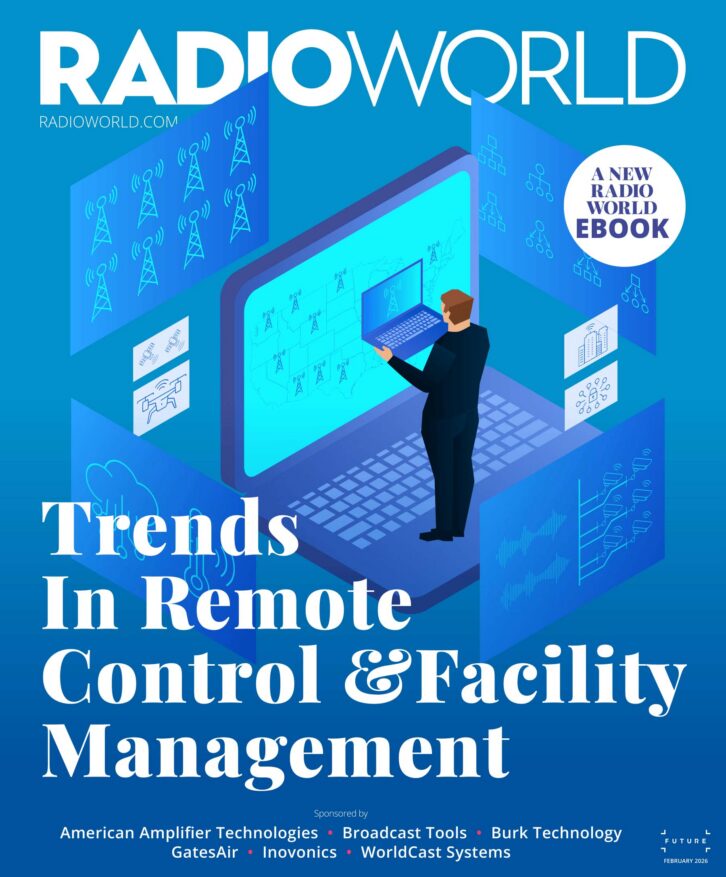
“The connection can be left open all day on your work desktop or phone showing all your sites at once for easy, quick access. Plus there are a whole host of new, inexpensive devices to monitor many other situations at your site to make sure there aren’t problems at the site you wouldn’t normally see.”
Ben Nason works in product development, tech support and engineering for Broadcast Tools.
“For us as a hardware manufacturer, the continued adoption of SNMP in broadcasting has been very important in guiding our product development decisions,” he said.
“SNMP integration goes hand in hand with the trends we see in broadcasting of increased adoption of audio-over-IP and software-based solutions. When in the past you might have been looking for a single device to solve a problem, now it’s much easier to use multiple devices distributed as needed and connected via SNMP over Ethernet.”
He said broadcasters use all of the tools available to them to provide redundancy.
“We believe that control of your transmitter is too important to be left to a single point of failure. For example, what are your options if you accidentally misconfigure the network interface on your transmitter while working remotely? If you have a remote control, even if it’s just in a backup role, then you have redundancy and you’ll still have control until someone can visit the site to correct the misconfiguration on the transmitter.”
For Mike Dorris, COO of Inrush Broadcast Services, the key trend is that now you can control everything at a site, primarily powered by that much wider adoption of SNMP that we’ve discussed in this ebook.
“Granted it sounds silly, since SNMP is rather old tech for the rest of the world,” he said.
“But for broadcasters, as always, it still feels like a struggle to convince stations of why it’s so powerful and not scary newfangled tech.”
He said being able to bring in telemetry from UPSs, dehydrators, environmental monitors, tower light controllers and other systems and aggregate them in a central monitoring device without hours of wiring or large capital costs in extra IO is “huge.”
He also noted the deployment of relatively inexpensive cameras — indoors to view equipment indicators in a rack, as well as outside as a backup “tower light monitor” or to watch for downed fences, copper thieves and other concerns.
“Nearly every new station we engage with we find ourselves rolling out SNMP and cameras almost immediately to aggregate all this kind of data.”
Jacub Emery of Dielectric points to a shift from binary “on/off” alarm monitoring toward ongoing, pattern-based monitoring of the entire RF system.
“Historically, transmitter control systems were focused on a simple question: ‘Is the transmitter on the air?’ Alarms were triggered only when something crossed a hard threshold, power dropped, VSWR spiked or a fault occurred.”
Emery said this approach was inherently reactive and often meant engineers learned about problems only after service was already degraded or lost.
He said products like Dielectric’s RFHawkeye take a more sophisticated mindset.
“The focus is no longer just whether the transmitter is operating, but whether the entire RF chain including transmitter, transmission line, antenna, and environment is healthy, stable and predictable over time.”
Rather than relying on yes/no alarms, he said, modern monitoring focuses on long-term trend analysis, established baseline deviation and identifying subtle changes in normal RF system behavior.
He said this allows engineers to ask whether the system is behaving the same way it did last month, last season, or under similar conditions. Small changes in impedance, phase, reflected power or noise that would not trip a traditional alarm can be detected before they become outages.
“This move toward holistic, data-driven RF monitoring is one of the most significant advances in broadcast transmission control today.”
Let’s end our ebook with a sampling of quotes about other aspects of this topic.
Cybersecurity
Ben Nason, Broadcast Tools: I’m probably preaching to the choir here, but if you are still using port forwarding or providing full access to a device over the internet using a static IP address, you should make plans to convert those sites over to secure access methods as soon as possible.
Current best practices for systems that need to be remotely accessed is to keep them behind a firewall and to use secure access methods such as a VPN to access devices on the site’s network and/or a remote desktop client to reach a PC on the site’s network. VPNs can be provided by dedicated router/firewall hardware from manufacturers like Ubiquiti, or by software-based solutions like Tailscale.
For larger broadcasters these kinds of IT and networking best practices should be second nature, but for smaller broadcasters with less in-house IT support there can be a learning curve. We recommend that engineers and managers who might not be familiar with the ins and outs of firewalls and VPNs take advantage of the many resources available including training from organizations like the SBE and outside IT/networking consultants.
Ed Bukont: The advice of a transmitter manufacturer’s support tech comes to mind: “Nobody ever died from a lack of rock and roll.”
Making your remote control easy for you to access makes it easy for others to access. Solutions should “dial out” rather than “dial in.” Being able to restore operations should not be an excuse to shortcut security protocols and best practices.
Control of access should limit the ingress necessary. Ingress and egress do not have to have complimentary network configurations. Most products designed to be accessed remotely for monitoring allow more than one level of access, from admin (setup only) to monitor (observe readings) to control (make adjustments). Each level should have some distinction and unique passwords.
The generic admin should have its password changed to something quite long, and a secondary admin user created for setup and admin.
Nautel and GatesAir have published guidelines on site network security. There are resources via SBE meetings, webinars and NAB shows. The information to secure your network is out there and often free. Join a users group such as Broadcast Engineers on Facebook to access the body of knowledge.
Do not put your devices directly on the internet, use a jump box — and yes, learn such IT lingo so you can ask for the support you need in a way that IT will understand.
Nothing about broadcast is unique in a way that cannot be properly managed according to recognized best practices, no exceptions. If you have an exception, it probably means you have a vulnerability.
Centralization
Jim DeChant, Transmission Services Group: Radio broadcast monitoring is undergoing a significant centralization into network operations centers utilized by major groups like SBG, Nexstar and iHeartMedia. This consolidation is driven by efficiency and advanced technology across three primary levels.
First, the regional/national NOC model employs a hub-and-spoke system where small, specialized teams use sophisticated dashboards to monitor and remotely troubleshoot hundreds of sites 24/7.
Second, the industry is adopting cloud-native management, shifting monitoring infrastructure to hybrid cloud solutions and utilizing monitoring-as-a-service platforms such as Kybio and Skyline DataMiner for secure, web-accessible monitoring.
Finally, centralization now encompasses integrated asset and logistics management, linking technical health with financial data through tools like EZO AssetSonar. Automated systems instantly generate service tickets as with Zendesk or ServiceNow, with diagnostic logs and dispatch contract engineers upon system failure, streamlining the entire operational lifecycle.
Richard Sondermeyer, G.S. Broadcast Technical Services: We’ve seen very little movement toward fully centralized monitoring and control infrastructures among private radio broadcasters in Canada. Most private operators still manage their transmitter sites individually, with each location monitored and controlled on its own rather than through a unified national or corporate operations center.
Our public broadcaster, does have a centralized alarm-monitoring facility. They use this to collect alerts from across the country, providing a higher level of national oversight than what is typically found in the private sector.
In our own operations, we monitor more than 15 sites using remote-control systems. We rely on cloud-based alert-management software to ensure that fault notifications are distributed to all our technicians quickly and consistently. While this gives us an efficient, unified alerting workflow, we still log into each site individually for detailed diagnostics, control actions, and troubleshooting.
More on SNMP
Jim DeChant, Transmission Services Group: While Simple Network Management Protocol remains the mandatory foundation for radio transmission control in 2026, its role has narrowed. Every modern transmitter must support SNMP, making it a prerequisite rather than an advanced feature.
Buyers must insist on the highly secure SNMP v3, which utilizes AES encryption and SHA-256 authentication to protect public infrastructure, as older versions transmit passwords in plain text.
Additionally, the MIB (Management Information Base) file is essential, acting as the device’s dictionary for remote control systems.
For complex, real-time control and high-speed data, manufacturers are increasingly relying on faster REST APIs. The industry is also pivoting from constant bandwidth-heavy “polling” toward efficient Traps (alerts only on issues) and high-speed streaming telemetry for sub-second updates.
Connectivity
Barry McLellan, Bonneville: Local telcos have priced POTs out of existence or the facilities aren’t maintained any longer. Cellular connectivity doesn’t give the reliability or all the functionality I would like.
Ideally IP connectivity is needed. The addition of an IP drop to your site allows for always-on connectivity and multiple simultaneous connections available. This allows for a graphical interface to your remote control, helping you understand more quickly and completely what’s going on at your site.
If available, fiber to the building would be preferable to decrease the chance that a voltage surge could harm your gear. An IP connection may also provide an alternate audio delivery path that many stations operating with a microwave STL might not have.
Ben Nason, Broadcast Tools: There are several factors that go into selecting connectivity for remote sites including cost, bandwidth and reliability.
Historically, just getting enough bandwidth has been a challenge in some areas, although telemetry itself is fairly low-bandwidth. IP-based STLs require bandwidth and are more and more common. Fiber is great if you can get it, but it’s not immune to outages caused by things like falling trees, cars hitting utility poles and ill-advised excavation.
So redundancy is key. In that area an important trend that we have been seeing is the use of satellite-based ISPs like Starlink, either as the primary provider or more commonly as a redundant backup provider in conjunction with a dual-WAN router.
Mike Dorris, Inrush: The best approach is centered around ISP diversity. Have two network paths to a site. Ideally one is a wireless network link back to a studio, and one is an outside ISP at the site.
The best way to deploy this is via an SD-WAN, but that can become complex and costly. A simpler approach is to have a firewall that can establish a site-site VPN with basic failover to the other ISP; this is a good compromise that most engineers can set up and configure.
The ISP connectivity at each site will vary wildly by physical location and availability. But Starlink has proven to be a game changer on the technical level for satellite internet delivery. And in a situation where you can’t manage a wireless shot of your own but you can have a cable circuit and a WISP, that also helps achieve path diversity.
Jim DeChant, Transmission Services Group: Multi-Bearer Bonding is the necessary standard for reliable, mission-critical radio broadcast connectivity, especially at remote sites, making reliance on a single internet service provider unacceptable.
The essential “always-on” hybrid strategy uses a combination of four components:
The primary link is fiber (dedicated internet access), chosen for its symmetrical speed and ultra-low latency, and is now deployed with a 99.99% SLA.
The secondary link, Starlink or LEO satellite, has replaced traditional GEO satellites, providing consistently low latency that acts as a critical, air-gapped backup.
The mobility link leverages 5G and Private LTE, with 5G serving as the out-of-band management standard, using network slicing to guarantee critical data transmission.
Finally, the crucial component is SD-WAN and bonding, where a router like Peplink or Cradlepoint bonds the fiber, Starlink and 5G into a single virtual pipe.
This ensures unbreakable connectivity, as data packets instantly shift to active links if one fails, without dropping the session. The router also enables cost management by routing heavy data over fiber and duplicating critical light data across all links.
Customization
Jim DeChant, Transmission Services Group: Remote monitoring customization has evolved significantly, moving beyond simple control mapping to deep UI/UX tailoring and workflow automation.
The core areas of this evolution include “No-Code” Dashboard Orchestration, which allows engineers to build persona-based, dynamic interfaces using widgets, from complex RF spectrum views for chief engineers to simple “green/red” status displays for program directors. Furthermore, customization now includes programmable logic and “agentic” automation, enabling broadcasters to define conditional macros and self-healing routines for tasks like switching transmitters.
The API-First Integration approach, often called the “Lego” approach, permits the seamless overlay of critical external data, such as live weather or power status, with alerts directed to unified communications tools. Finally, virtual hardware and “soft” controlsSurfaces are replacing physical panels, allowing users to build custom mixing consoles or controllers on touchscreens with physical controls that utilize relegendable LCDs to adapt their function and appearance based on the station’s operational state.\
Notifications and alarms
Ben Nason, Broadcast Tools: As with connectivity, it’s important to have redundancy in notifications and alarms. Email and SMS text messages are two ubiquitous methods for alarm notifications. We recommend using a provider that’s purpose-built for notifications, such as SMTP2go. It provides SMTP service for email and can also provide shared or dedicated numbers for SMS text messaging.
Trust us when we say that using free email accounts and carrier provided email-to-SMS gateways can cause problems.
Alarm notification and remote control via telephone call should not be overlooked. Devices like our WVRC-4 Plus and WVRC-8 Plus remote controls support SNMP and have HTML-based web interfaces, but we also provide a telephone interface for alarm notification via recorded alarm messages and control via DTMF commands. As telephone providers continue to phase out copper-based POTS service, we’ve found that VoIP providers such as Ooma and others that are compatible with inexpensive professional-grade hardware from manufacturers like Grandstream to be a good solution.
John Ahern, Davicom: Select the points you absolutely need to monitor, then select those that are nice to have. Set up your alarm ranges/thresholds and observe system operation for a few days. Look for glitches and special conditions that cause an overabundance of alarms. Fine-tune the thresholds and activate de-glitching delays, hysteresis, signal averaging and root cause logic so that you aren’t alarmed to death. Too many alarms, or even receiving alarms from non-essential systems, can cause you or your personnel to experience alarm fatigue and start ignoring alarms.
Barry McLellan, Bonneville: At our site, we’ve expanded the capability of our remote control by adding third-party sensors that work independently but provide a summary output closure to our remote control.
The sensors are from a company called YoLink. I like this brand because of the wide variety, low cost and lack of subscription costs. They have devices for many scenarios: water leak detectors, configurable temperature sensors, door, window, smoke, vibration, power loss, motion detection, remote access, siren, paging, personal alarm fobs, smart relays & outlets.
When an alarm comes from these sensors, we get a push notification on our phones, and sensors we set up as critical alarms trigger a summary closure to our remote control. These sensors connect wirelessly in the 900 MHz band to an IP-connected hub.
This architecture gives you long range in hostile RF environments or even through the steel walls of the building. They are inexpensive. Three temperature sensors or leak detectors with a hub are $55. We’ve used this gear to protect our site in ways that expand on your remote’s capabilities — leak detectors in ventilation ducts where rain or snow from serious storms could get in and drip on equipment. Also, ambient room temperature and transmitter exhaust temp with alarm trigger points that tie into the remote control. Door, motion and smoke sensors could also eliminate an alarm systems monitoring costs.
Sensors can be set up this way according to the needs of your site without consuming a status/metering channels. You have so many options with this gear.
Third-party providers
Mike Dorris, Inrush: This is rapidly becoming a much larger part of our business. More and more of our broadcast customers who sign up as Inrush Member Stations are using us as their front-line responders to any of the various remote controls and other site monitors and alarms for their facilities.
Internally we use several tools to aggregate these data and alarms to a rotating on-call system, with several layers of backups. For many of these customers, these are sites hundreds of miles from our main offices, so we’re cognizant that we still need them to be the last-mile boots on the ground. But before any of them have to be sent out to investigate, we’ve triaged the alarm, activated backups if available, determined the priority of the alarm and whether it requires a wakeup call, and summarized the situation to the client.
With proper planning and investment, the overnight call can be eliminated almost entirely.
Richard Sondermeyer, G.S. Broadcast Technical Services: In Canada, most major radio broadcasters continue to manage the control and remote operation of their transmission facilities in-house. They generally maintain their own engineering teams and technical staff, relying on third-party providers only to supplement internal resources when needed.
However, there is a growing segment of broadcasters, particularly small operators, who are relying more heavily on external service providers. In some cases, such as with several of our clients, we manage virtually everything from the microphone to the antenna. This includes full responsibility for the transmission chain as well as overseeing building maintenance, infrastructure and even coordination with tenants in shared facilities.
Misconceptions?
John Ahern, Davicom: Some RTUs initially seem expensive. However, the real cost benefit is in the trips saved and operational efficiency provided. Having a well-configured RTU at the site can save thousands of dollars. Customer surveys that we have done — considering travel costs, salaries, overtime, overhead — show that a site remote control can pay for itself within 12 months if one trip per month is saved to the site.
Jacub Emery, Dielectric: The most common misconception we hear is: “If forward/reflected power and VSWR look okay, the RF system is okay.” That view misses slow degradation that doesn’t immediately trip transmitter alarms. Our RFHawkeye was built to localize small changes in VSWR across the line/antenna system in real time, so you can catch deterioration before it becomes expensive damage or downtime.
Another misconception is that arcing is an early warning. However an arc event is often evidence of a problem that has been deteriorating for some time, not the first sign. The modern mindset is “trend + baseline + location,” not just binary alarms.
Ed Bukont: Just because you are off the air doesn’t mean it is the engineer’s problem! Not every fault is a truck roll, especially if the engineer is driving his or her POV.
Nothing coming out of the speaker at the GM’s home? First call the OM and be sure the automation is really playing. If not, then ask, “Is the log created and loaded?” Who handles that and can they be contacted outside of business hours? Check with the A/P person that the ISP bill has been paid.
If the automation is playing and the STL is intact, now call the engineer. What then can be diagnosed or serviced remotely?
Then, if a dispatch is needed, is there someone with a brain who can arrive at the studio or transmitter faster than the engineer or the OM, to be guided by the knowledgeable person?
At one station the contract engineer had a strict limit of hours. The OM was afraid of the transmitter site and did not have a POV. But the new person, the daughter of an electrical transmission engineer, was happy to assist and offered a pair of eyes, ears and hands under remote direction.
This is supposed to be teamwork. Sending all alarms to the engineer is not using the team to do the work.
Read more on this topic in the free ebook “Trends in Remote Control & Facility Management.”