Anyone who has spent time driving the coverage area of an FM translator has probably discovered something interesting. The coverage contour shown on paper and the coverage contour experienced by listeners are not always the same thing. What should we conclude is realistic coverage? 60 dBu? 50? Perhaps even 40?
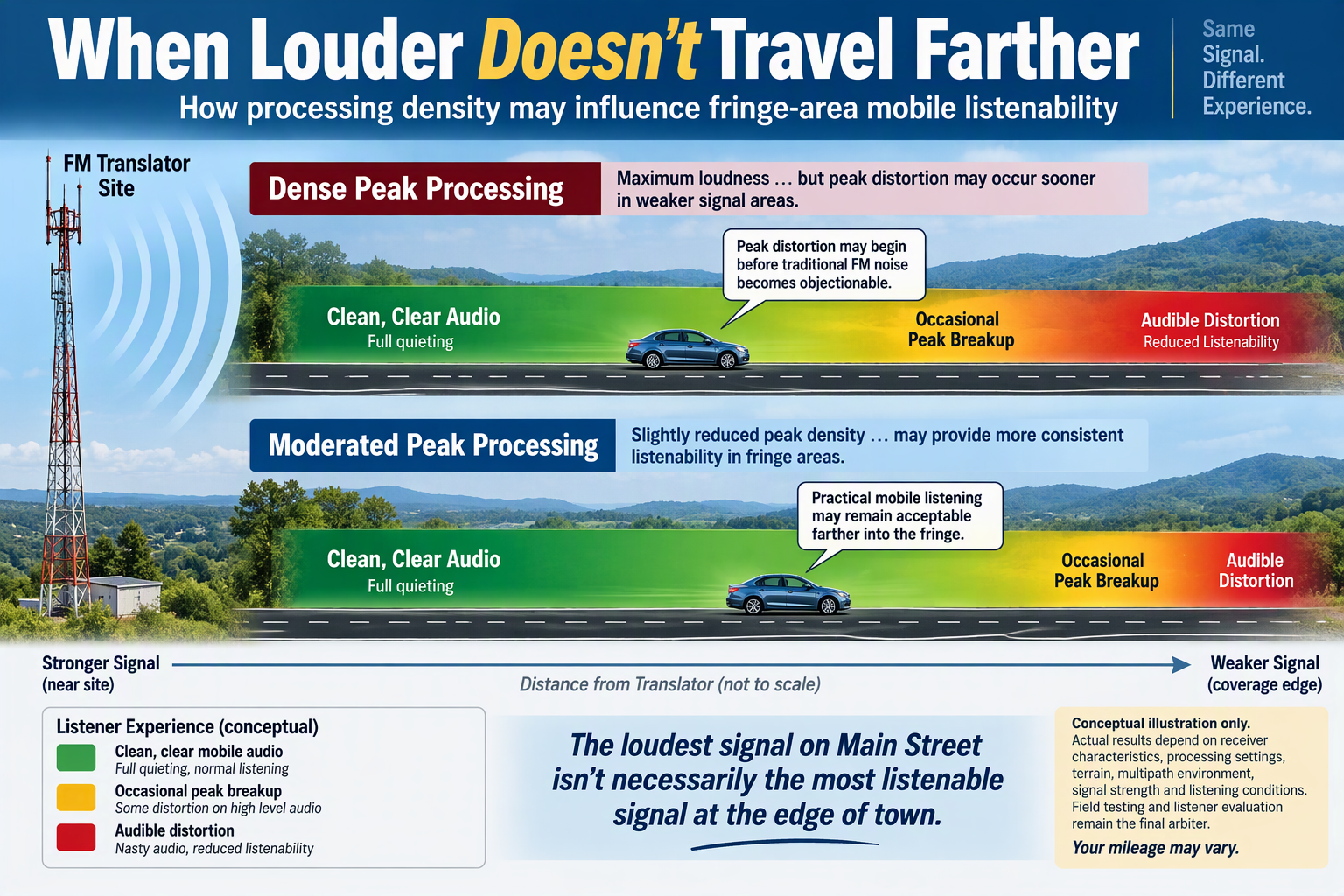
Years ago I started paying attention to a phenomenon I was hearing during routine drive tests. Many of our translators would continue producing a fully quieted signal much farther than I expected. In fact, if the station happened to be transmitting silence, the receiver often sounded remarkably clean well out toward the fringe.
Then the program material would come back.
A loud music passage, heavily processed program audio or a high-energy announcer would suddenly reveal problems that weren’t apparent a moment earlier. The signal strength had not changed. Yet the listening experience was now unacceptable.
That observation started me down a road of experimenting with translator audio and trying to determine exactly what listeners were hearing near the edge of a station’s service area.
With a typical 250-watt translator operating from an average-height site, you need that 40 contour to be usable. Not every translator enjoys a mountaintop location or a 1,000-foot tower. While some translators are fortunate enough to operate with substantial Height Above Average Terrain and can sound like a full Class A facility, many of us are working with 250 watts or less from antenna heights closer to 230 feet above average terrain. The amount of real estate to the 40 is not that great, so extracting every bit of practical listenability becomes important.
Over time I learned something that many engineers before me had already discovered: just because a receiver can hear your signal doesn’t mean it can reproduce your programming cleanly.
The entire transmission chain matters. Not just the transmitter. Not just the antenna. Not just the processor.
The listener’s receiver is a major part of the system, and you can’t adjust it.
And as much as engineers may hate admitting it, the practical coverage area of many FM translators is therefore ultimately determined by the limitations of the radio in the dashboard.
Coverage vs. usability

As engineers, we often talk about contours, field strength and signal levels. Those measurements are important. But listeners rarely evaluate a station using engineering standards.
They evaluate it using a far simpler standard.
“Does it sound good?”
The average listener doesn’t know if the signal is arriving at 70 dBu or 38 dBu. They know whether the station is enjoyable to listen to.
That distinction becomes important because a signal may remain receivable well beyond the point where the programming remains pleasant.
That means the engineer’s definition of coverage and the listener’s definition of coverage can be two very different things.
Now before somebody writes me a letter, I’m not suggesting contour maps are wrong. Nor am I suggesting that decades of propagation studies should be tossed out the window.
What I am suggesting is that the practical listening boundary is often determined by receiver behavior rather than simple signal strength.
The problem with 100% modulation
At the point where a signal gets near the limit of full quieting, strange things can start happening.
High frequencies become ragged. Sibilants become harsh. Music loses smoothness. The station takes on a tearing or spitting sound that’s difficult to describe but instantly recognizable.
Yet nothing appears wrong at the transmitter.
The receiver, however, is beginning to struggle.
[Related: “Translators Are a Phenomenal Tool With Many Applications”]
Every engineer has encountered at least one receiver that seemed determined to make a liar out of every theory he ever learned. Unfortunately, many of those receivers are sitting in listeners’ dashboards.
My own observation has been that many consumer receivers seem less comfortable reproducing large deviation swings as signal strength drops. The audio may remain perfectly acceptable when modulation levels are modest, but the combination of weak signal conditions and repeated full-deviation peaks can push some receivers into a region where the demodulated audio becomes a real problem.
Whether every receiver behaves this way is certainly open to debate. Some radios are far better than others.
But from a practical standpoint, listeners don’t care why the distortion is occurring.
They simply hear a station that sounds rough.
And here’s the important part:
Listeners are remarkably tolerant of a little hiss that can be masked by moderate density, but they are much less tolerant of distortion.
A station that spits and tears on every vocal peak gets abandoned quickly.
Backing off the peaks
One of the easiest experiments I’ve performed involves a slight reduction in peak modulation.
Notice I said peak modulation. Not density. Not average loudness. Not overall punch.
Peak modulation.
Many engineers automatically assume maximum legal deviation equals maximum practical coverage. In my experience that is not always the case. Modulation level in AM is more important to coverage than in FM.
By backing peak modulation down slightly, perhaps operating closer to 90% rather than constantly chasing 100%, some translators seem to maintain cleaner audio farther into the fringe.
The tradeoff is generally modest. Modulation levels may appear slightly lower. But modern processors provide numerous tools for maintaining competitive loudness without endlessly hammering the modulation meter to 100% or beyond for some stations.
In many cases, the improvement in fringe listenability more than compensates for the slight reduction in peak deviation.
Unfortunately, some operators become fixated on what the modulation meter is doing.
Listeners never see the modulation meter. They only hear the result.
Many major-market stations learned years ago that sounding loud is not necessarily the same thing as operating at maximum peak deviation.
The goal should be maximum listenability, not maximum needle swing.
The stereo question
Another issue that inevitably enters the discussion is stereo versus mono operation.
For talk programming the answer is usually simple.
Mono wins.
You eliminate the stereo penalty and devote all available resources toward producing the cleanest possible audio.
Music formats become more complicated.
Listeners enjoy stereo. It creates a larger soundstage and helps a station compete against other FM signals in the market. If your intended audience is comfortably inside the coverage area, stereo often makes perfect sense.
However, the equation changes when the goal is maintaining enjoyable listening at 40 dBu and below, particularly in areas where co-channel interference is not the limiting factor. Many engineers correctly point out that modern receivers blend toward mono automatically as signals weaken. That’s certainly true.
But transmitting stereo and allowing the receiver to blend is not exactly the same as transmitting mono from the start. A stereo signal still contains pilot and stereo-difference information. A mono signal does not.
Will converting to mono double your coverage? Of course not.
Will it solve a co-channel interference problem? Not likely.
Can it produce a small improvement in signal-to-noise ratio and overall robustness in fringe areas? In many cases, yes.
And when operating at the edge of usable coverage, small improvements matter.
Every engineer eventually reaches the point where he or she realizes there are no magic solutions left. At that stage, success often comes from collecting a dozen tiny improvements rather than discovering one huge one. Mono operation can be one of those improvements.
The high-frequency debate
Now we arrive at what may be the most controversial topic of all.
High-frequency audio response.
Those of us who grew up during FM radio’s glory years remember stations that sparkled.
A cymbal crash sounded like a cymbal crash.
A triangle sounded like a triangle.
The upper harmonics of instruments seemed effortless and natural.
Today, many successful stations sound very different.
Spend some time listening critically to major-market stations and you may discover that very little energy exists above 10 kHz.
At first, that realization bothered me.
Then I began asking questions.
I spoke with several engineers responsible for highly successful stations, and most shared a similar opinion. Their listeners simply weren’t noticing what engineers were noticing.
And in some cases there were advantages to giving up a little top-end extension.
FM broadcasting relies on pre-emphasis. High-frequency content receives special treatment throughout the transmission chain. The processor has to manage it. The limiter has to control it. The transmitter has to accommodate it. The receiver has to reproduce it.
All of that consumes headroom.
A carefully managed roll-off beginning around 10 kHz can free processing resources, reduce unwanted artifacts and provide a little more room to achieve competitive loudness without creating additional listener fatigue. Some listeners even describe the resulting sound as smoother. (Yes, really.)
Will a trained engineer hear the difference? Probably.
Will the average commuter notice while driving down the highway? Probably not.
The reality is that many listeners today consume their audio through streaming codecs, Bluetooth links, data reduction systems such as MP3 and earbuds that would have horrified audiophiles 30 years ago.
In comparison, a modest reduction in extreme high-frequency content often goes completely unnoticed.
Now before somebody writes another letter, I’m not advocating turning every station into a telephone.
Every format is different. Every market is different. Every set of goals is different.
But it may be worth asking a question that engineers don’t always like asking:
Are we transmitting those last few kilohertz because listeners value them, or because engineers value them?
The answer may not always be the same.
Before somebody writes me yet another letter, I’m not suggesting every station should immediately become a mono, 10 kHz-limited translator running 90% modulation. Every market, format and audience is different. The point is to experiment and determine what works best for your particular listeners.
Engineering for the real world
The common thread running through all of these observations is simple. The listener’s receiver matters. Perhaps more than we sometimes want to admit.
Backing down peak modulation slightly may help some radios maintain cleaner audio longer. Mono operation may provide a small but useful advantage in fringe areas. Moderating extreme high-frequency content may create a cleaner, more robust signal while freeing processing headroom.
None of these techniques will perform miracles. They won’t overcome interference. They won’t create signal where none exists.
What they may do is improve the practical listening experience. And in the end, that’s what we’re really trying to accomplish.
I’m not presenting these observations as laboratory research. I’m presenting them as lessons learned from years of driving translator coverage areas, listening carefully and paying attention to what real radios and real listeners seem to prefer.
Engineers naturally love measurements. Listeners don’t.
They care whether the station sounds good. If a listener can travel another five miles before reaching for another preset, that’s often more valuable than a theoretical gain calculated on a coverage map.
After all, listeners don’t drive around with field-strength meters. The true measure of coverage is not where the signal disappears.
It’s where the audience decides to stop listening to it.
Radio World welcomes letters to the editor on this or any story. Email [email protected].