Nick’s Signal Spot is a new feature in which Nick Langan explores RF signals, propagation, new equipment and related endeavors.
In 2019, I was about ready to give up the long-distance FM radio listening hobby.
All right, maybe that’s a bit of an exaggeration. FM DXers in particular are known in our small circles to go through phases of frustration. The hobby is not for the faint of heart. There are only so many opportunities in a calendar year to catch unique propagation events such as E-Skip, even if your dial conditions are optimal!
And for FM DXers, the best analogy I’ve heard applies the concept of fishing lines to the conditions that make our hobby run.
The more fishing lines you have in the pond — which in our case represents the 88–108 MHz FM spectrum — the better chance you have of catching that elusive prize.
In metropolitan areas worldwide, as spectrum becomes scarcer and in high demand, open channels have become harder and harder to find.
About seven years ago, my most prized fishing line became occupied by a local translator. The 92.9 FM frequency acted as a wonderful indicator for E-Skip, which is lower in the FM band and more susceptible to E-Skip propagation, as we’ve written about, with a lower maximum usable frequency.
I use a sharp Yagi antenna on my roof, the APS-13. The problem — and this is common in many metro areas — was that if I nulled the translator licensed to Burlington, a low-power FM timeshare in Philadelphia was waiting in its wake.
Was it time to throw in the towel?
Combined diversity
What’s neat about many software-defined radio concepts is that they apply technology that has been around for some time.
The concept of phasing to aid FM DX is also far from new. In the early 1990s, radio hobbyists Andy Bolin and Dennis Jacob brought phase cancellation into the spotlight, publishing work on DIY “phase tilters” and building custom 360-degree phase boxes to help TV and FM enthusiasts unlock occupied channels. Bolin shared many of the details behind the system in an article you can view on DXer Mike Bugaj’s website.
The premise, according to Bolin’s documentation: Combine signals from two separate antennas through a splitter hooked up in reverse, equalize the input levels with an attenuator and adjust the phase of one line until the incoming voltages cancel out to zero.
Imagine aiming right at a semi-local FM station and nulling it out completely. Turn your antennas 10 degrees, null it again and repeat the process across the entire 360-degree phase spectrum without swapping coax jumpers.
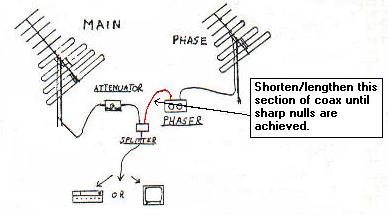
DXers saw distinct results using the Bolin box, but analog hardware phasing came with physical caveats. You had to carefully match coax lengths, balance line levels using attenuators and ensure your phase antenna had enough relative gain.
As Bolin explained, the resulting directivity in a null could only ever be as good as the worst directivity of the two antennas involved.
Software-defined radios took the premise of phasing and made it accessible through connecting two antennas and panning with your mouse.
In 2018, SDRplay released the RSPduo SDR dual-tuner unit.
When paired with its SDRuno software, it offers spatial diversity processing. Instead of messing with coax jumpers, variable capacitors or manual attenuator dials, the system digitally adjusts the phase and amplitude of signals coming from two independent antenna inputs, allowing users to manually subtract (null) or add (peak) signals.
In HF reception, this technique is frequently used to phase out localized electrical noise from power lines. Here’s an informative presentation worth your time from John Fallows (VE2EY) on what the RSPDuo can do on HF.
But for FM DXers, adjusting digital phase across two separate antennas allows for the creation of nulls you may have previously written off as a lost cause.
I started experimenting with this technique in 2020, during the COVID-19 pandemic, when I purchased an RSPDuo. I have my APS-13 atop my roof, and I bought an Innov 8-element antenna model, from U.K.-based InnovAntennas.
I was immediately impressed.
In SDRuno, control centers on the diversity wheel. Rotating the wheel shifts the relative phase between your two antenna inputs, while the sliders let you match signal amplitudes to find a precise null.
I am never terribly fond of referencing my own catches and videos, but on my YouTube channel, I have several examples of diversity mode in action. Here’s a random example from 2022: 96.5 W243BR(FM) from Harrisburg, Pa., during tropospheric enhancement, with both of my antennas aimed right at Philadelphia, nulling WTDY(FM).
Rules of thumb
Despite living in New Jersey, I don’t live in the immediate vicinity of tower farms. Philadelphia’s Roxborough is a little over 30 miles away, providing some breathing room.
Several of my fellow DXers have observed that the RSPduo SDR is sensitive to front-end overload when used in the vicinity of strong RF sources.
My observations may vary from your own. But after using diversity mode heavily for more than five years, I offer these tips for best practice:
- I use two FM Yagi antennas in my diversity setup. I know that’s easier said than done for many. Two dipoles can certainly work. Attic antennas, too. You’ll get nulls. But bear in mind, what’s left in the wake of the signal you null is left to the same restrictions as you might hear on the dipole without diversity mode.
- Bolin’s rule about the antenna with the worst directivity prevailing in your null holds similarly with diversity mode. Often, when I’m using my APS-13 and Sky Blue SBFM9 antenna, for example, the result of the null is whatever I am hearing with the SBFM9, which is less directive than the APS-13.
- I use a rule of thumb that to achieve an optimal null, you’ll want to try to phase an FM signal with a signal strength of –70 dBuV/m or weaker. You can use the RadioLand app to get an estimate of the field strength of an FM signal at your location. That’s not to say I haven’t gotten nulls on stations with stronger signals, but they are harder to come by.
- As a result, if you’re in a metro area with signals over –80 dBuV/m in strength, nulling the primary signal might be tough. However, an HD Radio sideband, previously impenetrable, might be a better target.
- I mentioned before that if I nulled my 92.9 Burlington translator with the APS-13, I’d get the LPFM combo from Philadelphia. This is where, in FM DXing in 2026, height is not always might. I’ve gotten good results with two Yagis at ground level, not even 10 feet off the ground, with my SBFM9 and my Innov 11-element antenna. I can null Burlington, I don’t hear the Philadelphia LPFMs, and yet, multiple times per day, I’ll hear troposcatter from WLTJ(FM) in Pittsburgh, at approximately 290 miles from my location.
- What I’m unclear on, and I would love to get someone’s expertise for, is the unexpected results within nulls. Sometimes, I can tell that in the diversity null, I’m also nulling the DX signal! There are all sorts of computations, as far as signal arrival angles, that come into play.
Since I started using diversity mode, SDRplay has released SDRConnect software and ended official support for SDRuno. SDRConnect includes diversity mode, but it does not yet feature native support for MPX output.
Because I use MPX output with RDS Spy software — an important tool for RDS-based decodes on signals in my diversity nulls — I still use SDRuno.
If the use of two antennas is a barrier for you, I’d encourage you to check out the Airspy SDR# co-channel canceller, which was released in 2020 and is designed to remove a local station with distorted phase and emphasize weak stations in the background, for both AM and FM!
I’ll repeat the same sentiment I’ve shared previously: If you can manage a little breathing room from transmission centers, this is a fun time to be a DXer. I hope some of this helps you. Let me know if you’ve experimented with diversity mode at all.
Maybe you’ve uncovered tricks that I simply haven’t found!
[Read the Signal Spot from Nick Langan for More DX-Related Stories]