Today, the radio listening environment inside your home might as well be like trying to overhear a conversation in a noisy taproom.
If you live in an apartment, you know this better than anyone.
Many apartment or condominium dwellers have difficulty picking up their favorite stations, and when they do, the signal may be marred by electrical noise — particularly on the AM radio band.
Why does this happen, and what can be done about it?
To find out, we spoke with two popular radio-flavored YouTubers well-versed in the matter.
The Pennsylvania-based Tyler Kleinle is better known on YouTube as the “Antenna Man.” His channel has approximately 362,000 subscribers.
“Most of my expertise in RF comes as a hobby growing up,” he told Radio World. “I lived in a rural area with limited radio stations and took great efforts to pick up distant radio stations that offered music formats not available locally.
“It was a lot of experimentation over the years to master the craft.”
Montreal’s Gilles Letourneau, meanwhile, runs a well-known YouTube channel of his own, with around 50,000 subscribers. He also has authored hundreds of reviews on radio equipment.
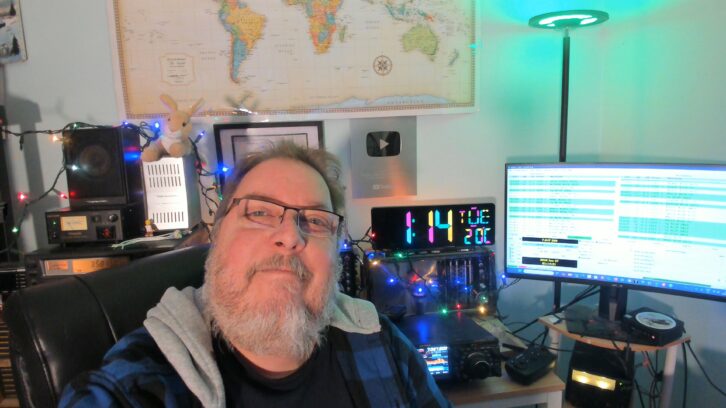
Letourneau is also the host of a weekly radio live stream and is the editor of the Canadian International DX Club’s utility column, and, as we chronicled, the co-host of the “International Radio Report Show” alongside Sheldon Harvey.
Letourneau has heard many signals in his 43 years of listening, and as he explained to us, he has seen the evolution of radio reception.
Raising the floor
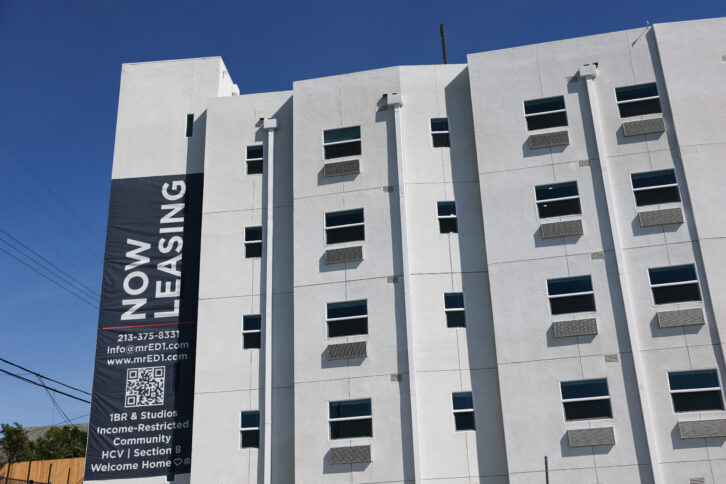
What causes such reception to be so challenging, even for nearby signals, in certain houses and apartments?
This is the big question, and there are two parts to the answer.
The first part is tied to the materials that make up modern dwellings.
Most apartment buildings are constructed of steel with brick or stucco that has a greater impact on radio signals than a wood home with vinyl siding, Kleinle explained, which can result in a “Faraday cage” effect — blocking wanted signals and keeping unwanted noise in place.
The second part to the answer has to do with the electrical environment that most of us live in today.
Radio reception, Letourneau explained to us, has always been susceptible to electromagnetic interference.
But because radios were used in a relatively simple analog environment — with stricter government regulations shielding other devices to prevent noise from creeping out — the interference was not nearly as impactful to hearing our favorite AM and FM stations.
Time, however, marches onward.
“More and more devices began using switching power supplies,” Letourneau explained, “and the power adapters were much smaller and lighter, but they also had a negative effect on noise.”
Switching power adapters, he said, use oscillators to make alternating current run at much higher frequencies.
For the consumer, this is wonderful — the adapters can be very powerful with such a tiny footprint. But the oscillations in the same devices make them subject to harmonics, or multiples of the base frequency that can be generated from a poorly designed power supply.
“Unfortunately, a majority of modern power adapters and devices use these poorly designed circuits,” Letourneau told us.
Today, from cell phones to laptop computers, these types of adapters exist in almost every home. While their mere presence increases the “noise floor” — the sum of all unwanted signals — the wiring in many homes acts like an antenna, creating a compound effect.
“In apartment buildings and condos, that noise might come from the neighbors’ electronics,” he explained. “Add to this the fact that new lighting systems are based on LED technology and fluorescent tubing.
“This high noise level makes it difficult to hear any signals on the radio bands,” Letourneau summarized.
Location, location, location
Over the century of commercial radio broadcasting, listeners have become accustomed to using an antenna, either indoor or outdoor, to improve weak signal reception.
But if the listening environment is plagued by electrical noise, that same noise may only be amplified by the antenna.
That’s where the antenna’s position, Kleinle explained, is critical.
“You can have the best antenna, but if it’s in a bad location, it may not pick up your favorite station,” he said.
As a result, the first step we recommend:
Step one: Locate your radio closest to a window or wall on the side of the home closest to your desired station’s transmitter.
Even in a small dwelling, the side of the house you place your receiver can favor particular directions, or block others.
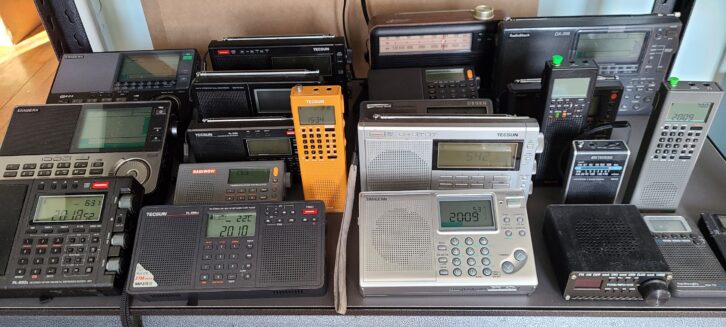
Portable receivers have gotten more selective and feature rich over the years. We’ve chronicled the excellent firmware available for the TEF6686 receivers, for example.
Many portables also have built-in directional AM antennas, so try rotating your radio to improve reception. Sometimes, this simple trick can make a real difference.
If your reception problem is on FM, extend your radio’s retractable antenna if it has one, or try different positions and antenna lengths to improve signal strength.
Get your own house in order
The easiest devices to eliminate that wreak havoc on your RF noise floor are your own.
Step two: Unplug as many of your home’s devices as you can — flip circuit breakers if you must — and check your receiver to see if the noise level has dropped.
In such cases, it can be worthwhile to use a battery-powered radio, because the power adapters that come with radios can also generate noise — even on the high-end models.
Adding an antenna
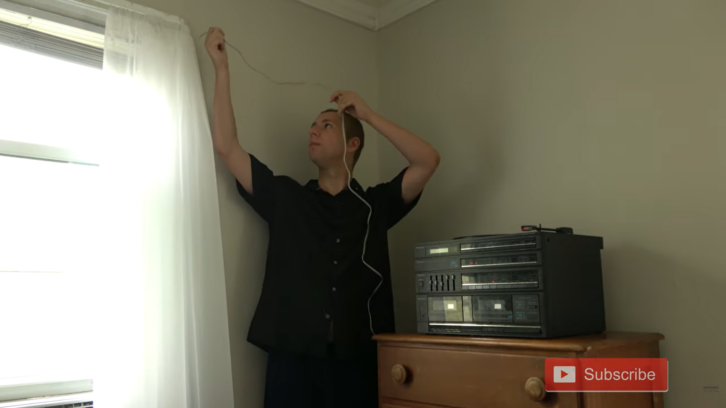
In its simplest form, an AM indoor antenna can consist of a piece of speaker wire wound around your radio’s antenna at one end, and taped to a wall or hung out a window.
The key is to give it as much height as possible, even if that means running a length of wire around your ceiling.
So, we will summarize our step three: Evaluate some basic antenna options, and map out a few spots around your dwelling for placement.
For better performance, Kleinle recommended a loop-style antenna like the Bingfu AM Loop Antenna, but it can only be used if the receiver has an input for it.
For FM, he pointed to the Aediko FM Dipole Antenna for its flexibility and that it can be hung on a wall or window.
Another FM model we like, if you have attic space and don’t necessarily have a preference on the direction you seek, is the Stellar Labs Omnidirectional FM antenna.
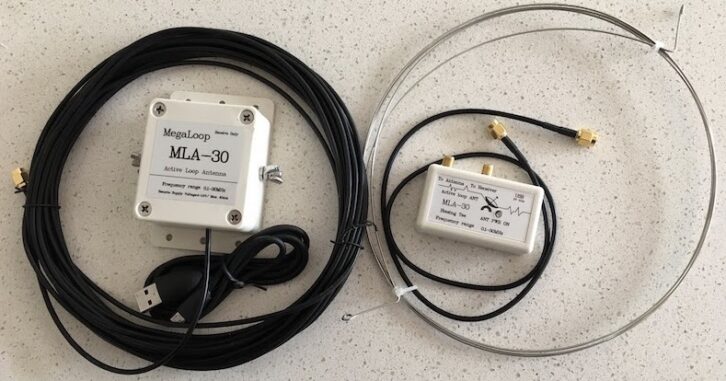
Letourneau, for his part, vouched for a magnetic loop antenna for AM and shortwave.
These antennas, he explained, receive the electromagnetic component of a radio signal.
“Since noise from our surrounding electronics has a strong electric field component, the magnetic loop is not sensitive to this component of noise, and will help in reception,” he said.
Letourneau uses a Deshibo GA-490. (The author of this story uses a MLA-30 Loop Antenna.)
There are also more advanced versions such as the W6LVP loop and the Wellbrook.
Escape the noise
Our experts agreed that, when it comes to RF noise, your own mileage may vary.
Simple reception fixes are also often effective.
But if all else fails — sometimes the great outdoors is the best remedy.
So, our final step: Sometimes it’s better to travel.
“Every year, I do what I call an ‘Urban DXpedition,’” Letourneau explained. “Going away to remote wooded areas and parks might be the only true way to escape the noise.
“This way, I hear very weak signals that are impossible to receive at home.”
Indoor radio reception problems, in the end, are a consequence of our technologically-advanced society.
But as radio enthusiasts, whether it means taping a piece of speaker wire to your wall or standing on one leg like a flamingo, the end game is the same: Do whatever it takes to produce signal clarity.