Audacy is a company whose business relies heavily on audio — the word is baked into its name, after all — and over the past six years the company has been tracking how connected-car technology is changing the driving and listening experience. It says its most recent findings reinforce the importance of audio and radio as part of that.
The company has conducted online surveys dating back to 2021. The most recent was done last December and had about 1,100 respondents age 18 and up.
Audacy finds that cars are getting smarter, more intuitive and more personalized. Also, voice technology and artificial intelligence are making it easier for drivers to access, control and discover audio, while larger screens and autonomous features open new paths for advertisers.
Audacy’s Reggie Shah, VP of research and insights, and Emily Hurwitz, senior analyst, highlighted several findings in a blog post. “Our 2026 study shows that as the technology evolves, audio’s role in the car is growing right along with it,” they wrote.
They say that 70 percent of connected-car drivers in the study turn to local radio for breaking news, weather and traffic, which they say puts radio in front of social media and phone apps for that information. The same percentage look forward to hearing their favorite station hosts as part of their routine.
The authors looked in particular at responses from “AI Intenders,” drivers who want more AI-powered features in their next vehicle. They describe the demographic as “tech-forward drivers worth watching. They embrace cutting-edge automotive technology, but they also value what they already know and love about audio. These younger drivers are serious audiophiles, and connected-car advancements give them even more control over what they hear and how they access it.”
Among that group, Audacy found that 65% say they listen to AM/FM radio in the car. Just over half listen to radio through an app.
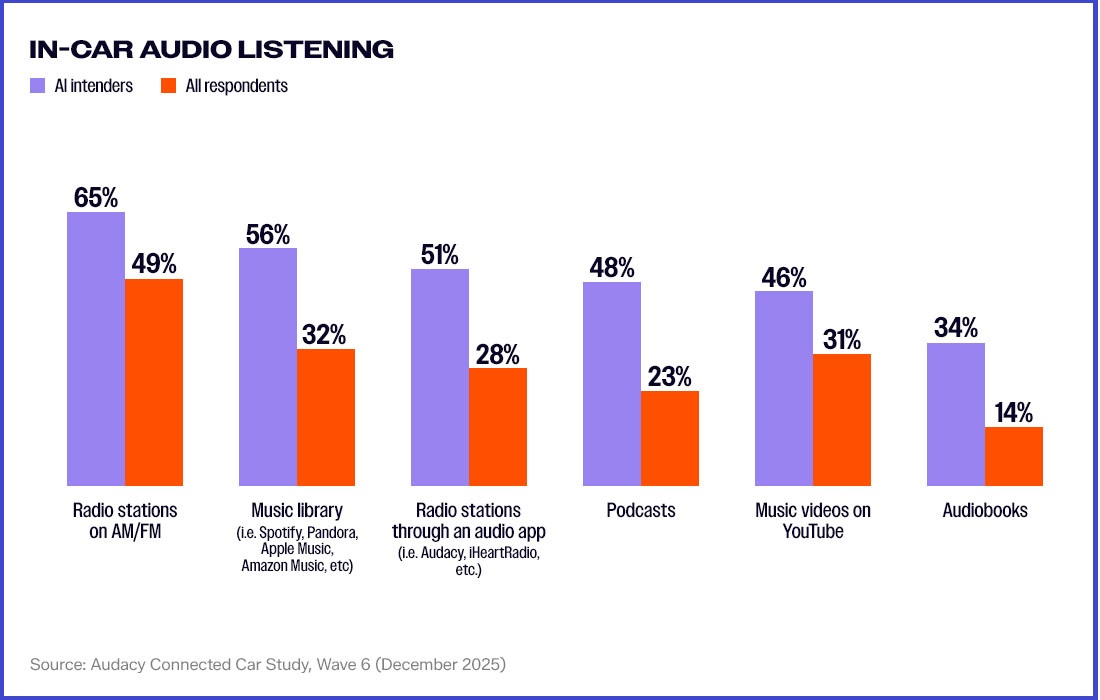
Voice activation and voice-controlled audio systems are key for these AI Intenders; three in four want an audio system managed by their voice so they can do less screen tapping. The authors conclude that drivers want “control and the ability to get to their content without taking their eyes off the road.”
Thus integrated voice control plays an important role in discoverability because drivers can use it to access radio, music and podcasts.
As an owner of radio stations as well as a radio app, Audacy found a lot to like in the results. The authors said connected car technology is opening opportunities for local radio.
“The connected car is making radio advertising more visible, interactive and actionable. A message heard in the car can prompt searches, conversations, store visits and purchases, moving consumers from awareness to action,” the authors wrote.
The study found that connected-car drivers are highly receptive to visual ads, and that screens are bigger than ever, from “14-inch displays in midsize SUVs to the Mercedes-Benz EQS’s eye-popping 56-inch hyperscreen display,” Audacy said.
“When logos, promotions and other visuals appear alongside a radio ad, they extend the audio message and deepen engagement.”
The study found that after hearing radio ads, connected car drivers took action in a number of ways.
In response to the question “Which of the following types of action have you taken in the past 12 months after hearing an audio ad in your car,” 45% of 700 connected car drivers said they had looked up a product, 36% of people visited a store they heard about and 39% purchased an advertised product.
Autonomous driving also is opening a door to a bigger role for audio, Audacy says.
“Drivers see these capabilities as an opportunity to move beyond their usual listening habits and discover something new. In 2026, 36% of connected-car drivers said autonomous driving allows or would allow them to explore new types of audio content, twice the share reported in 2024,” the company found.
The company has posted details of its study.