The author is senior product development engineer for Wheatstone.

Broadcasters have spent the last few decades feeding their air chains highly compressed source material. But now, with affordable archiving available and the impact of streaming across several platforms, not to mention the adoption of lossless streaming by Spotify in late 2025, music mastering seems to have shifted back toward retaining program dynamics rather than buzz-sawing them as before.
This means that radio can now deliver much better sound to its listeners, which is good because radio today competes with so many other listening options easily available to the public.
Spectral processing
The spectral approach to audio processing that we developed considers how the human ear hears and then interprets audio. It uses the laws of psychoacoustics to mask the action of peak control while also revealing subtle audio details usually buried by other processors.
Audio researchers tell us that our auditory system can be modeled as a filter bank with 25 overlapping bandpass filters known as critical bands (i.e. bins). By modeling our limiter on a similar structure, we can not only surgically limit audio without affecting nearby frequencies, but also uncloak subtle audio details that wouldn’t otherwise be heard.
This is because limiting a signal in one narrow band psychoacoustically preserves the subtle audio details residing adjacent to the band in limiting. Even though the audio signals in the bands adjacent to the one being limited have not undergone any modification, our brain decodes it very differently and allows us to hear subtle details in the program material.
We call this our critical band theory of spectral audio processing, and Wheatstone’s new Neuron FM/HD/DAB+ processor was designed around this theory. Neuron is a spectral audio processor that models its 31-band limiter algorithms on the human auditory system and uses the ISO standard 1/3 octave frequencies.
Critical-band theory
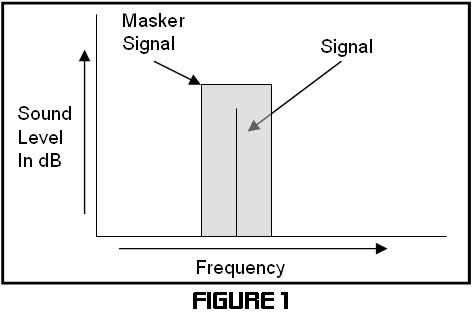
What is important to remember about critical bands is that our ears can’t tell that there are other signals inside a bin when one is slightly louder than the other (see Fig. 1).
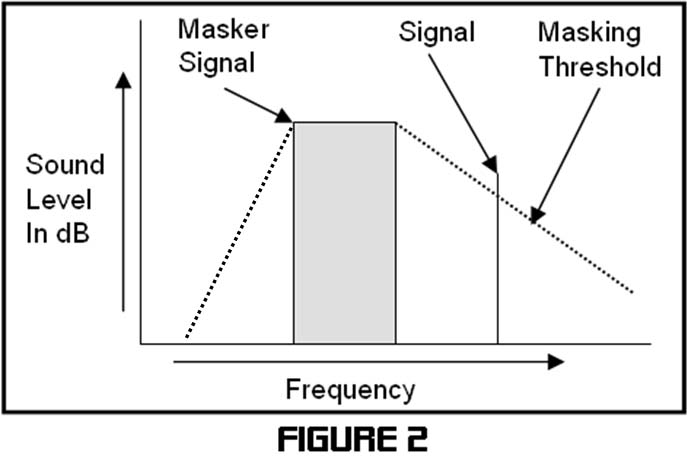
When there are audio signals present in different bins, each signal is heard independently as long as the signals are loud enough and far enough apart in frequency to stay above and away from an adjacent bin’s asymmetrical masking threshold (Fig. 2).
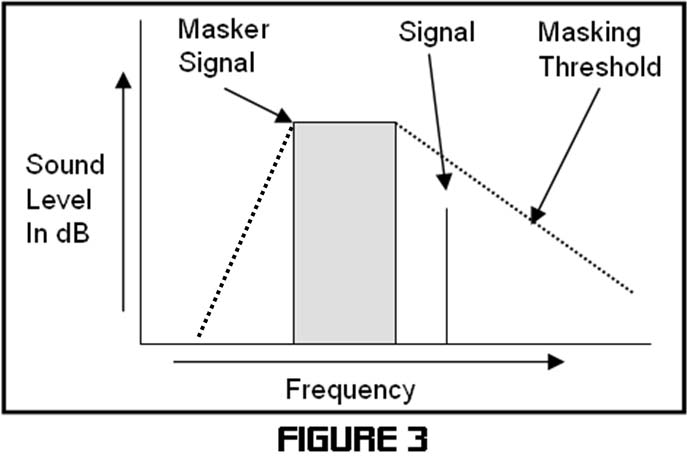
If an audio signal is soft enough in level or close enough in frequency to sneak under the masking threshold of an adjacent band, that signal is inaudible. Even so-called Golden Ears can’t hear it (Fig. 3).
When audio is divided up into numerous frequency bins, the energy within each bin falls according to how many bins the audio has been divided into — the more bins there are, the less audio there is in each bin. Probably not intuitive in Fig. 1 is that when there are 25 bins or more, the “sound of processing” within an individual bin disappears because of the “in-band, multi-stimulus” masking rule.
More limiter bands? Better?
Limiters with only a few bands are often seen in operation with more than 6 dB of limiting depth. On the contrary, because a spectral processor has such a small amount of audio energy in each band, it typically needs no more than a dB or two of limiting.
Such shallow limiting combined with the high number of bands meshes so well with how human hearing works that it makes the spectral processor’s operation remarkably invisible to the ear. Gone are the dense, smashed-sounding audio and other annoying characteristics of multiband limiting.
A better listening experience
Our patented spectral processor manages the energy of electrical signals without our ears noticing that limiting has even occurred. But just as important, the spectral processor also uncloaks fragile audio details, the same ones often turned into mush by less-capable limiter techniques.
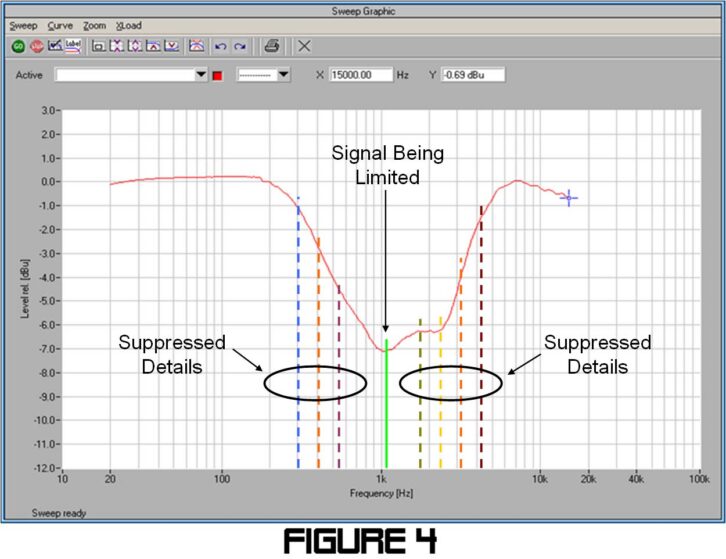
In a conventional multiband limiter, the broadness of each limiter band (Fig. 4) allows the act of limiting to affect a large portion of the audio spectrum; nearby frequencies that don’t even need limiting get pulled down too and many users end up driving the limiters harder and harder trying to get those lost details back.
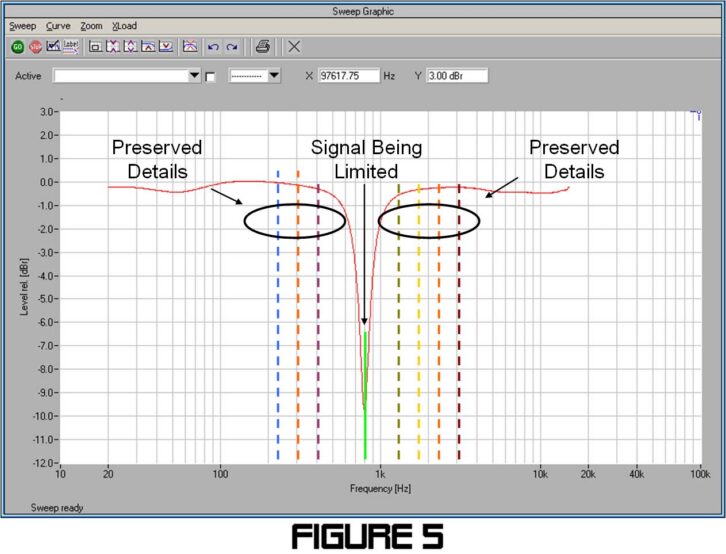
Conversely, as Fig. 5 shows, each band of the spectral processor is quite narrow — note how little audio spectrum is affected by one limiter band. Even more important is how the high selectivity of the spectral processor allows adjacent audio details to be completely untouched — it is all still there.
This is completely different behavior from the way multiband broadcast limiters with only a few bands work. It sounds a lot different, too!
The science is in the details
When a band of the spectral processor reduces its gain to limit a particular frequency, two things happen.
One is that the level of the signal being limited is restricted to the band’s limit threshold, just as it would be in any limiter.
But what also happens is that the act of limiting a signal in one narrow band psychoacoustically raises the perceived loudness of subtle audio details residing near to, but not inside of, the band in limiting.
Even though the audio signals in the bands adjacent to the one in limiting have not undergone any modification, our brain decodes it very differently and allows us to hear subtle details in the program material not often heard from other broadcast audio processors.
The mechanism for this is quite simple: The frequency in the band undergoing limiting and the audio frequencies in nearby limiter bands not being limited have undergone a change in their relative gains. Our brain doesn’t notice the effect of limiting because, psychoacoustically, it is constrained to such a narrow band. But there’s a perceived increase in the level of the nearby signals in the nonlimited bands even though their electrical amplitudes have not changed.
This is entirely opposite behavior from what limiters with only a few bands do when they carve up huge chunks of the audio spectrum just to limit a single isolated signal.
The goals of audio processing haven’t changed, after all. We still need peak protection and audio levels normalized.
But what has changed is that we can now deliver so many more program details to listeners and in a way that’s energetic, vibrant and easy to listen to all day long.
This article is from the free ebook “Optimize Your Air Chain.”