The author is head of radio at the European Broadcasting Union.
In a media landscape defined by fragmentation, acceleration and uncertainty, radio continues to offer something remarkably human: trust and companionship.
Radio is there when people wake up, when they drive, when they work, when they cook, when they feel alone, when they need music and when they need to know what’s happening. It can be intimate and collective at the same time. It speaks to one person while connecting many.
But trust and companionship do not happen by accident. They are built through talent, journalism, music, culture, local presence, technical reliability and long-term audience relationships. And they are sustained through distribution and partnerships.
Listening first
The EBU is a member organization. As head of radio, my role is not to define the future of radio, but to listen carefully to what our broadcasters need, understand the pressures they face and help create the conditions in which public service audio remains strong.
These radio organizations are already doing the hard work: innovating formats, serving local communities, developing podcast strategies, experimenting with visual radio, reaching young audiences, defending prominence and adapting production workflows.
My role, and the EBU’s, is to facilitate that work and build the collaboration it depends on to endure.
Audio is strong, but habits are changing
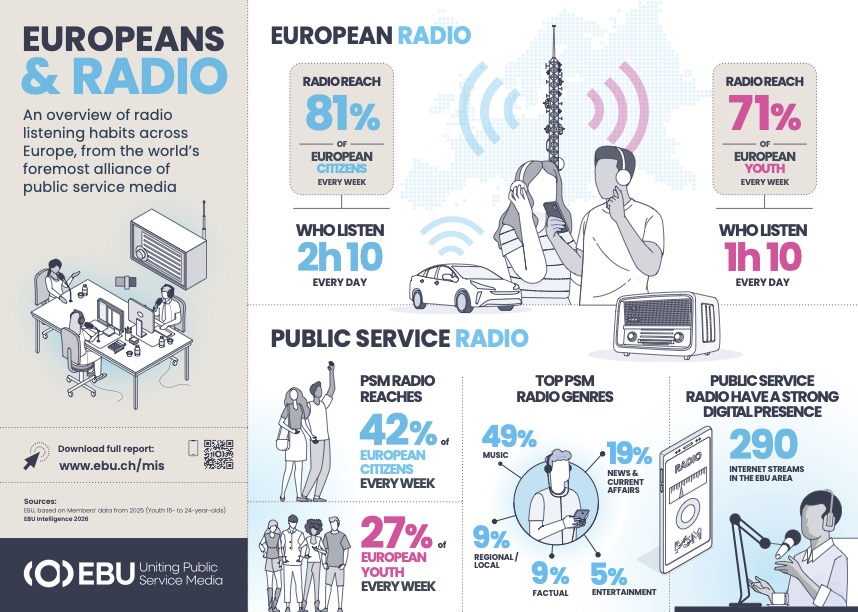
According to EBU Intelligence’s Audio Trends 2026, radio reaches 81.3% of European citizens every week. Even among young people, weekly reach remains high at 70.9%. The same report shows Europeans still listen to radio for an average of two hours and 10 minutes per day. This is not a medium disappearing from people’s lives.
At the same time, listening habits are changing. People ages 16–24 spend an average of three hours and 56 minutes per day listening to audio (Source: GWI Core, average of Q1-Q3 2024). Young people are not turning away from audio. They are building their audio lives through music streaming, podcasts, YouTube, social discovery and on-demand habits.
The challenge is not to defend radio against these changing habits. It is to carry the trust and public value that radio has built into the future.
Content is where trust begins
Trust is earned through the content we put on air and online: verified journalism, distinctive voices, music discovery, local stories, cultural diversity, sports, children’s content, emergency information, humor and human connection.
People trust radio to help make sense of their world.
This is how radio’s companionship becomes more than background sound. A familiar voice reduces distance. A local bulletin makes a community visible. A music program opens the door to culture. A sports broadcast creates shared emotion. A podcast takes a story further than any schedule allows. A youth format gives space to voices not often heard elsewhere. Emergency information turns a broadcast into a lifeline.
Distribution keeps companionship alive
Distribution determines whether this trusted content remains available, and that availability is what builds companionship.
This is especially true in the car. EBU Intelligence data show that radio reach in the car across 15 European markets stood at 56% in 2024, remarkably stable over five years. In the U.K., France and Germany combined, 61% of recent or prospective car buyers name FM/DAB/DAB+ radio as their most frequently used in-car audio platform, compared with 17% for online music services. In the U.K., 77% of car users say they value being able to listen to radio in a vehicle (sources: EBU Intelligence members’ data, Edison Research for WorldDAB’s Dashboard Dialogue Study 2023 and Ofcom’s in-car audio survey 2024).
The risk now is visibility.
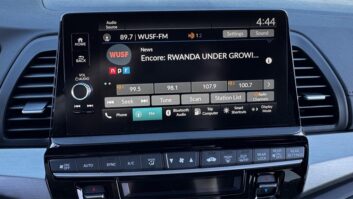
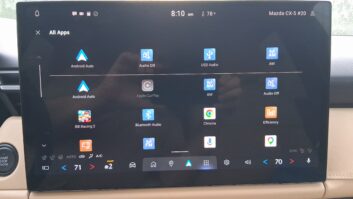
As dashboards become software environments, radio must remain prominent, intuitive and reliable. The stakes are highest in a crisis, when people need trusted information fast, and radio must be there, easy to find.
[Related: “EBU’s Vincent Sneed on the Digital Networks Act”]
That is why regulation matters: In a platform world, public value depends on findability. Our work on a strong Digital Networks Act (DNA) is part of that effort, helping ensure that services of public value remain accessible, discoverable and usable in digital environments.
Radio cannot talk only to radio
This is why partnership matters, and why we need to look beyond the classic radio stakeholders.
Cooperation within the radio sector remains essential: Public and commercial broadcasters, industry organizations, regulators and standards bodies all have important roles to play. Radio Ready is a good example. What started as an EBU initiative has grown into a cross-industry and worldwide campaign to guarantee radio’s presence in the car. By bringing public and commercial radio together with wider industry partners, it gives radio a much stronger common voice.
But the next phase requires us to reach further outward: to industry and technology partners (car manufacturers, technology companies, platform designers, AI developers and telecom operators); to content and creative partners (music partners, creators, educators and cultural institutions); and to public interest partners (emergency services and civil society).
That does not mean giving up our values. It means carrying them further.
Using AI to unlock public value
AI is one example.
Public service media produce an enormous amount of audio every day. EBU Intelligence reports that EBU members operate 901 linear radio services and 290 internet streams, covering 125 different languages and 85 minority languages. AI can help make that audio more searchable, accessible, multilingual and reusable. But it must be guided by editorial responsibility, transparency and trust, and should not replace the human qualities that make radio trusted.
That requires collaboration between program makers, technologists, legal experts, accessibility specialists and audience teams.
Radio professionals are eager to understand how AI can make their work better. Part of our work at the EBU is to support that through information, shared resources and training.
Video as an entry point into audio
Video in audio is another example.
Video podcasts and visual radio are becoming important entry points into audio, especially for younger audiences. EBU Intelligence, citing ACPM/CSA’s Les usages du podcast en France, finds that in France, 56% of the population has already watched a video podcast, and even among people who do not listen to podcasts, 39% have watched one. Among internet users ages 16–24, 57% watch video podcasts on YouTube (source: GWI Zeitgeist April 2025 – France, Germany, Italy, U.K.).
This does not mean radio should become television; it means visual formats can help audiences discover audio and build relationships. Used well, video can help bring audiences closer to trusted content. The strongest visual audio formats remain audio-first: simply using the screen to create discovery, context and connection, without losing the intimacy of listening.
Built together
Radio’s strength has always been its ability to adapt without losing its essence. It has moved across technologies, devices and habits. What remains constant is its public value: trusted content, human connection, accessibility, universality and companionship.
The future of radio will not be built by one organization, one platform or one sector alone. It will be built by the radio sector, and by partners, old and new.
Because if trust and companionship are radio’s greatest strengths, then our shared responsibility is to make sure people can continue to find it, hear it, feel it and rely on it — wherever the future takes us.
A Radio World ebook, “Global Radio Update,” explores trends across the industry and in various countries.