On the same July day that broadcasters were on Capitol Hill lobbying for the “AM for Every Vehicle Act,” Nielsen posted a story on its website headlined “Tuned In: Why Removing AM/FM Radio Is a Multi-Billion-Dollar Gamble for Automakers.”
The company, working with iHeartMedia, conducted a study to demonstrate that radio is one of the most valuable entertainment options in the car. It gathered sentiments of about 1,000 recent and prospective car buyers.
These two companies clearly have bulls in this ring, but their findings are worth reviewing for anyone whose job involves explaining the benefits of radio in the second quarter of the 21st century.
- They found that around half of respondents said they would refuse to purchase a car that doesn’t have AM/FM radio. Among those ages 18–34 it was about 40%, while among those 55+ it was 67%. These percentages are not as high as they would have been in the past; but to me they still represent big potential pools of potential revenue. Why turn away such buyers?
- More than 70% of the consumers view AM/FM radio as an essential feature that should come standard in new vehicles. You can almost hear many of them thinking, “Duh!”
- Radio accounts for 55% of audio time spent in the car while streaming accounts for 16% and YouTube, podcasts, SiriusXM and owned music/audiobooks make up the remaining 29%.
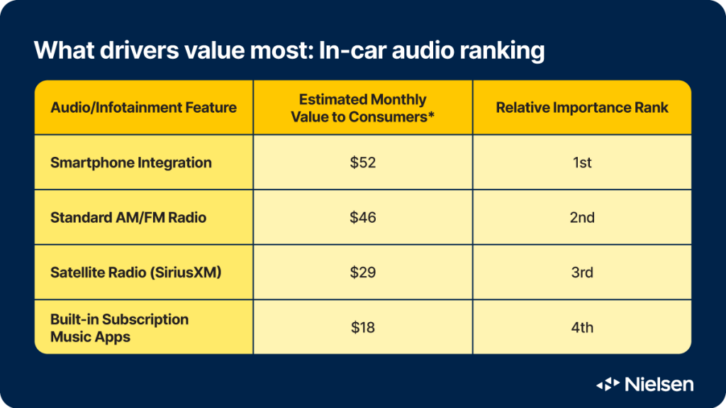
- Nielsen found that AM/FM radio had the second-highest impact on vehicle choice decisions, behind smartphone integration. The company used a process called Choice-Based Conjoint Analysis, a methodology familiar to carmakers “because it mirrors real-world shopping decisions by forcing consumers to make tradeoffs among features and price.” The results in the chart below show audio/infotainment features ranked by their impact on respondents’ vehicle choice decisions.
- Around half of respondents said they would have a less favorable view of a car brand that removed AM/FM radio from its lineup. “The risk is especially pronounced among buyers aged 55+, where both purchase refusal and brand erosion are stronger.” I wish radio didn’t have to rely so much on seniors like me; but boiling the discussion down to money again, why antagonize this important buying group?
- Eighty percent said it is important for their vehicle to receive national Emergency Alert System notifications. Alerting is an angle on which NAB and its allies are leaning heavily in their arguments for the AM bill.
- Two out of three consumers said zero latency for live sports is important when listening in the car. Here’s a topic that probably deserves more attention from those of us making the case for radio’s relevance. Nielsen said the fact that radio has no inherent latency is especially valued by male drivers, younger demographics and hybrid and EV owners.
- Last, “while four in 10 drivers prioritize connecting their phone first when they get into a car, a quarter still turn first to AM/FM radio.”
The study is aimed directly at carmakers. Nielsen concluded that for OEMs looking to secure market share and build vehicles that consumers love, “innovation should add to the dashboard, not strip away what drivers already value. Keeping standard AM/FM radio in the vehicle isn’t just about preserving tradition. It may also help preserve brand equity and sales.” And in turn, stripping AM/FM out “isn’t just an unpopular design choice but a direct threat to customer loyalty and, ultimately, vehicle sales.”
I sense increasing urgency across our business about the apparent willingness of car companies to contemplate a future without broadcast radio as a front-and-center standard feature. That includes FM as well as AM.
I suspect it’s one reason we’ve seen, for example, a series of blog posts from Pierre Bouvard, chief insights officer at Cumulus Media and Westwood One Audio Active Group, bearing headlines like “Reach Future General Motors Buyers on AM/FM Radio, The Medium GM Drivers Listen to Most.”
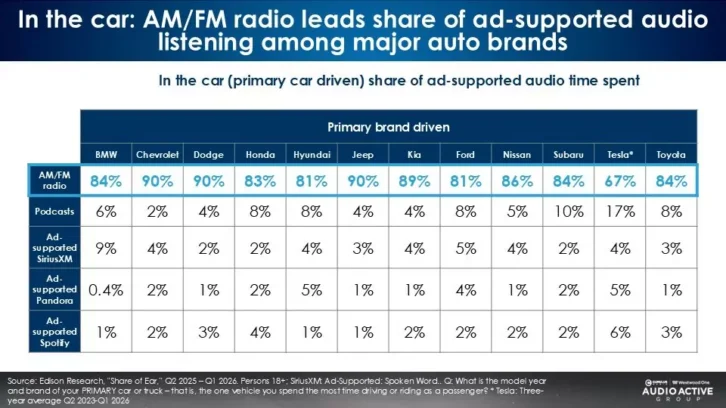
By my count he has written about more than a dozen separate car brands since April. On the face of it he’s explaining to their ad buyers why they should promote those car brands on the radio; but the series also constitutes a clear, direct shout from the radio industry to car companies about our medium’s overall continued impact and role in American life.
Both Bouvard and Nielsen/iHeart are appealing pragmatically to carmakers’ self-interest. We need more of that kind of ammo in this battle.
Radio World welcomes letters to the editor on this or any story. Email [email protected].