Radio World Editor in Chief Paul McLane’s posts about his early radio memories prompted reader Lewis A. Edge Jr. to share his own experiences, including how he got into engineering and management, and his work with Georgia broadcaster Jim Wilder.
During the first semester of my college sophomore year in 1962, as a pre-dental biology major, I had never been inside a radio station.
My friend and fellow student, Sonny DuBose — a senior, president of the student body and Little All-American football player — had a weekend on-air job with WPCC, the local AM radio station in Clinton, S.C. But he planned to resign because of the demands of his academic load and student body president responsibilities.
When he suggested that he could “give me his job,” I was skeptical, but he promised to teach me. He provided the information I needed to apply for the required FCC license and said he could introduce me to the station’s manager.
As a hobbyist already building my own stereo equipment from kits, I was not a stranger to electronics and technology. Sonny taught me how to operate the station equipment and helped to hone my announcing skills using the recording equipment for practice.
Sonny introduced me to Louis Bagwell, general manager of WPCC, and I was delighted to be hired on the spot.
That part-time job proved to become a life-changing experience. My maternal grandfather had wanted me to follow in his footsteps as a dentist. He offered to give me his equipment and his practice when I earned my DMD and he retired; but I was having second thoughts about spending the rest of my life working in people’s mouths (no offense meant to dentists).
Those doubts led me to my college guidance department to take a battery of tests measuring my interests and skills. They recommended that I change my major to electrical engineering. I would lose most of my biology credits but not “require” a graduate degree.
My next courses were at Georgia Tech in Atlanta. Still needing part-time work, I applied to Jim Wilder, owner of WBIE(AM/FM) In Marietta, Ga., and immediately snagged a job with the station — initially babysitting the FM automation system in the evenings.
Wilder, a senior broadcaster who had received his license from the old Federal Radio Commission, turned out to be an enthusiastic mentor. He encouraged me to take the FCC First Class Radiotelephone License exam, then he got me involved with the construction of his new 10 kW three-tower directional AM transmitter site. I was still an EE student but also an FCC licensed engineer.
We laid tower-base copper screens, and we silver soldered massive copper grounding straps and the 120 radials we plowed from the base of each tower with the aid of a surveyor’s transit.
Upon graduation, I faced loss of my academic draft deferment. To avoid being drafted into the Army, I joined the Air National Guard at nearby Dobbins Air Force Base in Georgia.
This involved a year of active duty and five years of active reserves, working with automatic tracking radar and missile guidance systems, radio relay and troposcatter communications systems. Most of my active-duty time was at Keesler AFB in Biloxi, Miss., where I applied for a weekend job at WLOX Radio and TV and was immediately hired.
Although I was undecided about a career in broadcasting, upon completion of my active duty I was surprised to be offered an attractive full-time position at WLOX. My active reserve military obligation required weekends at Dobbins, which would have caused a logistical nightmare while working in Biloxi, so I returned to the Atlanta area.
Jim Wilder had a staff engineer’s job waiting for me at WBIE.
During my time there, I had a hair-raising experience: a direct lightning strike on one of the AM towers.
A ball of energy rolled out of the front of the transmitter and finally dissipated in front of me. It knocked us off the air by welding the spark gap on Tower #1. In the middle of that storm, the only way to get us back on the air was to use a cold chisel and a ball-peen hammer to break apart that weld and re-establish the air gap.
I was grateful to survive.
After several months at WBIE, Wilder encouraged me to advance myself by seeking a chief engineer’s job. I was familiar with “Atlanta’s Voice of the Arts,” WGKA(AM/FM), and I knew that they had plans for major upgrades. With Wilder’s endorsement, I applied and snagged the job.
I arranged with John Portman, architect/developer of the Peachtree Center complex in downtown Atlanta, to use a helicopter to install a 150-foot tower on the roof of the 35-story Peachtree Center building. We installed a 20 kW Collins transmitter in the elevator machine room and built offices and studios on the 19th floor of that building delivering a 100 kW V&H stereo signal for a radius of nearly 100 miles. I also upgraded the AM station to a lower frequency that provided greater coverage.
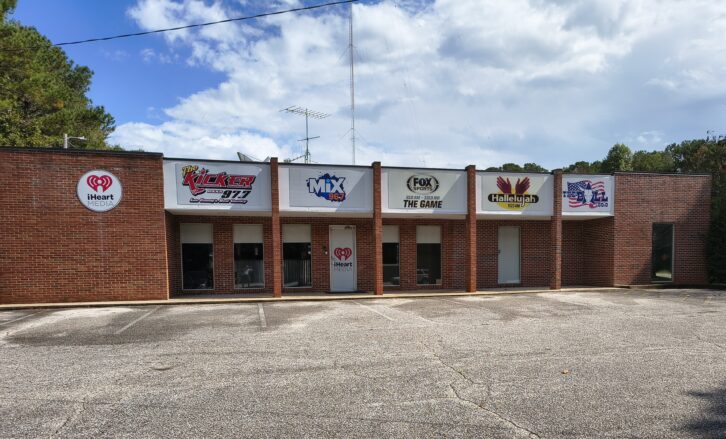
After completing that project, and on Jim Wilder’s recommendation, I was hired by the Faulkner Radio Group to build an AM and an FM station from the ground up and be their general manager, to serve Opelika and Auburn, Ala.
The stations, completed in 1968, are still in operation as shown in the accompanying photo.
From there I moved to WEAV(AM/FM) in Plattsburgh, N.Y., to manage their stations and to expand their background music service. Two years later I moved to Princeton, N.J., to run Nassau Broadcasting’s top-rated AM station, and ultimately became the general manager of their Broadcast Division until the stations transferred ownership in a highly leveraged sale.
That ended my full-time broadcasting career of 20 years. I knew that the buyer would have to cut costs to pay off their debt and that this would affect their ratings. After I was long gone, they were forced into bankruptcy and sold their properties at auction.
Remaining in Princeton, I moved into computers, publishing and part-time engineering consulting work, then worked as a Realtor for 11-1/2 years before finally retiring in 2016 at age 75.
Jim’s lessons
My career in broadcasting enabled me to gain unique insights in all types of business.
My experience and training, especially after moving into broadcast management, meant becoming immersed in the communities that we served, maintaining qualified news teams, doing repeated audience surveys and directly supporting charitable community events and broadcasting high-quality content and signals. It also involved joining service clubs such as the Jaycees, Kiwanis, Rotary and other not-for-profit organizations, often serving in leadership roles.
The stations that I managed became market leaders. In those early days, without cellphones, satellite radio, the internet or even portable devices to play recorded music, radio stations had less competition in our markets. The equipment available for broadcasting during the ’60s and ’70s was primitive compared to what is available today. In my senior years working part-time as a broadcast engineering consultant, it was a pleasure to install and configure digital systems.
My boss and mentor Jim Wilder told me that as a broadcaster and station owner, he was committed to excellence. He said that at the end of the day, if he could not honestly believe that his listeners were better off for having tuned in, he would get out of the business.
In the mid-1960s, when I was working for him as a staff engineer and announcer, Jim told me that a competing radio station in our market was off the air. They had spread all kinds of vicious falsehoods about us, so my first reaction was “Good riddance.”
When they remained off the air for a second day, he surprised me by saying “We need to help them.” When I asked why, he simply said “They are fellow broadcasters.”
We drove to their transmitter site and found that their engineer had not yet diagnosed the problem. Jim and I did some quick measurements and determined that their AM modulation transformer had failed. Again to my surprise, he told their engineer that he had a new spare in his shop that we would install for them at no charge if they would agree to replace it.
Of course they accepted his offer. Within about an hour we had their transmitter back on the air. His help ended their vicious attacks.
Jim Wilder never retired. He died in 1981, having refused multiple offers to sell that would have made him wealthy. I never forgot his lessons and tried to apply them as both an engineer and a manager. Even while working in other careers, I kept a hand in broadcasting as an engineer. I continue today as an enthusiastic listener. During my long career, until I retired, I was proud to have never been unemployed.