The author attended the CES show in pursuit of future tech that will enhance our radio industry. (Read his previous posts.)
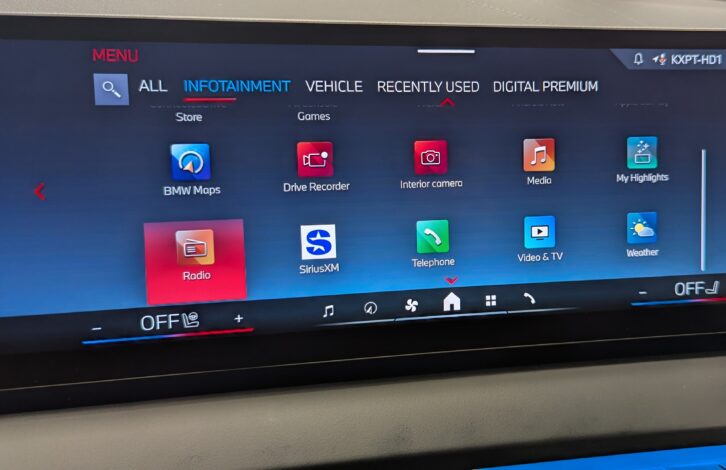
As I traveled back to D.C. from CES 2026 and reflected on ways that AI will impact the radio industry, I continued to picture in my mind the dashboard of the BMW X3 M50 at the Xperi booth.
The photo above shows a “Radio” icon on the BMW dash with a dozen or so others. We may be living through the final model years of many automobiles in which an icon plainly labeled “Radio” is on the dashboard screen.
In another significant impact to radio, the content side of AI was illustrated at CES in an optimistic way.
CES showed a culmination of multiple technologies coming together somewhat serendipitously.
AI has been with us for some time. Think back to the times when making airline reservations we resorted to yelling “agent … agent … agent” at the phone, as the airline foisted upon us its early attempt at AI prowess.
Multiple discrete technologies and our robust democratic social order have matured and combined to enable AI as we know it today, including computers, fiber, networking, software, TCP/IP, wireless, integrated circuits, data storage devices, screen technologies and our First Amendment. Posit the lack of any of those, and it is doubtful that AI in its current form would exist.
What is radio?
We now need to ask the existential question of “what is radio” while on the AI highway to the singularity.
Radio is certainly no longer simply AM, FM, the transmitter and an FCC license to spew RF on a specific portion of spectrum.
Radio is also not everything electronically audio. “Everything audio” envelopes too much and implies that amateur radio hams and Spotify are radio broadcasters, which they plainly are not.
I suggest that radio’s definition flows from that pesky, never clearly defined Communications Act term, “the public interest.” Therein lies radio’s uniqueness to drive forward.
Sadly, there are many radio stations that clearly do not serve the public interest. Eighteen-minute commercial blocks and jukebox programming are antithetical to the public interest.
Radio stations that defile the public interest deserve to die a horrible death at the hands of AI. Those stations that observe good business practices and have as their mantra “service to the public” will, I predict, prosper with AI.
AI will force each broadcaster to choose whether its stations will be suffocated in AI’s chaos of unlimited choice, or whether its stations will use AI in a positive way to rise to the top.
Content creation AI
I believe that the next seminal stage for radio will be through many of the AI content creation technologies.
I circled back to Lee Perryman, owner of Sylacauga’s Radio Alabama, who in the first post in this series spoke of seeking “any appliance that a listener, reader or viewer might use” to reach audiences. I asked about his use of AI technologies.
Lee comments that at his oldies station, he has taken airchecks of heritage local air personalities from the 1960s and ’70s and, with permission, uses ElevenLabs AI along with OpenAI and Voitrai to create voice tracking content that hosts current shows, even to the extent of taking requests from listeners.
Big John Small, owner of Sioux Falls, S.D.’s Sunny Radio and, with his wife, co-host of “ on more than 300 radio stations, says, “I may be Gen-X, but I lean boomer on many things, so I was not a fan of ‘anything AI’ when it first came out.”
Lately, however, John has warmed to a few AI tools including ElevenLabs. “As a small team it has allowed us to have additional voices for our commercials. I pay for a bigger ElevenLabs plan, not for more volume as I’ll never need this many credits, but I wanted more voice choices.
“I use the ‘voice changer’ feature, so I record the ad with the proper inflection and the proper pronunciation, then I convert the file to a new voice. I’m quite impressed with the results. It sounds amazing and is an affordable solution for a small team like ours.”
Sandra Lange’s The Original Company Inc. in Vincennes, Ind., uses ChatGPT in sales and proposal help. In production they use ElevenLabs. Sandra notes that “with dwindling staff resources, it helps us make the most of the time and hands that we have.”
AI in the dashboard
As important as AI’s content creation abilities are, radio will also be affected by the technological AI controlling automobile dashboards much as it now controls many smart speakers and TVs.
On the floor of CES, Quu’s Steve Newberry suggested that I was living in the past for advocating for the “AM for Every Vehicle Act” and for my optimistic belief that radio can be kept predominant in the automobile dashboard.
Steve feels that radio has been fighting the wrong battles for a number of years. Steve believes that our industry should focus on persuading auto manufacturers and third-party dash software designers to ensure that radio programming is continued to be delivered by whatever AI is embedded in the dash.
He encourages radio trade associations to advocate on behalf of radio for mutually beneficial arrangements with auto manufacturers to boost radio in the AI environment, similar to SiriusXM purchasing its dashboard position in many vehicles.
For radio to survive, he says, it must newly fight for its place in the soon-to-be AI curated dashboard audio choices.
Evolution, not failure
Fletcher Ford is owner of an Iowa group of stations and CEO of RadioWorkFlow, which is billed as an AI-powered workflow for the modern radio station.
“Radio keeps saying it’s about appealing to a new generation,” Ford said, “yet we keep framing the dashboard debate around what was easy for the last one.”
What felt intuitive to one generation often feels outdated to the next, he feels. “That’s not a technology failure, that’s evolution. Every generation learns the tools placed in front of them, not the ones we’re nostalgic for.”
Fletcher says, “This isn’t just about kids … The same broadcasters arguing that radio needs to be easy to find are using smartphones every single day. We learned how to navigate iPhones and Androids. We learned how apps work. We learned how to scroll, search, swipe and customize. We figured out Apple CarPlay and Android Auto without instruction manuals, training videos or panic buttons. No knobs. No presets. No problem.”
Anyone with children can validate that even “very young kids today can find Disney+ on a screen in seconds. They can scroll YouTube, jump between platforms, search content and customize their experience faster than most adults can unlock their phones. … Screens don’t intimidate them, they expect them.”
So why, in radio, Fletcher asks, do we keep acting like listeners are fragile?
“We argue that radio must be one button away … that if it isn’t immediately obvious in the dash, people will abandon it. Meanwhile, those same listeners, young and old, have no trouble finding navigation, streaming apps, podcasts or social media buried multiple taps deep.”
Radio’s problem isn’t discoverability, Fletcher says. It’s familiarity.
“Nothing in the modern dashboard is easy the first time. Drivers are trained, consciously or not, on how to access what they value. They learned Bluetooth. They learned CarPlay. They learned Apple Music. They learned podcasts. Repetition creates access.”
Looking back, Fletcher observes that “radio, for decades, relied on habit instead of education. Presets did the heavy lifting for us. Now that the dashboard has evolved, we’re blaming technology instead of adjusting our mindset.”
He said radio doesn’t need to be the simplest thing in the dash. It needs to be the most trained. It isn’t a technology problem, it’s a mindset problem.
“The listener didn’t suddenly get dumber. Our generation didn’t suddenly forget how screens work. The dashboard didn’t get unfair. The rules simply changed,” he said.
“The broadcasters who win won’t be the ones trying to slow down technology or force it backward. They’ll be the ones who embrace evolution, teach access, reinforce behavior and remind listeners, across every generation, why radio is worth finding in the first place.”
Fletcher closed by beseeching our industry to “stop resisting change. Start training the audience we actually have — not the one we remember.”
New analytics
I wrote last week about DTS AutoStage. Lee Perryman says the platform “has changed my life, because I’m able to show prospective advertisers where and when people are listening, which I can’t do otherwise.”
Because he is in an unrated market, there are no metrics.
“I can’t prove anything, so we produce coverage maps that show our proposed coverage areas which we layer into DTS AutoStage Maps showing where people are listening, and pair that with data from our streaming services to show the demographics of those people are as representative samples.”
After leaving CES, I caught up with Mike Hulvey, president and CEO of the Radio Advertising Bureau. He spoke about DTS AutoStage on two fronts, one globally, and one from the radio industry’s perspective.
Mike observes that DTS AutoStage “is a tool that is now available to every broadcaster regardless of market, from the smallest of markets to the largest of markets. By establishing a communications link with the automobile dashboards in your market, you’re able to access near real-time consumption data, regardless of where you’re at.”
Mike continued: “One of the things I hear a lot at RAB from marketers is, ‘We know digital, we know that digital is consumed and things occur. But how do we know that from radio?’ DTS AutoStage is a tool that allows a radio station to have that kind of engagement from the audience, regardless of market size, so that’s exciting.”
Mike is former CEO of Neuhoff Media. “We were one of the first adopters of the DTS AutoStage technology in our markets. We would take DTS AutoStage heat maps out to local advertisers who questioned the viability of our radio station to show them who’s driving in front of their store real time which was our listeners.”
He noted that DTS AutoStage is available at no cost to stations and helps the industry to tell its story. It works whether or not a radio station is utilizing HD Radio.
DTS AutoStage is only available where carmakers have enabled the technology. But his perspective is that “it captures consumption, allows stations to share important information directly from the automobile, advertisers are excited about the capabilities the technology provides.”
Reaching into the future and touching upon RAB’s expertise, Mike observes that “the ‘Holy Grail’ in advertising is attribution. How can we prove that some action occurred because a commercial ran on the radio? Measuring consumption is important, but expanding attribution will always be the goal.”
An RAB webinar last month explored DTS AutoStage further.
Lessons for radio
We see how new tech and AI shown at CES will scramble things. Broadcasters of today destined to succeed tomorrow will no longer be substantially assisted by FCC or government regulatory welfare. There are scant things the FCC could change that would have a significant impact on our radio industry’s prospects.
Soon, stations will be selected on the automobile dashboard based upon what AI thinks the listener likes. Revenue realization for stations will be based upon real-time metrics of who, where and why a listener is listening, and subsequent listener choices. With AI, radio ads increasingly will become targeted personal invitations to consumers that will reliably hit targets.
Tech shown at CES will enhance operations for the station that has moved beyond relying only upon its multi-kilowatt transmitter by using AI and branching into streaming, podcasts, video and whatever form of content is welcomed by the listener community.
Irrespective of where or whether the Radio icon sits on the display, still-nascent AI radio content will lead to radio as an equal or better among the stars in the media galaxy.
There are multiple articles, blogs, podcasts, posts and videos on the cool consumer tech at CES 2026. This Radio World series is not one of those. My focus was to approach the show in pursuit of future tech that will enhance our radio industry.
Content AI and dashboard screens are not anything that will show on a CES top-10 new tech list with cuddly AI-enabled stuffed animals and recipe-assisting refrigerators. Content AI and the all-media-inclusive automobile dashboard, however, are the predominate radio tech emanating from the show. So here’s hoping that content AI and new automotive dashboard tech will assist radio in continuing to prevail in our 21st century plethora of media sources.
Comment on this or any story. Email [email protected] with “Letter to the Editor” in the subject field.