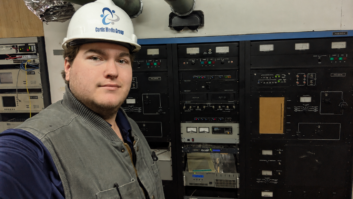
You may remember that a couple of years ago, Roy Becker of Bible Broadcasting Network told us about using ferrules for making wiring connections on modules.

Ed Bukont of systems integration firm E2 Technical Service expands on that idea. He says you have probably used butt splices to join two wires. However, when the wires are too short or if you can’t fit a crimping tool into your workspace, ferrules can help. They do a great job in splicing wires together and they come in a variety of sizes.

Safety docs
The organization called the National Association of Tower Erectors changed its name six years ago but retains the acronym. It is now NATE: The Communications Infrastructure Contractors Association, a non-profit group that aims to provide a unified voice for the tower and communications industry.
NATE recently released two new safety documents that may be of interest to those of us who work around tower sites. These have to do with smoke and poop.
The Wildfire Smoke Protection Chapter is part of the NATE Safety & Health Manual Online Resource Library, which is free to members and available for purchase to others. And the NATE Biological and Animal Excrement Awareness Guideline is available for free for all to download.
Radio World’s Nick Langan pulled out some of the tips on our website; read his post at https://tinyurl.com/rw-nate. And the NATE offers a lot of other great material. Explore those assets at https://natehome.com/resource.
Warming food
After getting my driver’s license at age 16, I mapped out and visited every radio station in the D.C. metro. I remember seeing a grate that someone had installed above the 4-400 transmitter tubes in an old 1 kW AM transmitter; it was used to keep food warm! Cheese and grease ran down the sides of the tubes from the grate, showing that this “warming oven” got a lot of use.
It didn’t occur to me until I took an electronics course in college that those tubes had at least 2,000 volts on them. The jocks were regularly reaching in to place wrapped burgers and fries atop the grate, to keep them warm!
Frequent contributor Dan Slentz offers a better, safer idea:
The next time you get to the transmitter site, the food is cold and there’s no microwave, Dan suggests grabbing your heat-shrink gun! Voilà, hot food again. Just be sure the gun isn’t lined with asbestos.
Small-engine tips
Frank Hertel of Hertel Engineering watched a YouTube video by the offbeat host of “Taryl Fixes All” in which the host discusses problems involving small engines. He reviewed a product that stabilizes fuel and rejuvenates old or stale fuel.
Perhaps you have a lawn mower or generator that has untreated fuel in the tank and the engine doesn’t run well, if at all. The stabilizer may be worth considering. Frank was convinced by the video and ordered some.
The product is made by Power Research Inc. It is sold by Amazon, Home Depot and other online retailers. Search “PRI-G” and scroll through the options.
Quick phone interface
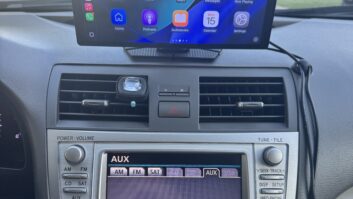
Michael Baldauf offers a quick, inexpensive way to set up an interface for remote broadcasts so the talent can use a cell phone.
At the station, connect the receiving cell phone to a Bluetooth receiver and then to an input on the control board. Michael used an eppfun brand Bluetooth 5.2 receiver purchased for $10 from Amazon. There are many similar products available with a range of prices. (Note that some console models now have Bluetooth capability built in.)

Initially, the output level of the Bluetooth adapter was too low for the board. You can boost the gain with a preamplifier; Michael used a Radio Design Labs RDL ST SH2 Headphone amplifier.
The Bluetooth pairing is easy. Remember to mute the phone if there is noise in the studio. Also keep a phone charger at hand especially for longer broadcasts.
Install one of these in your production room to record calls.
Workbench submissions are encouraged and qualify for SBE recertification credit. Email [email protected].
[Do you receive the Radio World SmartBrief newsletter each weekday morning? We invite you to sign up here.]