This is the third in a three-part series about radio traffic reporters. (Start with Part 1 here.)
During snowstorms or heavy rainfall events, it doesn’t take long for the images to go viral: Google Maps’ traffic overlays, depicting a sea of orange or red.
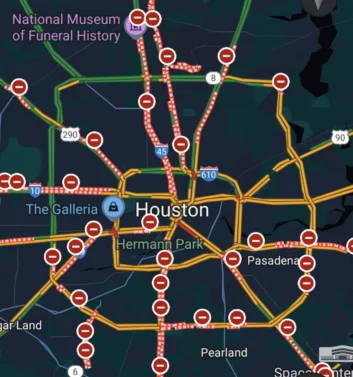
That “flow data,” WTOP’s Dave Dildine told us, has become quite reliable.
The passive, anonymous location and speed data beamed directly from the smartphones of drivers on the road is a process Google has documented as a blend of crowdsourcing and predictive monitoring.
Apple, with a fleet of millions across the U.S. using iPhones, relies on random data segments from iOS drivers to fuel real-time road conditions in Apple Maps.
And then there’s Waze. Founded in 2009, its crowdsourced reports led to broadcaster partnerships only two years later, and later establishing collaborative relationships with radio companies, which we’ve written about.
Radio traffic reporters certainly aren’t ignoring these apps. In fact, every single one of the broadcasters we spoke with uses them to build their daily reports.
This is part three of our “Beat the Traffic” series. Today, we’re looking at how local reporters offer an on-air delivery that informs without overloading the listener.
We also asked each of our eight reporters about the one long-standing advantage radio traffic reporters have always had over an algorithm: listener tips. Are they still useful?
Working alongside the screen
New York’s Greg Rice of WINS(AM/FM) told us that some of the fun of navigation apps is the challenge of working right alongside them.
If a driver notices a screen displaying conflicting or overbearing alerts that cause them to doubt if the information is even legitimate, Rice said they know they can tune into WINS to learn what’s really happening.
“Want to know if what your app is showing is real? Trust us!” he said.
On the flip side, Rice said that he constantly monitors the apps himself just to visualize exactly what his listeners are seeing on their dashboards.
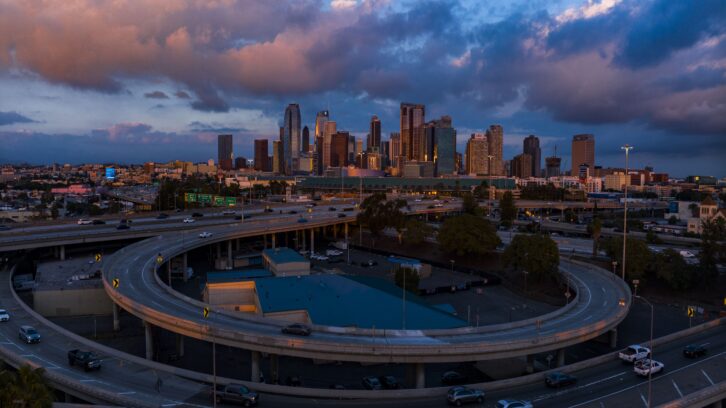
In Los Angeles, Sabina Mora of KNX(AM) has handled traffic reporting for both television and radio across her career.
Because radio is a purely aural medium, Mora actually believes her audio reports end up being more accurate. “It took time to build traffic graphics and set up a shot for TV, but with radio reports, I give updates that immediately get on the air,” she said.
Apps, Mora explained, are highly valuable when determining average speeds or pointing out an initial hazard. “But, for example, I can see that a heavy-duty tow truck won’t arrive for another hour and I have a bird’s-eye view of the alternate routes,” she said.
Every time Chicago’s Beau Duran of WBBM(AM/FM) drives, he uses Google Maps, even if it’s just for his daily commute. He openly acknowledges that a radio host cannot offer the hyper-personalized, turn-by-turn navigation of a smartphone.
“But what we can do is supplement that information with the ‘why’ for drivers,” he said.
And for a listener cruising along the Tri-State Tollway who isn’t currently stuck in gridlock over on the Dan Ryan, there is added entertainment value to the broadcast.
“Man, I’m glad I’m not stuck in that!” Duran laughed.
When Waze first hit the market, WTAM’s Pat Butler in Cleveland was highly skeptical of its crowdsourced framework.
“We were relying on the average Joe to tap something on their phone,” he said. Now, he appreciates it as a great supplemental tool to confirm his own real-time suspicions. Because he knows normal daily traffic patterns so intimately, if Butler sees an unusual slowdown on his monitors, he will immediately check Waze to see if a commuter has logged an incident.
That crowdsourcing model in Waze, specifically, has significantly lowered the barrier to entry for reporting incidents on the road.
But that ease of access is a double-edged sword, KYW’s Stevie Reese in Philadelphia told us. She has found numerous user mistakes and information that appeared to have been entered purely as a prank.
“Ice in summer, flooding where there is no water, water main breaks,” Reese said. “It’s our job to sort it all out.”
When a driver logs a quick incident in Waze, it is difficult for a digital interface to depict the actual severity of the scene — which makes sense, since the app has to prioritize convenience and basic safety for a driver tapping a screen behind the wheel.
“It can’t tell you how serious the problem is and when it might be out of the way,” Reese said. “Live, human reporters can.”
“Because I’m looking at live ODOT cameras, I can tell you exactly what is happening in real-time,” Butler added. “I can tell you, ‘Hey, it’s a FedEx truck on the side of the road, and the real bottleneck is just rubbernecking,’ or ‘A fire truck just pulled up and blocked two more lanes.’ Giving people that extra level of detail and context provides comfort. If you’re going to be late, it helps to at least understand why you’re late.”
“We can offer you details and perspective that apps cannot,” concurred WTOP’s Dave Dildine. “People naturally fear what they don’t understand.”
Ultimately, by offering a reason behind the backups, Dildine sees it as radio’s advantage that it needs to embrace.
“Focusing on impact and perspective should be a priority if broadcast traffic reporting is to stay relevant in the digital age,” he said.
The eyes on the road
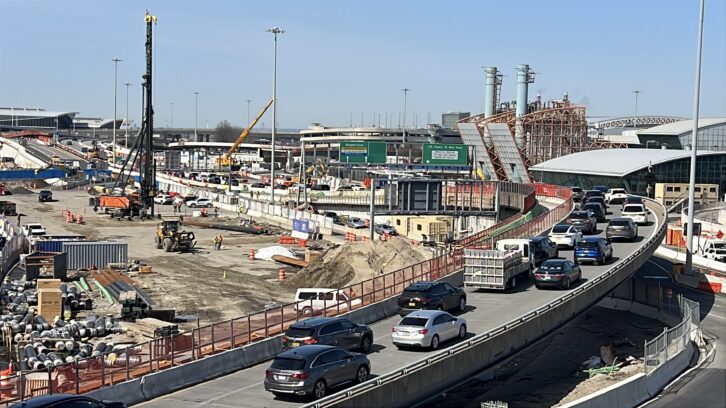
Even with digital tools, each of the reporters we interviewed said that listener tips remain a sizeable portion of the information gathering process.
Duran called call-ins via tip lines critical in Chicago. “Our market encompasses 11 counties across three states,” he said of the station’s massive coverage footprint. “With the reach WBBM has, those tipsters are all over the DMA with eyes in places that in our wildest dreams we wouldn’t be able to see.”
In fact, WBBM relies on its tip line so heavily that Duran said the station often gets inquiries from DOT officials, local police contacts and even TV-based traffic reporters in Chicago asking if radio tipsters have any boots-on-the-ground details on a blind-spot incident. “I’d say eight out of ten times, the answer is yes,” Duran said.
Truckers, Uber drivers and everyday commuters make sure to call in tips in true Chicago style, he said — early and often.
Out west, Mora has worked at many radio and TV stations across her career, but she hasn’t quite experienced the kind of intense listener loyalty that KNX News Tipsters provide.
Particularly when it rains in Southern California, Mora said that tipsters will flood the station with dozens of phone calls every single hour. She called those loyal commuters their true eyes on the road. “I make it a point to thank our listeners and encourage engagement,” she said.
KYW’s Traffic Tip Line provides some of the most valuable information the Philadelphia all-news station gets, according to Reese. “We encourage hands-free calling, of course,” she said.
But over the years, KYW has built and maintained deep relationships with callers, some of whom have phoned in reports for decades. Many truck and limousine drivers, along with road construction workers, are valued partners who will pass along vital information. “They are our eyes when there are no cameras,” Reese said.
At WBZ, Gina Tempesta said local callers will often give the station breaking information before it even comes over police scanners, indicating exactly which lane is blocked. “We also will try to do detective work if a caller lets us know there is a backup and we are not sure what the exact problem is,” she said.
WINS’ Rice remains highly active on X (formerly Twitter). Having listeners send photos of what they are seeing — hopefully from the passenger seat — offers him a clear visual image of what he is reporting on in real time.
In addition to tips — quite a few stations used to rely on traffic helicopters. Those have been reduced, due to both cost and safety. In Washington, D.C., for instance, Dildine said that the fixed-wing aircraft age has passed and TV news choppers are limited to a zone outside the Beltway.
But WTAM’s Butler can draw on his own experience reporting for Cleveland’s WKYC(TV), where he reported from it helicopter for around five years each morning. “That aerial view gave me a highly unique perspective on how all the highways connect,” he said.
A signal through the noise
While still useful, listener tips aren’t quite as critical to survival as they were a decade ago. Dildine called that earlier era a societal sweet spot, back when cellphone calls were paramount in the information gathering process.
“In general, fewer people make voice calls these days, so it’s a risky proposition to lean too heavily on the tip line,” Dildine said. Still, WTOP gets hundreds of tip line calls a day, though he estimated about one in 20 calls are truly useful.
Because there is a limited amount of time between traffic hits, spending too much time on the phone can be a potential hindrance to a solo broadcaster. “With the available tech, you can now get ahead of most incidents and stay there without a great need for calls,” Dildine said. The station also receives plenty of digital-based tips.
Sometimes, it also depends on the nature of the call itself. “The ground truth occasionally helps,” Dildine explained. “The grievances do not.”
Similarly, a single minor accident might generate a massive raft of calls from frustrated commuters.
“There are thousands of crashes and smaller impediments that fray nerves every day. Each one is personal to someone,” Dildine noted.
That’s where he emphasizes the importance of focusing on large-scale impact. “During rush hour, there might be dozens of incidents that go unreported and resolve in minutes. It takes restraint to find the signal through the noise.”
Dildine said many of the smaller items reported that don’t make it onto the airwaves are still included on the traffic sections of WTOP’s website and mobile app.
The voices behind it all
So we went over all of the different data points at the disposal of today’s radio traffic reporter. But are they worth anything without being able to condense the information into a short radio hit?
Greg Rice said that since he joined WINS, one definitive approach has been instilled in him: Traffic reports are not a data dump.
Each specific section of the tri-state area, be it any of the five New York City boroughs, Long Island, the myriad of highways in New Jersey or Connecticut, could easily have its own one- to two-minute feature if time allowed.
Rice started off his career in sports broadcasting, so he has maintained traits and habits from that fast-paced style.
“During a sports broadcast, you’re at the beck and call of the broadcaster’s voice and how they use it,” he explained. “When they speak in a certain cadence or with a certain volume, you know how important that moment is. I treat traffic reporting the same way.”
Calm is not an adjective that Total Traffic’s Jill Myra thinks is suitable for her reports on New Jersey 101.5. “I try to empathize instead,” Myra explained. “I always picture the listener stuck and frustrated. They have children to drop off, medical procedures, meetings and important things that they are going to be delayed for as a result.”
“It’s important for me to remember that a crash or other incident isn’t just numbers or words on a website,” KNX’s Mora told us. “On my drive to and from work, I remind myself that we have listeners just like me who want to get to work or arrive home safely with the least amount of frustration.”
There might be a temptation to insert humor to lighten the mood, but KYW’s Reese says the short intervals she has to report prevent over-the-top antics. “There’s not really enough time to be ‘full-on funny,’” she explained, “but I do try to keep it upbeat and mildly entertaining, when possible.”
For Boston’s Tempesta, it goes back to basic radio fundamentals. “Imagine you are speaking directly to your listener and smile! I try to be conversational as well, so I think that adds to the warmth of delivering a report, which sometimes cannot be pleasant news.”
Duran tries a matter-of-fact approach for his Chicago listeners. “If a road is a parking lot, I’ll tell you that,” he said. But while he is delivering the bad news, he tries to make the audience smile in the process. “With Chicago traffic, if we don’t laugh, we’ll cry,” he said.
Dildine said he tries to offer both macro perspective and a necessary dose of hope whenever possible. “There is no worse place to be stuck than in the batch of traffic that gets stopped between an exit and a full closure without an egress,” he said.
In those tough moments, he shows deference to that stranded section of his audience, acknowledging the stress but reassuring them that even the worst backup will eventually pass. When appropriate, Dildine uses a simple, grounding catchphrase to guide his listeners home:
“Stay the course… the road ahead is open,” he said. “It’s a work in progress. Such is roadwork. Such is life.”
Comment on this or any story. Email [email protected] with “Letter to the Editor” in the subject field.
Do you receive the Radio World SmartBrief newsletter each weekday morning? We invite you to sign up here.