It is difficult to imagine radio today without computers. Between program automation, transmitter control, AoIP consoles, programmatic advertising and general accounting and administrative duties, most stations would quickly grind to a halt without their PCs and microprocessors. It was not always this way.
In the mid- to late 1970s, the world of radio and the world of computers were virtually isolated from one another. Radio technology revolved around analog audio recording and playback devices as well as RF and antenna technology. It was a much more tightly regulated industry than it is today, and much engineering time and money was spent to ensure compliance with FCC regulations.
Mainframe computers by the likes of IBM, DEC and Wang Labs dominated the computing landscape. PCs would not begin to show up in earnest for another 10 years. Most users of mainframe computers were large corporations, which used them for data storage and retrieval as well as record-keeping and accounting applications.
A lot of mainframes also ended up at colleges and universities, where they were used for research and computer programming courses along with the aforementioned administrative functions. Data centers were staffed by programmers who spoke of strange languages like COBOL and FORTRAN. Most had little or no interest in broadcast engineering. Large mainframe computers were very expensive, which limited the customer base that could afford to use them.
Despite the divide between these two worlds, a few early adopters in radio had envisioned many of the computer applications that we take for granted today and had begun to put the theory into practice.
Some of these efforts originated at the corporate level, while others were grassroots projects that stations created to solve specific problems. Radio World spoke with two of these pioneers about how and why some of the first computers found their way into radio stations.
The dawn of program automation
One of the early applications for computers in radio was program automation. Broadcast automation systems had begun to flourish in the 1960s, using carousel cart machines, reel-to-reel tape players and time-announce machines. Programming of automation, such as it was, involved plugging pin diodes into a matrix board.
It was basically some variation of a sequential logic system using lots of relays. Logging was accomplished by a printer that was very similar to the teletype machine used for AP and UPI news services. Later, that was replaced by a dot-matrix printer.
IGM — International Good Music — was one of the big players in early broadcast automation, and in 1976, the company offered its 750 system with control via a Digital Equipment Corporation (DEC) PDP-8 minicomputer.
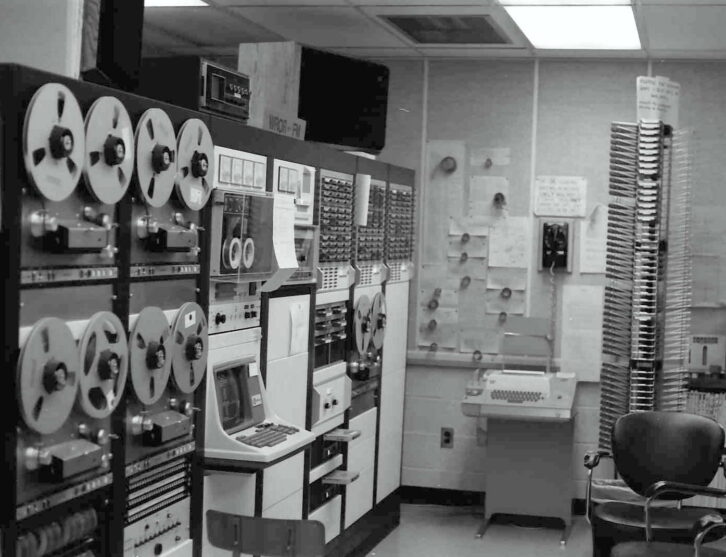
One of the early adopters of the 750 was WROR(FM), an RKO General station in Boston. Rick Sawyer, a WROR engineer from 1974 to 1977 and later an IGM field service engineer, recalls the system was very advanced for its day.
“WROR’s automation was comprised of three IGM stereo Instacarts with a total capacity of 144 carts, four Ampex 440 tape decks and a time-announce machine,” Sawyer said. “Amazing for the time were the silence sensor, emergency channel (in case the PDP-8 crashed), on-the-fly program change insertion and full logging. The Instacarts provided FSK logging output, and the tapes used 25 Hz detectors for signaling.”
He added that there was an oscilloscope permanently mounted in one of the automation racks to monitor phase response.
At the heart of it all was the DEC PDP-8.
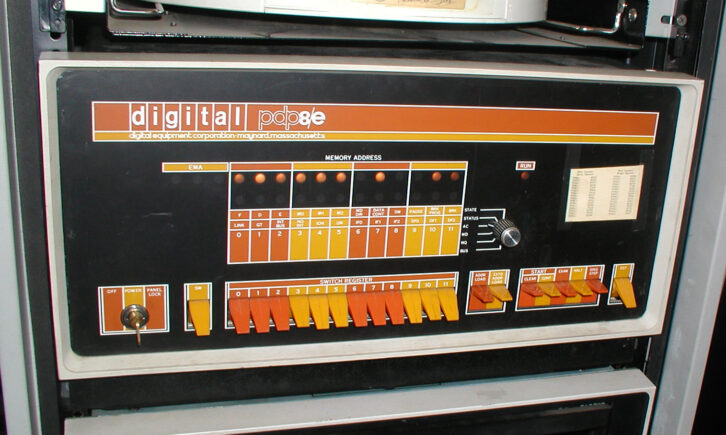
“It had 4K of core memory for RAM, which was huge for the time,” Sawyer noted. “Startup involved ‘toggling’ in a set of instructions with front-panel switches, followed by a BIN loader paper tape on an ASR-33 teletype reader, followed by a magnetic tape load. Once the system loaded, all programming and control was via a green phosphor VISTAR monitor-keyboard. Event logging was done on an Epson dot-matrix printer.”
According to Sawyer, the system was taken down for maintenance on Saturday nights while the Wolfman Jack program aired via tape from an adjacent production room. Occasionally, a DEC field engineer would come by to oversee system work on the PDP-8.
Engineers who did maintenance on WROR’s 750 recall that the computer side was extremely stable. Most of the work was comprised of cleaning and aligning heads, capstans and pinch rollers, along with replacing moving parts that wore out with repeated use.
Computer control marked the dawn of truly flexible automation programming. Before that, all that was possible was to loop machines in sequence, in some cases changing their order with a pin-diode matrix. Now, dayparts and days of the week could be different.
Stations could opt out of hourly network newscasts during overnights. Unattended operation was still the norm, but last-minute inserts of commercials or other changes could be easily accommodated.
WROR’s format was “Solid Gold” from Drake-Chenault. Programming was done by Art Ortez, who is remembered by coworkers for not only his understanding of the automation system, but also for pushing it to the limits of its flexibility.
Even in the 1970s, computer technology did not stand still for long. The PDP-8 era was short-lived. These systems were quite expensive, largely due to the DEC minicomputer. The WROR automation cost around $150,000. The PDP-8 was soon replaced by less expensive single-board computer systems developed by IGM and others.
A few years later, they in turn were replaced by personal computers.
Redefining remote control
Around the same time that the PDP-8 was running WROR’s automation, a computer-enhanced transmitter remote control was being developed in-house for WRKO(AM), RKO General’s AM station in Boston. While the project was very advanced for the time, Bob Smith, chief engineer of WRKO/WROR from 1978 to 1988, recalls it was developed to fill a practical need.
“Since WRKO was directional, we were required to have a First Class operator on duty 24/7,” Smith said. “The typical duties of these engineers ranged from bench repairs to studio construction projects to ongoing maintenance. No matter what they were doing, engineers had to break away every 30 minutes to go back to master control and take a set of readings. This led to inefficient workflow and distractions to the task at hand. The engineering staff and I developed a way to streamline the transmitter meter-reading process, while still maintaining compliance with FCC regulations.”
WRKO’s transmitter site was controlled by an MRC-1, which was a landmark device in its own right, being the first microprocessor-based remote control to be developed by Moseley. Smith and the engineers at WRKO took the MRC-1 to the next level by adding a computer front end to the system, using a Radio Shack TRS-80.

Out of the box, the MRC-1 was a versatile device, with many of its features made possible through the use of the microprocessor as the main control and logic element. The control terminal, located at the studio, could manage up to nine remote terminals. Each remote terminal could access as many as 32 status (on/off) inputs, 32 metering inputs and 64 command (on/off) outputs. The control terminal and remote terminals could communicate with each other via two- or four-wire phone lines, STL subcarrier, aural SCA or microwave links.
Also new with the MRC-1 was the use of LEDs for channel and status indicators, as well as a digital display for remote metering and others indicating which remote unit and channel number were being displayed.
Despite all the advanced features, the MRC-1 was designed to have a human being press buttons on the control terminal and write down meter readings in the log. That is where the Radio Shack TRS-80 came into play.
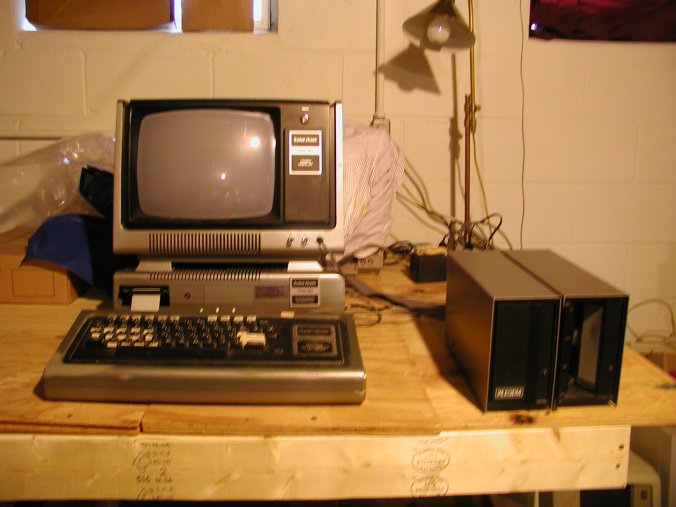
The TRS-80 would poll the MRC-1 every 30 minutes for a set of transmitter readings, which would be output to a dot-matrix printer. Additionally, readings could be printed on demand with the press of a button. An audible alarm would sound throughout the station to summon the engineer on duty, should any of these readings go out of tolerance.
The operator need only sign on the log at the beginning of his shift, then check all the readings when he signed off at the end. No more 30-minute trips to and from master control.
Smith and the staff developed a program for the TRS-80 in machine language and BASIC to perform these tasks. There was also a substantial hardware component to the project, as a lot of interfacing was needed to connect the TRS-80’s serial port to the MRC-1.
Circuits were broken down into functional groups, with each one built on a wire-wrap Vector circuit board. These boards were all housed in a Vector card cage.
Comment on this or any article. Email [email protected].