What would a future-proof broadcast system look like?
That’s what Kenya’s Radio 47 network set out to discover.
The network is owned by independent Kenyan broadcaster Cape Media. Its main studios are located in Nairobi, the country’s capital city. It broadcasts on 103.0 FM from there and is heard on different FM frequencies throughout Kenya.

It is rated among the top three Swahili-language radio stations in the country, according to IPSOS Synovate.
Simon Gisharu, Cape Media’s chairman, sought a transition to an IP-based infrastructure that supported remote access, automation and multiple cameras for simulcasting its broadcasts.
Nine months to a transformation
Radio 47 enlisted integrator Mediacity Ads to come up with the concept. Fred Martin Kiwalabye, Mediacity Ads’ project director and system integrator, led the project and contributed to the technical design, equipment specification and workflow training.
Mediacity Ads CEO Jesse Maxella also played a pivotal role in developing the original radio concept that ultimately led to the birth of Radio 47.

Mediacity Ads is based in Kigali, Rwanda and is Lawo’s regional partner in Africa.
[Related: “Lawo Raises Kenya’s Radio 47 to the Future”]
The project involved the design, construction, system integration and technical setup of three radio studios. Two are used for on-air and one for production.

Work began last September. The new system was operational by this past March, and final integration was completed in June.
Kiwalabye described the remade studios in Nairobi as modern and visually dynamic, with a color palette of yellow, blue, grey and white, which aligns with Radio 47’s brand.
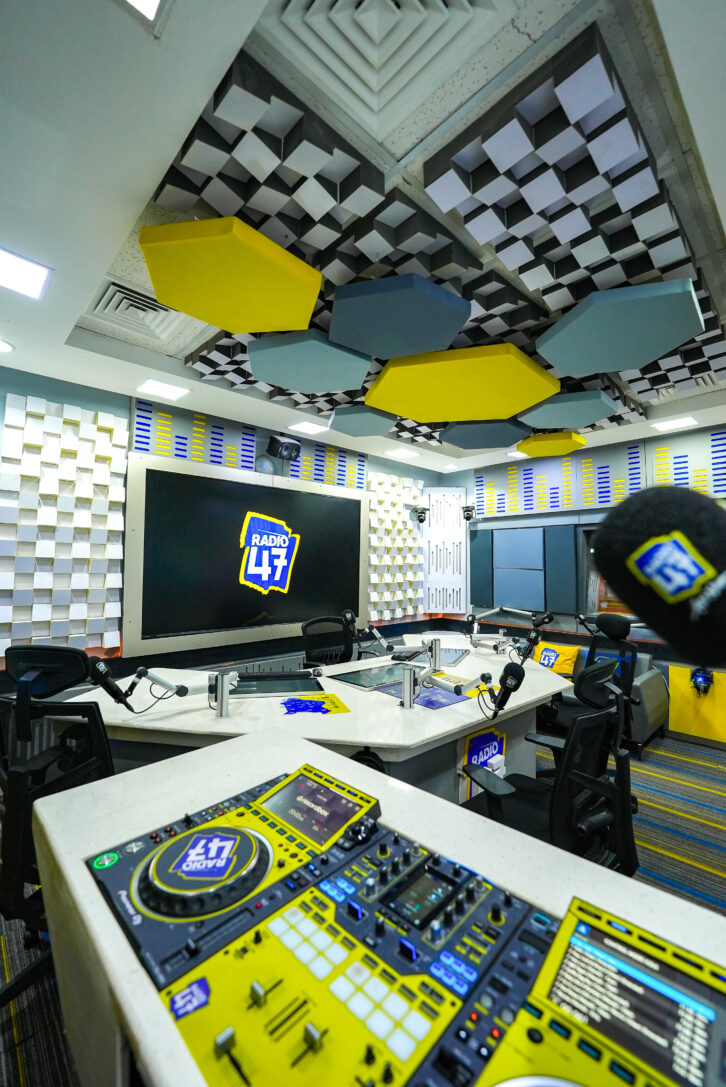
The new space incorporates 3D acoustic wall panels with hexagonal ceiling designs. There is integrated LED lighting with large digital screens for visual content.
The furniture by contrast, Kiwalabye said, has a minimalist approach, while its striped carpet complements the color scheme.

In total, he said that the design balances functionality and aesthetics.
“It’s an engaging, camera-friendly environment ideal for both radio and multimedia broadcasting,” Kiwalabye said.

Kiwalabye credited Cape Media’s Geoffrey Mungou, its head of radio, Wilson Mbugua, its technical director, and Irene Mbaya, head of radio production, for their support and feedback. Patrick Maura and Gathoni Najou, Radio 47 senior producers, Patrick Kariuki, Cape Media’s technical head, and Elilah Kariuki and Lawrence Musembi, Cape Media technicians, were also involved in the transformation.
According to Kiwalabye, Ntege Willy assisted as a lead studio contractor, while Cyrus Githagia offered network infrastructure support. Fred Sagoo also contributed to the interior design and architecture, while Evans Magati, a local contractor, assisted with construction.
Nairobi studio feeds affiliates
The Radio 47 studios in Nairobi send program audio to an Omnia.9 MKII audio processor at its transmitter site via AES67-compliant Livewire+ AoIP streams.

At the transmitter, the processed signal is sent via an Elenos STL link to a network of repeater and relay stations across Kenya. Networked stations are linked to a transmitter site via a Barix IP-based UMH160 IRD. The encoder receives and decodes the stream, which is then fed into local Elenos transmitters for regional FM broadcast.
The Radio 47 setup uses Lawo’s VRX8 virtual mixer, its Crystal Clear control package and its 12-fader Diamond console that is part of an infrastructure that Kiwalabye said allows for high-quality connections without complex setups.

Applications that remote contributors use include AVT Collaboration, Magic ThipPro Lite and Cleanfeed.
The Voceware software handles studio indicators remotely via virtual GPIOs and WinCam automates camera switching based on audio sources.
Field reporting, through ScoopyFlex, content management, through WinMan, and ad sales, through WinSales, are also web-based, Kiwalabye said.

On the cusp of something big
Radio 47 has approximately 11 regular on-air hosts. The IP-based infrastructure allows a number of hosts and correspondents to now broadcast remotely.
The transformation was fitting for a broadcast outlet based today in Nairobi. The capital city of Kenya is said to be a rising technology hub of East Africa.
Cape Media sensed they had achieved something significant, especially when compared to other operations in the continet. They enlisted Kenyan videographer Reallex Films to capture both photos and video of the deployment.

“We documented every step,” said Kiwalabye. “We knew this wasn’t just for us.”
Cape Media and Mediacity Ads were both cognizant of the trend for new layouts to lean toward streamlining and centralization, allowing for both cost efficiency and the ability for contributors to broadcast remotely.
Kiwalabye said the feed is completely synchronized nationally with consistent audio quality.
But seeking flexibility, the studio supports broadcast in person or via a mobile device.
In the end, the transformation Gicharu — Cape Media’s chairman — sought, was delivered in nine months.
Mediacity Ads said the project stands as the largest and most advanced they’ve completed, calling the installation a “continental benchmark.”