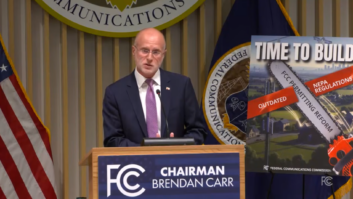
Despite the government shutdown, the FCC had a surprisingly-full agenda at its October open meeting this week, and has already made plans for the next one. FCC Chair Brendan Carr called for an end to the government shutdown while also providing updates on the agency’s ongoing work if the shutdown continues through the end of the year.
During his post-meeting press conference, Carr said that the agency would hold another meeting on Thursday, Nov. 20, for votes on items and issues that the agency had been working on prior to the shutdown. Carr did not specify what items the commission might consider in November or December. Those agendas are typically announced about three weeks prior to the open meeting. In remarks to reporters, Carr, a Republican appointee, complained about the shutdown, referring to is as “the Schumer shutdown.”
“I think there’s been a dozen votes to try to reopen the government, and we are seeing negative consequences …,” said Carr. “We’ve got our own national security officials who are here working without pay. There’s been a lot of our equipment certification work that obviously has had to push pause on as there’s no piece of electronics or communications device that can be sold or used in the U.S. without an approval for the FCC. And so we’re starting to see a backlog there of licensing requests.
Carr also noted that about 20% of the FCC’s employees were currently working — only those vital to national security.
He continued: “In terms of the ability to pay, there’s been an amount of carryover funds that the FCC has had, and also we have a separate appropriation for work on auctions related spectrum issues. For this [October] meeting [where] obviously, we had nine [items], we’re not going to have nine, unfortunately, at the November meeting. But the nine [discussed today] were largely baked fully before the shutdown hit, and we had sort of a skeleton crew able to take any … meetings people wanted, be able to respond to edits and to come in and present the items.
“We’re trying to be really good stewards of the limited dollars we have all the same time urging the full reopening of the government,” he said, adding that “Our plan is to try to continue to hold [open] meetings as long as we can. Again, they won’t be as full as this meeting because we have fewer staff. We’re gonna try to move ahead with November meeting … but, again, the [items for] November was largely done before the shutdown … I think you’re gonna start to see a bit more difficulty going forward after that.”
Carr also reported that, pre-shutdown, the agency had an equivalent of about 1,300 full-time employees, one of the lowest head counts in recent years.
“I think we’re below the lowest number of FTEs [full-time employees], at least from the chart that I’ve seen, in terms of the number of years that it goes back, and we’re still churning out a tremendous amount of really good work product, at least before the shutdown.”
During a separate press conference, Commissioner Anna Gomez, the agency’s lone Democrat, criticized Carr for pushing ahead with votes on controversial items during the shutdown.
“You [might] imagine that the work the agency does would slow down while the government is closed but the opposite happened for this meeting,” said Gomez. “Instead of focusing on only absolutely-necessary items, the FCC voted on a whopping nine items today. This is the most items I have voted on in a single meeting since I became a commissioner. Nine items is a lot of work for a small team to handle at a meeting.
“But what made the decision to pad the FCC agenda during a government shutdown even more outrageous is that most of my staff is furloughed. My decades of experience in telecom policy helped me to keep up with a wide array of substantive subjects we covered at this month’s meeting. But it was [still] like playing volleyball with one hand tied behind my back. You have to be really good at spiking.”
The FCC’s various votes at its October meeting also created many problems for the public, she said.
“Stakeholders were affected as well,” said Gomez. “Stakeholders were confused on whether the commissioners were still taking meetings to discuss the items. They didn’t know who to reach out to because they knew staff was furloughed. I was even asked if the meeting was still taking place and still open to the public — a logical question since the government at large is closed.”
She concluded: “Overloading the agency’s agenda during a government shutdown and providing no guidance to stakeholders about how to still reach decision makers is concerning enough. Even more concerning was the theme that this month’s agenda initially displayed based on the drafts initially circulated. This was set up to be the most anti-consumer agenda ever put forth during my time as a commissioner, and that was really troubling. Cloaked by a government shutdown, the FCC was set to propose a slew of anti consumer-measures in the name of deleting regulations.”
Gomez was referring to the fact that the commission voted 2-1 to revise rules on broadband labels, robocalls and the regulation of prison telecommunications services that she opposed.