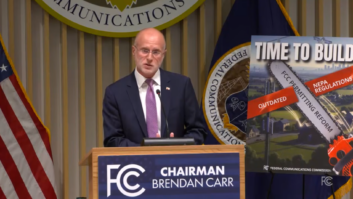
The Multicultural Media, Telecom and Internet Council’s annual Former FCC Chairs’ Symposium last week included former commission chairs and commissioners, but it also featured two of the three present-day members.
The symposium promised to cover the hottest topics in the broadband, broadcast, cable, tech, telecom and wireless industries, but the direction of the present commission quickly became the main focus of the event.
In opening remarks at the symposium, Chairman Brendan Carr talked about his initiatives since January, including the much-discussed Delete, Delete, Delete initiative.
“You know, for far too long a regulation will get on the books and it will just sit there well past the expiration of its shelf life,” Carr told the audience. “In fact, just recently, we took some action to deal with regulations relating to the provision of telegraph service.
“We still have some of those rules on the books. We have rules on our books that were effectively wiped away by courts years ago, but they just stayed there,” he continued.
Carr said, by the time his chairmanship is over, he hopes to have shrunk the FCC’s rulebook. In his speech, he called it “an Ozempic-style approach” to the FCC Code of Federal Regulations.
The chairman also spent time his hope to free up more spectrum for 5G services, which is something that directly affect radio broadcasters. The FCC introduced a Notice of Inquiry earlier this year to gauge industry reaction to repurposing up to 200 MHz of the C-band for 5G services. Such a move could displace satellite companies that use C-band spectrum for radio and television satellite downlinks.
Carr calls his plan to free up more spectrum “restoring America’s leadership in wireless.”
“Most people don’t think about (spectrum),” he said. “They just turn their phone on and they expect it to work. They don’t realize that if we don’t free up more airways, their data is going to slow down [and] prices are going to go up.”
During his remarks, Carr also took time to thank President Trump and his “one big, beautiful bill,” which among other things restored the FCC’s authority to conduct spectrum auctions.
“Now we are hitting the ground running at the FCC to get more options, get more spectrum out there,” he said, “It’s not just good for consumers, it’s also key for America’s geopolitical leadership. China is not standing still. To make sure that we continue to lead the world in next-generation technologies, including AI, we need more airways.”

Commissioner Anna Gomez followed the chairman on the symposium’s dais and discussed the current FCC’s lack of independence. The commission “is supposed to make decisions based on law, facts and technical expertise, not politics,” she said.
“We take our direction from the Constitution, the law and the public,” Gomez said in her speech. “That is what Congress intended when it created this independent agency. Here we find ourselves … watching as this administration takes deliberate steps to usurp the power granted by Congress to the commission to oversee the communications technologies of our time.”
The lone Democrat on the commission also talked about the First Amendment, diversity, equity and inclusion (DEI) and the delegated authority granted to the commission.
In regard to the First Amendment, Gomez said the FCC has been working since Trump took office to implement a campaign of censorship and control.
“The First Amendment prohibits the government from acting to limit many freedoms, including freedom of speech, freedom of the press and freedom of association, and this is such a foundational principle of our democracy that Congress felt the need to use belts and suspenders on this issue by including language in the Communications Act, prohibiting the commission from censoring broadcasters contrary to the limitations of the First Amendment,” she said.
Gomez also tied the commission’s current debate over DEI practices to her First Amendment argument. Carr has expressed a strong stance against the DEI programs of broadcasters.
“[What it] comes down to is that the FCC is asserting that fairness for all requires discrimination against some, and that’s just wrong,” she said. “That unfounded accusation is being used to pursue intimidation tactics meant to control who gets to speak.”
The commissioner also discussed delegated authority, and the limiting principle of its use by federal agencies. She said delegated authority is being used as part of the “weaponization of the FCC to ensure actions that could not withstand judicial review never have to face it under the guise of serving an undefined public interest.”
She continued in her speech: “This commission’s most recent unreviewable actions include demanding changes to the employment practices of regulated entities to obtain approvals of billion-dollar transactions, placing a cloud over spectrum licenses worth billions to the detriment of apparently disfavored competitors.”
Gomez was harshly critical of the FCC vote last week along party lines to approve Paramount’s $8 billion merger with Skydance. The deal has been highly scrutinized by media observers. Carr said in a statement that he received assurances from Skydance leadership that the new company would be committed to unbiased journalism and would not establish any DEI programs.
Former chairs in attendance at the MMTC symposium included Reed Hundt and Mignon Clyburn. Former commissioners Jonathon Adelstein, Henry Rivera and Michael O’Rielly also took part. Former FCC Commissioner Deborah Taylor Tate served as a moderator.