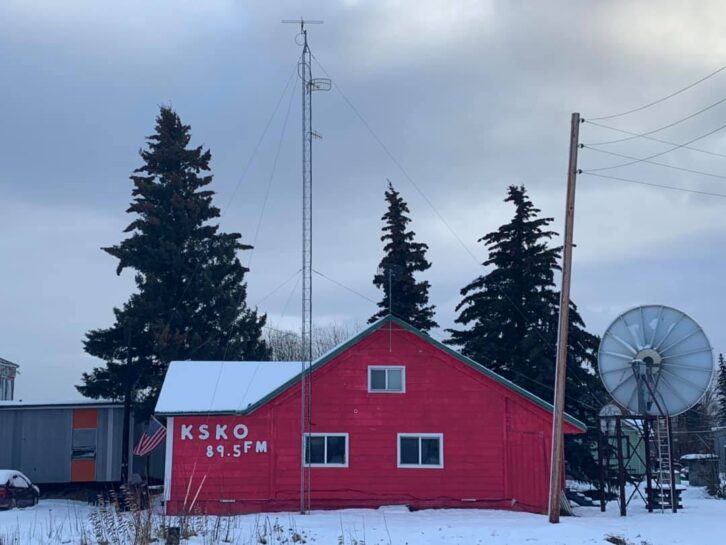
For Paul Walker, the sole full-time employee at 89.5 KSKO(FM) in McGrath, Alaska, it’s not uncommon for someone infatuated with perhaps the smallest NPR-member public station in the U.S. to send a token of goodwill its way.
But he took notice when a stream of donations started to trickle into remote central Alaska last week.
One came from an agency director on Madison Avenue, another from the Chesapeake Bay region of Maryland.
After the number reached a half-dozen, Walker asked each of the donors how they found KSKO.
“All of them, either directly or indirectly, said it was because of John Oliver,” Walker explained.
Oliver dedicated his Nov. 17 “Last Week Tonight” episode to the role public radio and TV plays in the lives of Americans. The HBO host focused on the $1.1 billion of federal funding that was eliminated for U.S. public media outlets earlier this year.
Walker said that as a result of those cuts, KSKO has lost approximately 70 percent of its yearly operating budget. Its primary 90-watt FM signal and its nine repeater stations not only serve the population of 301 in McGrath but several nearby Indigenous communities.
“We’ve had to cut a few extraneous expenses, but we have some reserves,” Walker said of the station’s current operating status.

Bidet bids
For situations just like KSKO, Oliver set up an auction that closed on Nov. 24 featuring items like a Bob Ross original painting — he’s a PBS icon, after all — to a bidet signed by The Berserker Blothar. The proceeds benefited the Public Media Company’s Bridge Fund, an initiative that collects and distributes funding to at-risk local public media stations.
But for those who didn’t want to get caught up in high rolling for a bidet — its current bid was $6,050 when we last checked — Oliver promoted adoptastation.org, the website developed by Alex Curley as part of his data-driven public media project.
Adopt a Station allows visitors to either find their local public media station by state, or support a station that has lost 30% or more of its total revenue through the federal rescissions package.
Walker said several of the KSKO donors told him they were routed via Curley’s website.
“I was blown away,” Walker said.
Data-driven difference
Curley lives in Asheville, N.C., and worked nearly a decade at NPR, including as product manager for the Public Radio Satellite Service — its content distribution arm. He was laid off from NPR last year.
Shortly thereafter, the remnants of Hurricane Helene struck western North Carolina. Curley was struck by the sheer amount of misinformation being spread.
“Until you’ve lived through a natural disaster, you don’t understand just what the value of being able to access genuine news means,” Curley said.
One of the public media outlets Oliver lauded in his monologue was the Asheville-based Blue Ridge Public Radio. BPR’s seven employees kept working through a 53-day stretch where the community did not have access to clean water.

That storm, Curley said, resulted in Semipublic, originally a Substack-newsletter that morphed into a data-driven effort to underscore the value of public media to communities.
There were not-so-veiled early hints that public media would be the target of federal cutbacks. It became evident that some outlets would be more equipped to deal with ramifications than others. But generalizations were rampant, Curley said, in terms of impact.
“There’s a lot of very broad numbers that were cited in reporting,” he told Radio World. “But there was very little online to cross check.”
With his years at NPR, Curley knew exactly where to look for the data. The Corporation for Public Broadcasting mandated financial openness from stations that relied on its funding.
Many stations submitted a form directly to CPB that was often scanned in manually. So starting in January, Curley went through the website of every single public media station to compile their finances — approximately 570 in total — and manually transcribed the federal funding they received from CPB in FY 2023. The effort took until April to complete.
A labor of love? Maybe. But in the end, it was rather prescient on Curley’s part.
How to help
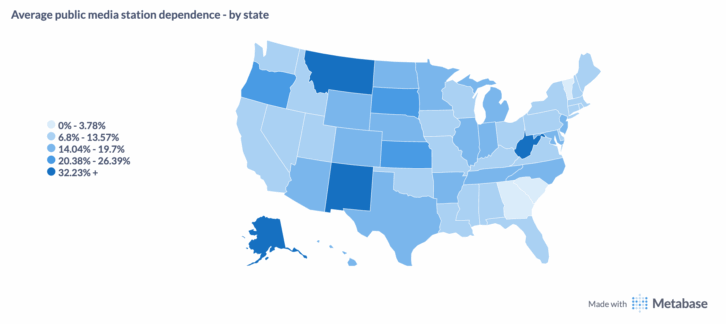
Curley published an article in April on just how much public media relies on federal funding, which gained quite a bit of attention.
Then came the May Executive Order from President Trump. And when Congress officially voted to rescind public media funding on July 18, the requests started to trickle in: Which stations would be affected most?
Self-trained on back-end software development, including with SQL-based database management, Curley launched Adopt a Station.
The website flags stations that have lost 30% or more of their federal funding, such as KSKO.
Which outlets are seeing the most aid from Adopt a Station? Curley can’t say for sure, as the links on the platform take you directly to the station’s website to make a contribution, ensuring full transparency. That is why he was delighted to hear of Walker’s Alaskan story.
[Related: “Public Media Stations Confront Money Crisis”]
But he can say that more than half of adoptastation.org’s visitors ultimately click on a station’s website.
And since Oliver plugged Adopt a Station, Curley’s seen an cause-and-effect.
“Almost one-third of our total traffic has happened since the Oliver episode,” he said.
The table below, with data from Semipublic, shows the 10 public radio outlets that depend most on federal funding.
| Federal Support (%) | Recipient | City | State | Type | Affiliation | State GDP ($) | Region |
|---|---|---|---|---|---|---|---|
| 98.01% | KCUW | Pendleton | Oregon | Radio | Other | 331,029.00 | Pacific |
| 96.63% | KUHB | St. Paul | Alaska | Radio | NPR | 69,969.00 | Pacific |
| 95.03% | KSHI | Zuni Pueblo | New Mexico | Radio | Other | 140,542.00 | Mountain |
| 90.51% | KNSA | Unalakleet | Alaska | Radio | NPR | 69,969.00 | Pacific |
| 86.54% | KSDP | Sand Point | Alaska | Radio | NPR | 69,969.00 | Pacific |
| 79.58% | KGVA | Harlem | Montana | Radio | NPR | 75,999.00 | Mountain |
| 72.97% | KTNA | Talkeetna | Alaska | Radio | NPR | 69,969.00 | Pacific |
| 70.61% | WGVV | Rock Island | Illinois | Radio | Other | 1,137,244.00 | East North Central |
| 70.17% | WRVS | Elizabeth City | North Carolina | Radio | NPR | 839,122.00 | South Atlantic |
| 69.23% | WVMR | Dunmore | West Virginia | Radio | NPR | 107,660.00 | South Atlantic |
Semipublic mission
Next, Curley seeks to establish Semipublic as a nonprofit organization. He’s aiming to raise $30,000 to help its launch, and he’s a little under halfway there — again, thanks to help from Oliver’s mention.
Its mission, Curley said, is to be a central source for information and data on how public media is changing, a hub for journalists, foundations and private donors.
He can spin up a website or application appropriately with the data he amassed. He created a layoff tracker that shows a graph of personnel laid off since July 18.
Semipublic’s newly formed Public Media Jobs Index is another example. Curley collects every individual job listing that appears in public media, which is even more important with the loss of CPB Jobline, what he said was the most definitive source of public media job listings online.
Now, Curley tracks more than 15 different public media-specific job boards and aggregates postings. There’s many senior-level openings, he said. But for someone trying to break in, it can be discouraging.
He hopes to make it easier for job seekers at different levels to find roles more appropriate for their skillset.
“I have the data, and if I can do something useful with it, I will,” Curley said.
Feeling thankful
Walker said that, as of Monday morning, KSKO is up to 15 new members since the Oliver episode. He’s got some work to do — many donors contributed at the station’s “fireweed” level, which ensures swag that includes a t-shirt and mug. The $100 “blueberry” level raises the stakes even more.
“Someone in Philadelphia is going to be walking down the street in a KSKO beanie cap,” he said.
But this Thanksgiving week, in a tumultuous year for public media, Walker offers up some gratitude.
“When people outside the sphere of your normal life understand what you do, how important and vital it is and back it up with a donation, it is incredibly reaffirming of what we do,” he said.