It might be hard to find anyone in the radio industry who exudes more confidence in its future than Bruce McKirdy.
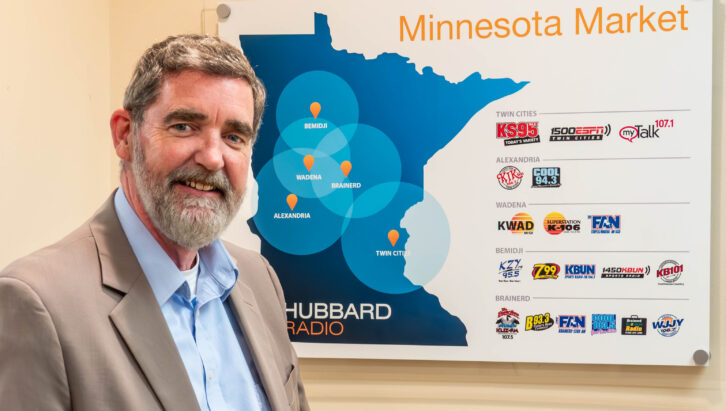
The veteran of more than 40 years in radio runs stations for Hubbard Broadcasting in Brainerd and Bemidji, Minn., 11 stations in all.
McKirdy’s perspective is both refreshing and reassuring. What he lacks in large-market experience he makes up for in small-market practicality.
If you were to hold up a mirror to a community, he says, “you should see the call letters in the reflection.”
Relevance gets results
McKirdy, 62, is regional general manager for the family-owned company founded in 1923 by Stanley E. Hubbard.
Brainerd and Bemidji are northwest of Minneapolis and separated by about 100 miles. McKirdy spends the majority of his time in Brainerd, tackling what he believes is the most pressing issue facing commercial radio managers in America.
“It’s perception. Radio is 100 years old and we’re not sexy anymore. But that doesn’t mean that it doesn’t work. I suggest exactly the opposite. Radio works, creates trust, familiarity, connection and opportunity.”
When McKirdy hears a client say that radio doesn’t work, he calls a timeout and offers a rebuttal.
“We have case study after case study that prove radio is still as relevant as it’s ever been. But it also depends on how radio is presenting itself.”
Negative headlines about large U.S. radio companies and their financial issues don’t dim his optimism.
“If you approach radio with a hub-and-spoke strategy that a lot of the big companies want to do, it’s a no-win. I don’t believe you can spread a staff over 200 stations and win,” McKirdy says.
“However, if you have a local presence that creates local content about things that are happening in the community, well then suddenly you’re relevant.”
He says people will listen to relevant radio. And it will get results.
“It’s remarkable to me how this is to some extent a foreign concept, and I think it really comes back to people trying to budget-cut their way into prosperity, and it’s not possible.”
Small-market tactics could work for the larger groups, he says, but first you need the ear of the community.
He says his stations are in the community for more than 200 dates a year, broadcasting ballgames, doing speaking engagements and conducting remotes.
“If you’ve got three people on your staff of four stations, you’re going to create no margin for yourself to be able to interact with the community. Those three employees will be lucky to finish their workload in a day.”
But for stations that approach things correctly, with a staff who are live and local, he feels the outlook is positive.
“If you want to talk dollars and cents from a management standpoint, the economic future of terrestrial radio is strong if and only if it moves from that idea of being more than just a transmitter to the idea of we are locally produced content and we superserve our audience,” he said.
“I don’t care how you superservice — it might be online, it might be on air, it may be through Alexa, it might be through apps. You can deliver it any way you want it, but if the definition of radio is locally produced audio, locally produced content, I think the future of radio is very bright.”
AI continues to make inroads in broadcasting, and McKirdy’s group is no different.
“You can’t ignore AI, and we are using it,” he said. “AI has some significant advantages if it’s used by a human on its own.
“I’ve heard of stations that are trying to be all AI. It’s not interesting. I think it’ll be novelty for a short time. That said, the worst that AI is ever going to be is today, and then tomorrow will be the worst day, and then the day after. It’s going to improve.”
Meanwhile, digital plays a key role in a small market. It makes up about 23% of his local group’s business.
“And it is growing and growing quickly. You can’t ignore digital. Radio is our core business. Digital is our growth business,” he said.
“Let’s say those numbers flip, that someday it winds up being 75% digital and 25% radio. I would suggest that it is the connection to the community from the radio that is going to be your ticket in to have conversations about digital advertising.”
Finding the right digital tools for the job is key, he said, and Hubbard has hundreds.
“We have a separate division for it. It’s called 2060 Digital, and it is world-class. All of our sellers are aware of it and selling it.”
The company recently rebranded as “Hubbard — Media That Connects.” McKirdy said it’s significant.
“There’s this debate: ‘Oh, should we be a radio-first company? Should we be a digital-first company?’ This is our way of saying ‘No, we’re client-first, we’re audience-first.’ We’re going to meet the customers and audiences wherever they are.”
He described the company’s podcast business as “exploding.”
“We’re already number eight in the nation. We’re not just a radio company. We’re all of the above, but we are customers and audience first, and then we’ll figure out what that means.”
On a larger industry scope, McKirdy expressed concern about the possibility of more consolidation.
“I’m open to it. I think it was needed in 1996 when they deregulated; it was necessary, and large broadcast groups became a thing,” he said.
“But if companies are going to use bankruptcy as a business model, if we buy a bunch of stations and then go bankrupt, that has to stop. We need to stop making it so easy. There is a very simple solution you could put in place. The FCC could say if you are going to declare bankruptcy, you forfeit your FCC licenses.”
He thinks groups would change the way they operate with such guardrails in place.
“Companies would make very different decisions if they knew there were real consequences. You have to get rid of the bailout.”
McKirdy is keeping an eye on the proposed AM for Every Vehicle Act. His three AMs operate with FM translators.
“I would say the vast majority of our listenership to our AM station is on the FM band on those translators. Translators are just wildly important for the AM band,” he said.
“But this is really more a fight for the dashboard. Radio is the largest competitor for everything else in your car, and if it can be eliminated from the dashboard, even by picking off an AM station, what you’re really saying is that only internet products remain. And they’ll get a subscription fee for that.”
Youthful goal
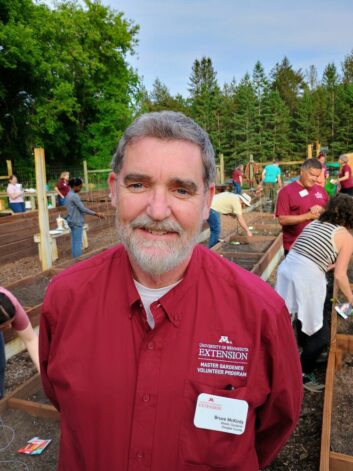
McKirdy — who has nine grandkids and another on the way — hopes to work another 10 years. He credits a fourth-grade mentor for inspiring him to get into radio.
“There’s always a teacher in your life who really mattered to you. For me it was Mrs. Speck. In fourth grade she had radio days in her class. I was a disc jockey, and we had a news guy, we had a sales guy, we had a station manager. I remember coming home that day and telling my mom, Maybelle, that I was going to grow up and work in radio.
“I’m sure she thought, ‘Well, this fourth grader doesn’t really know.’ But I was dead serious.”
In 1983 McKirdy begged his way into a job at KSDN(AM) in Aberdeen, S.D., in 1983. He went on to work other radio jobs in Grand Forks, S.D., and then Gillette, Wyo. He was also a radio consultant for a time.
His track record of success in small markets includes 23 years as VP of Paradis Broadcasting in Alexandria, Minn., where he was mentored by Brett Paridis, whom he found to be most inspiring.
Read more stories like this in our News Makers section.