The author is senior vice president, broadcast radio & digital audio at Xperi. This is an excerpt from the ebook “Global Radio Update.”
Despite a decade of streaming, satellite and connected-car competition, radio has held its ground where it matters most: in the car. Sixty-six percent of U.S. adults listen to AM/FM radio every day, and most of that listening happens behind the wheel.
Keeping radio competitive in an increasingly digital dashboard is where HD Radio technology comes in, letting AM and FM stations broadcast a digital signal alongside their existing analog one.

Developed by iBiquity Digital Corp., now part of Xperi, HD Radio technology was introduced in 2002 and first appeared in vehicles and aftermarket products in 2005. It has become the digital broadcast standard in the last 20 years, proving that digital broadcast can deliver scalable value within the current ecosystem, improving both experience and economics.
HD Radio by the numbers:
- Now in approximately 125 million North American vehicles, representing over 60% of new vehicles shipped in the U.S.
- By the early 2020s, the technology had become standard factory equipment in the majority of new vehicles sold in North America.
- Enables digital radio services on more than 2,700 AM and FM stations across the United States, Mexico and Canada.
- Reaches nearly 400 million people across multiple countries.
- The ecosystem delivers more than 750 million hours of digital listening every week.
Capabilities, benefits and opportunities
HD Radio’s most immediate benefit is audio quality. FM HD Radio delivers crystal-clear sound, free from distortion, and AM HD Radio reaches fidelity comparable to traditional analog FM, removing static, pops and cracks.
Just as important, a single licensed frequency can carry up to three digital sub-channels (HD2, HD3 and HD4), without any new spectrum, letting stations run entirely separate formats such as 24/7 sports, niche music or foreign-language programming. Each subchannel is a revenue opportunity for broadcasters: Stations can target niche audiences that attract specialized advertisers, lease unused capacity to third-party content providers for recurring monthly revenue, or feed an FM translator to launch what is effectively a new signal on the dial, with its own advertising inventory.
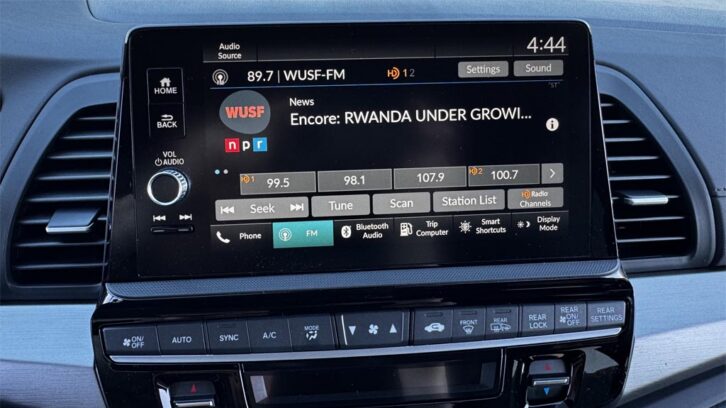
For listeners on the road, HD Radio technology transforms in-vehicle radio from just a frequency display into a visually immersive interface that is more compelling than, and competitive with, streaming services.
It supports advanced metadata services so receivers can display song titles, artist names, album artwork, station logos and emergency alerts in real time, making the listening experience more immersive and “sticky.”
The data channel also delivers advanced data services like traffic, weather and emergency information at up to ten times the speed of conventional broadcast data services.
Deployment in other countries
The same advantages that make HD Radio so widely adopted in the U.S. are also driving adoption abroad.
For example, for 15 years HD Radio has been successfully operating in Mexico, which is now one of the most established digital radio markets outside the United States. Today, HD Radio technology is widely deployed by broadcasters and in vehicles nationwide with more than 240 digital HD Radio channels in operation and over 190 new vehicle models equipped with factory-installed digital receivers.
And it is working: Broadcasters in Mexico report that HD Radio is invaluable for increasing audience engagement, opening up opportunities for new programming formats and more targeted advertising, as well as specialized digital services to expand audience reach and revenue potential.
The success of HD Radio in Mexico underscores how digital radio technology can expand programming options while preserving the reach and accessibility of traditional free-to-air broadcasting. It also means that Mexico has become a model for other countries evaluating digital radio strategies, especially India.
Outlook for HD Radio in India
HD Radio is gaining attention in India as an option for their next phase of digital radio development.
As the country explores digital solutions that can operate within existing FM spectrum allocations, Xperi’s engagement with policymakers, broadcasters and the wider broadcast ecosystem has increased over the past year. At the Broadcast Engineering Society (BES) Expo in New Delhi, as well as other recent industry forums, HD Radio demonstrations have attracted strong interest, especially around approaches that allow broadcasters to efficiently introduce digital services within the existing FM spectrum.
HD Radio technology continues to gain traction in India because it offers a path to enhanced audio quality, additional services, and new content opportunities, while preserving current investments.
Recent developments, future applications
HD Radio’s capabilities go well beyond audio quality and revenue opportunities.
Three recent developments stand out, two with broader significance for regulators and public service broadcasters, and one that is reshaping how stations monetize the dashboard:
- Emergency Communications and Data Services: As a “one-to-many” broadcast medium that operates independently of internet and cellular networks, HD Radio provides a critical channel for emergency communications when other infrastructure fails. The same data channel can also carry real-time traffic and weather information.
- All-Digital Broadcasting: The FCC has authorized U.S. stations to transition to full all-digital operation, eliminating the analog signal entirely. “All-digital” broadcasting enables higher audio quality, additional subchannels per frequency and expanded data capacity. It also dramatically increases signal reliability for both AM and FM, and improves building penetration for in-home and in-office radio listening.
- Visual Radio and New Revenue Streams: HD Radio’s partnership with Quu, an industry leader in providing easy deployment of visual content for radio, means the technology can also deliver synchronized text and visual images to radio displays, expanding the industry’s “screenification” of radio. This means broadcasters can display station logos, album art and visuals for advertisers on screen, which boosts listener engagement and creates new revenue streams. Quu data shows that stations are realizing a 10 to 15% premium for synchronized text with audio ads, and a 25 to 30% premium when text and images are combined.
Xperi’s role
Xperi supports broadcasters across the full process as they convert to HD Radio technology. It licenses its proprietary IBOC technology to stations, allowing them to broadcast a digital signal alongside their existing analog on the same frequency, with no new spectrum required. Transmission equipment is supplied by hardware partners, such as Nautel and GatesAir.
Xperi also works directly with the FCC on regulatory updates, most notably higher digital power limits for FM stations, and with automakers to embed HD Radio as factory-installed equipment.
Broadcasters can find more information on how to fully leverage HD Radio technology’s benefits, including details on the standard, stations already on air, and compatible receiver equipment, here. The past two decades have proven that broadcasters do not have to choose between the reach of free over-the-air radio and the capabilities of digital because HD Radio delivers both, and on infrastructure that stations already own. As vehicle dashboards grow larger and more visual, and as new overseas markets weigh their own digital transitions, the stations that treat the screen as a versatile and engaging platform, rather than a simple information display, will be the ones that succeed in turning radio’s next chapter into further growth.