Nick’s Signal Spot is a new feature in which Nick Langan explores RF signals, propagation, new equipment and related endeavors.
Numbers and radio stations seem to go hand in hand.
That’s what I found out when I wrote a column for the Radio World titled “The U.S. FM Landscape by the Numbers.” It was hard to limit myself to just 21 findings!
As proprietor of the RadioLand mobile app, I have access to a database of FM radio stations in North America. The data comes directly from the FCC’s LMS database, supplemented by the HD Radio Directory for HD operation and subchannel information. That directory is far and away the most trustworthy source of such data I’ve found and I encourage you to explore it.
I heard from several readers about that column, intrigued to find out more. I promise that I’ll do an AM radio version soon!
Some also wanted to know more specifics about nationwide HD Radio usage.
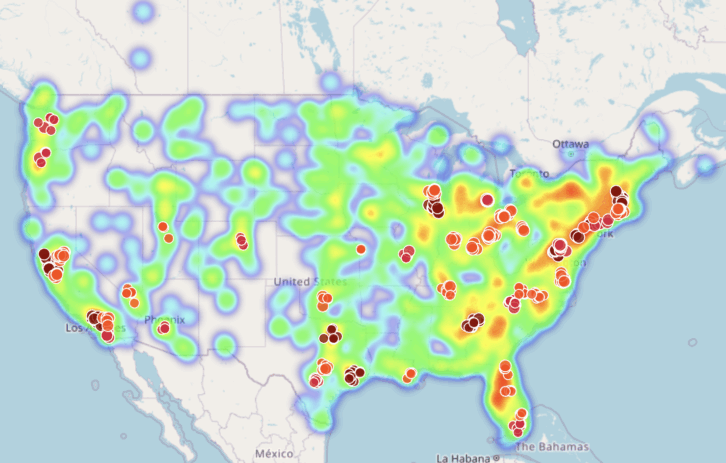
I wrote earlier that approximately 9% of the U.S. FM stations run HD Radio, and I included an interesting heatmap of the technology’s deployment that you can see in the original column.
But that 9% figure felt low to me, and I think it’s because we were looking across all FM signals in the country, including translators, boosters and LPFMs.
What if we only considered full-power FM stations and took a deeper dive into current HD Radio trends?
Well, I crunched the numbers in the RadioLand database, using Python-based data analysis tools, and it’s the subject of this latest Signal Spot column.
HD Radio by the numbers
First, to set the stage, my database as of Aug. 15 contains 21,980 FM stations in the United States.
If the station has an active license, I count it in my database, so there may be some instances where a station listed is not actually on the air.
Secondly, it’s only so useful if I talk about the numbers, without you, the reader, being able to see them with your own eyes! So, check out this updated HD Radio analysis map from my data, which is color coded to represent station classes in the U.S. and Canada. You can also toggle by Nielsen market, as well.
I’m noting an HD Radio station if it is counted in the HD Radio Directory as either operating in HD or “suspected.” There certainly may be examples of HD Radio stations not included or vice-versa.
Keep in mind, I’m just attempting to paint a picture here.
If I include “suspected” HD Radio stations in the mix — which I did not in May — the total of active HD stations in the U.S. is 2,114, up from the 1,936 I listed the first time.
After reviewing the suspected stations, I believe that for an accurate analysis, it was best to include them.
Xperi, HD Radio’s parent company, said that there are more than 2,500 stations in the U.S. broadcasting in HD Radio. It maintains a listing of stations; its count likely includes AM stations and stations that are licensed to broadcast digitally but currently are not doing so — 103.9 WPHI(FM) in Jenkintown, Pa., the FM simulcast of KYW(AM), is an example.
18 — This is the overall percentage of U.S. FM stations that use HD Radio when we exclude translators, LPFMs and boosters. That’s double the percentage I gave in May.
The data show that there are 8,330 translators, 1,989 LPFMs and 387 boosters. If you’re curious, I find 15 translators, seven LPFMs and seven boosters that run HD Radio.
21 — The percentage of commercial FM stations in the U.S. that use HD Radio, again excluding translators, LPFMs and boosters. This was determined by filtering for frequencies at 92.1 and above for commercial stations. Among noncommercial stations, that number is 14%.
Overall, there are 7,230 full-power commercial FM stations and 3,887 noncommercial stations on the air in the U.S.
The FCC’s quarterly broadcast data report lists those totals as 6,602 and 4,689, respectively. I’m not entirely sure why there’s such a large discrepancy in the commercial count. The commission may also be reducing its total further. I try to keep my count limited to active licenses and filter out stations that have filed for silent STAs.
68 — The percentage of U.S. HD Radio stations that use at least one subchannel (HD2, HD3 or HD4).
There are approximately 1,400 active HD2 subchannels, 630 HD3 and 140 HD4 subchannels.
150 — The number of sports-formatted HD Radio subchannels, making it the third-most common format.
Many of these sports subchannels are used to feed a translator. For example, in Chicago, Hubbard’s WTBC(HD2) provides a way to broadcast the signal of WMVP(AM) on FM, via an LMA with Good Karma Broadcasting.
The most common HD Radio subchannel formats are:
| Format | Counts |
|---|---|
| Christian Music* | 217 |
| Talk/News | 195 |
| Sports | 150 |
| Classical | 117 |
| Country | 75 |
| LGBTQ-related programming | 62 |
| Classic Country | 55 |
| Classic Hits | 54 |
| Oldies | 52 |
| Hip Hop/Rap | 46 |
* combining Christian Worship, Christian Contemporary, Spanish Christian, Gospel and Christian Rock
51 — The percentage of full-power FM stations in the top 50 U.S. Nielsen markets that use HD Radio.
Breaking down the Nielsen markets by county, there are approximately 1,430 FM HD Radio stations in the top 200 U.S. Nielsen markets.
HD Radio penetration is high in the top 50 Nielsen markets, with about 750 stations.
In markets 51–200, this declines by half to 25% penetration.
When reached for comment by Radio World, Joe D’Angelo, Xperi’s senior vice president of global and digital audio, said that in 2025, 78% of the stations that have implemented HD Radio are outside the top 50 markets.
52 — There are 52 HD Radio stations in the United States running at –10 dBc.
This data point should be considered with caution, as it was calculated using the FCC’s LMS database. Digital power data is available for only 863 stations, which is less than half of the stations believed to be using HD Radio.
Fifty-two stations run their HD carrier at –10 dBc, or 10% of their analog transmission power.
The most common power level is –14 dBc, used by 609 stations.
(If you’re not familiar, dBc stands for decibels relative to carrier. If a station is transmitting its HD Radio digital sidebands at –10 dBc, they are operating at 10 decibels below the analog FM carrier’s ERP, or 10%. Originally, the digital power limit when HD Radio was launched was –20 dBc, which is just 1% of the analog ERP.)
388 — The number of stations owned by iHeartMedia that use HD Radio, the most among U.S. radio owners.
The owners of the most U.S. HD Radio stations are:
| Owner | Stations |
|---|---|
| iHeartMedia | 388 |
| Audacy | 159 |
| Educational Media Foundation | 62 |
| Cumulus Media | 51 |
| Saga Communications | 42 |
For public broadcasters, Minnesota Public Radio is second, trailing only the Educational Media Foundation, with 31 stations.
5 — The percentage of full-power stations in New Mexico that use HD Radio, the lowest of any state. Florida has the highest usage at 41%.
| State | % in use |
|---|---|
| Top 5 | |
| Florida | 41% |
| Utah | 37% |
| Maryland | 34% |
| Nevada | 32% |
| Connecticut | 32% |
| Bottom 5 | |
| Montana | 8% |
| Arkansas | 7% |
| Mississippi | 7% |
| West Virginia | 7% |
| New Mexico | 5% |
3 — The percentage of Canadian FM stations that use HD Radio, with 51 out of 1,747 stations in the database using the technology. I excluded low-power and very low-power stations, as classified by the CRTC, Canada’s broadcast regulator.
The majority are in Toronto, which has 16 HD Radio stations, accounting for 31% of the country total. Vancouver has nine, while Montreal and Ottawa have four each.
Bell Media operates the most HD Radio stations with eight. The CBC has six, followed by Corus Radio, Rogers Media, Durham Radio and Dufferin Communications, all tied with three each.
Nick’s takeaways
I think a few of you were alarmed with the 9% figure when I did the analysis originally.
These data findings — specifically that 21% of commercial FM stations are using HD Radio — are more meaningful when assessing the technology’s adoption. If we used the FCC’s slightly lower total of commercial FM stations, that percentage would be even higher.
Xperi said that the U.S. stations that run HD Radio cover 80% of all listening across the country, meaning they are significant players in the medium. They reach 90% of the U.S. population.
It’s fair to conclude, however, that the digital format has ample room to grow and that rural broadcasters in rural areas and smaller markets are not flocking nearly as fast to invest in HD Radio, compared to those in the larger markets.
A higher percentage of commercial broadcasters use HD Radio than do noncoms, though not overwhelmingly so.
A majority of HD stations seem to be using their multicast channels to their benefit, which is a good thing.
Xperi told Radio World that in total, the technology delivers an additional 2,200 audio channels in the U.S. through subchannels.
However, the number of outlets that run subchannels with programming like sports and news/talk seem to support the view that many subchannels are intended to feed FM translators rather than trying to fill a market format void or experiment with new types of programming, as advocates of multicasting have hoped. Still it is refreshing to see some lesser-heard formats, like classical and LGBTQ-related programming, find an outlet through the subchannels.
Xperi celebrated the 20-year anniversary of the HD Radio technology this year, and I’d be curious what your thoughts are on its usage and adoption. Email me at [email protected].