Nick’s Signal Spot is a new feature in which Nick Langan explores RF signals, propagation, new equipment and related endeavors.
There’s a cool piece of technology built into the “seek” button on a car radio. Only signals of a certain strength trip the seek threshold.
Of course, that button may be harder to find on your car’s infotainment system these days — but no matter.
Have you ever had the experience of hitting the seek button on the FM radio dial, only for the receiver to do a full cycle of the band, unable to find a signal? It’s that kind of open band that can be such a boon to long-distance signal enthusiasts’ pursuit of DX catches.
Today, with more FM signals on the air than ever, particularly in the noncommercial band, these locations are harder and harder to come by. As a result, some DXers take trips, called DXpeditions, just to find such locations.
But in the lower 48 of the United States, which locations still stand out as wide-open for FM? I’ve crunched the numbers so you don’t have to!
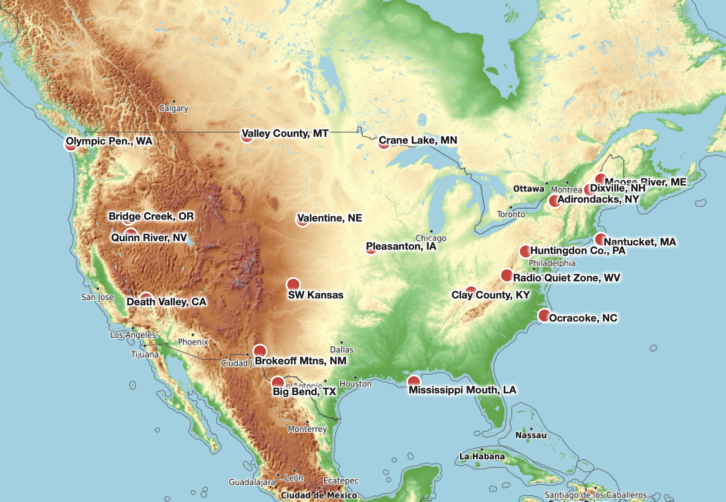
The top 20 locations
A few words before we dive into the list.
I teach a Computer Science class at Villanova University, and a research student I work with, senior computer engineering student Minh Bigting, designed a machine learning-based model trained on Longley-Rice prediction samples.
We’re calling it the JUDY model. I’m excited about the results it has produced so far!
So, with a speedy model at my fingertips, I had the model sample around 100 locations from each of the lower 48 states, and return the “quietest” locations in each state, weighing the locations that had the fewest number of FM stations that might trigger a car radio’s seek function. For purposes of this exercise, I’ve used a theoretical signal level of 60 dBu.
I then reviewed each location and substituted several with either my own observations or those from colleagues.
I focused on the lower 48, just because in a place like Alaska, there are so many remote areas. The same is true for Canada, once you get above the 49th parallel.
Many states, particularly in the western U.S., could also have multiple locations on this list. But for equal representation, I limited each state to a maximum of one appearance.
You won’t find many mountaintop locations on this list. Those are great places to scan the dial — but we’re looking for quiet band locations. High elevations, inherently able to overcome terrain obstructions, will often amplify signals, even those far away!
What my research doesn’t necessarily account for are locations, closer to population centers, that either through terrain, or even building blockage, feature a spot surprisingly conducive to signal-blocking.
Surely, I’ve missed really “open” spots. I’d love to hear where you’ve been. I invite your dialogue!
The locations are not necessarily in any particular order.
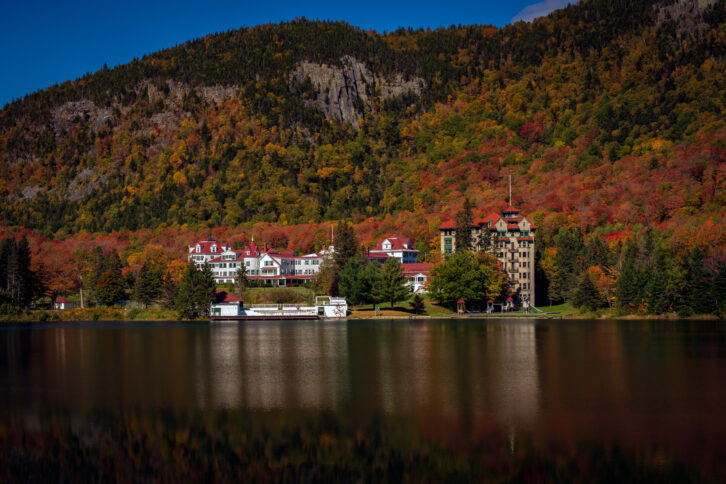
Dixville, New Hampshire
Estimated FM signals over 60 dBu: 3
Coordinates: 44.9448 N, -71.2402 W
Closest radio market: Sherbrooke, Québec
It’s a tradition that began in 1960. All eligible voters in Dixville Notch gather at midnight in the ballroom of The Balsams Grand Resort Hotel and cast a midnight vote during the New Hampshire primary and the U.S. presidential election.
If the voters turned on their radios after dropping in their ballots, there would not be a whole lot to hear on FM.
Part of the area in Coös County known as the Great North Woods Region, the closest three terrain-challenged signals, including New Hampshire Public Radio’s 90.3 WEVF(FM), are located to the west in Colebrook.
Crane Lake, Minnesota
Coordinates: 48.30745 N, -92.470590 W
Estimated FM signals over 60 dBu: 0
Closest radio market: Duluth
In a state known for its 10,000 lakes, this one may be its most remote, right on the Canadian border. But in the northeast corner of Minnesota, Crane Lake is a known destination for boating, camping and RV’ing. Bring your radio gear.
There’s just one FM signal within 30 miles — 88.9 WQRN(FM) from Cook, and very little farther out.
Valley County, Montana
Coordinates: 48.7767 N, -106.5359 W
Estimated FM signals over 60 dBu: 0
Closest radio market: Regina, Saskatchewan
There are several FM signals in the county seat of Glasgow, as well as 92.7 KVCK(FM), “The Wolf,” but farther north, heading toward Canada’s Grasslands National Park, the dial is rather vacant. The signals from Regina, Saskatchewan, are approximately 140 miles away.
The county includes the Fort Peck Indian Reservation.
Death Valley National Park, California
Estimated FM signals over 60 dBu: 1
Coordinates: 36.4696 N, -116.8679 W
Closest radio market: Las Vegas
It may seem counterintuitive to include a location within the nation’s most populated state on this list, but California is vast.
And at Furnace Creek, where the visitor center, museum and headquarters for Death Valley National Park are located, only a translator for Nevada Public Radio on 88.7, licensed to Death Valley, is nearby.
Large portions of Death Valley are below sea level, including Badwater Basin, the lowest elevation in North America, standing in stark contrast to towering peaks closeby, and also acting as a signal inhibitor.
Big Bend National Park, Texas
Coordinates: 29.1997 N, -103.3628 W
Estimated FM signals over 60 dBu: 2
Closest radio market: Chihuahua, Mexico
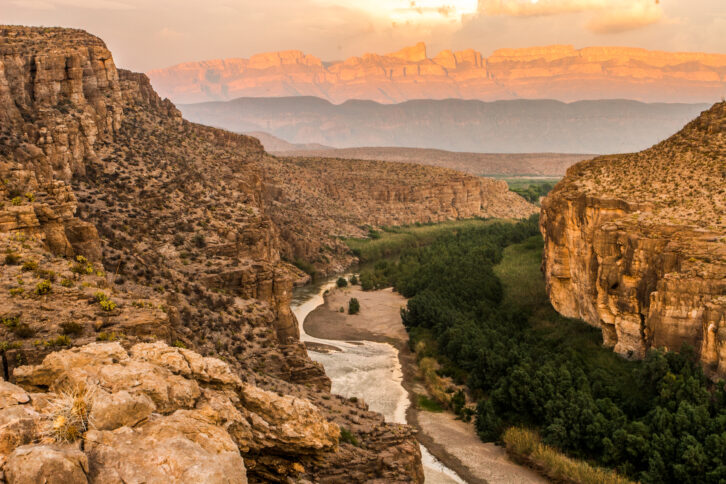
The combination of the arid Chihuahuan Desert landscape and the Chisos Mountains within the national park results in spectacular scenery, and hardly anything on the dial.
There’s only one FM signal anywhere near the park’s boundaries: 88.5 KTLG(FM), licensed to Terlingua. There are several terrain-blocked signals from Ojinaga, Chihuahua, across the Rio Grande River in Mexico, about 80 miles to the west.
Quinn River Crossing, Nevada
Coordinates: 41.5766 N, -118.4352 W
Estimated FM signals over 60 dBu: 0
Closest radio market: Reno, Nev.
This spot along State Route 140 in the northwestern corner of the state may constitute the truly most wide-open spot for FM in the nation. There are two full-power signals from Winnemucca, Humboldt County’s only incorporated community, but almost nothing else for miles.
The rugged, high-desert terrain in the region also acts as a signal inhibitor.
Nantucket, Massachusetts
Estimated FM signals over 60 dBu: 13
Coordinates: 41.26938 N, -70.13125 W
Closest radio market: Cape Cod
It’s where a nuclear shelter for President Kennedy was built. It’s home to a private golf club used by the likes of Bill Gates and Warren Buffett.
Make sure to bring your checkbook — but the island of Nantucket is also most hospitable for FM dial scanning.
Out in the Atlantic Ocean, it is the southeasternmost town in New England, approximately 30 miles south of Cape Cod.
There are five licensed FM signals on Nantucket now, but all of them are fairly low powered. Far removed from the many signals from Boston and Providence, a hobbyist can also easily tap into any sort of water-based signal propagation the Atlantic Ocean might offer.
Bridge Creek Wilderness, Oregon
Coordinates: 42.8925 N, -118.7177 W
Estimated FM signals over 60 dBu: 0
Closest radio market: Boise, Idaho
The forest here is mostly fir and larch with streaks of pine, according to the Travel Oregon website. “Orientation skills are a must for traveling because there are no maintained trails,” the website warns.
But if you do travel to southeastern Oregon, including to the town of Frenchglen, you’ll find a mostly quiet FM dial. The closest signals of significance are in the town of Burns, about 50 miles to the north.
Valentine, Nebraska
Coordinates: 42.7549 N, -100.7845 W
Estimated FM signals over 60 dBu: 6
Closest radio market: Rapid City, S.D.
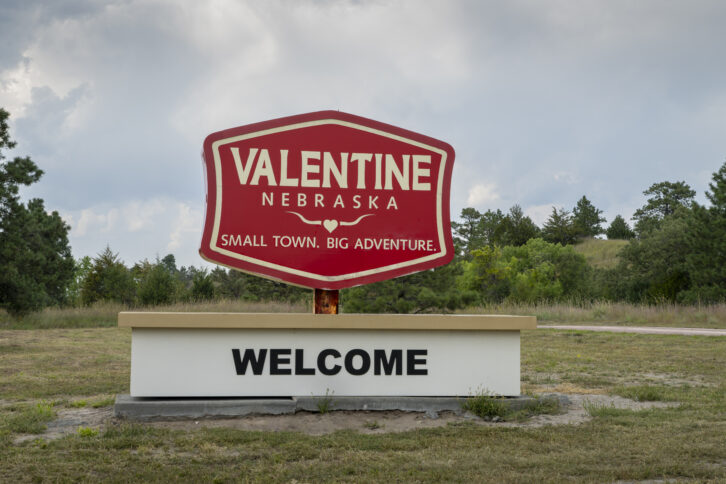
Cherry County is the largest county in land area in Nebraska. But with a population of 5,455, according to the 2020 U.S. Census, there are few FM signals.
99.5 KDJL(FM), 90.7 KMBV(FM) and 91.9 KVEJ(FM) broadcast from Valentine, the county seat, while 96.1 KINI(FM) and 88.1 KOYA(FM) transmit from the Rosebud Indian Reservation across the border in South Dakota.
Moose River, Maine
Coordinates: 45.7353 N, -70.1016 W
Estimated FM signals over 60 dBu: 0
Closest radio market: Québec City
Anyone familiar with the backwoods of northern Maine probably won’t be surprised to find one of its spots on this list.
There’s the high-powered Class C 105.1 WTOS(FM), licensed to Skowhegan, that covers a large portion of the western part of the state. Outside of that, as you ride up U.S. 201 toward the Canadian border, the closest signals are in Quebec, including two higher-powered FM signals from St-Georges-De-Beauce.
The Olympic Peninsula, Washington
Estimated FM signals over 60 dBu: 1
Coordinates: 48.1548 N, -124.6672 W
Closest radio market: Victoria, British Columbia
West of Olympic National Park, Clallam County contains the westernmost town in the contiguous U.S., Ozette.
It is also devoid of FM signals, with two Class A FMs and Class C3 96.7 KBDB(FM) licensed to the town of Forks. The Seattle FMs, 115 miles to the east, are largely terrain-blocked, as are signals from Victoria, British Columbia, across the Salish Sea.
The National Radio Quiet Zone, Virginia and West Virginia
Estimated FM signals over 60 dBu: 0
Coordinates: 38.4201 N, -79.8315 W
Closest radio market: Harrisonburg, Va.
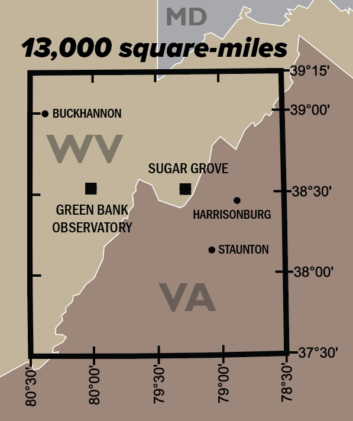
The 13,000-square-mile area surrounding the Green Bank Observatory in West Virginia — home to the world’s largest fully steerable radio telescope — is strictly regulated. The U.S. National Science Foundation operates the observatory.
In an even smaller, 10-mile radius around the observatory, there are stricter guidelines, prohibiting even Wi-Fi routers. Recently, the observatory allowed the adjacent Green Bank Elementary and Middle School to use Wi-Fi, but strict coordination is still required to even file for a communications license here.
As a result, the FM dial is exceptionally quiet. I’ve vacationed several times at an Airbnb in Highland County, Va., and with a Yagi antenna, the results have been eye-opening.
A meteor scatter train — a propagation mode I’ve written about previously — can light up the entire FM dial in one burst.
Most of the Harrisonburg and Staunton, Va., FM signals are either directional away from the Quiet Zone or blocked by terrain.
There is a full-power signal for the Allegheny Mountain Radio network in Monterey, Va., and a translator licensed to Durbin, W.V., but otherwise, the airwaves are yours to explore.
The Mouth of the Mississippi River, Louisiana
Estimated FM signals over 60 dBu: 4
Coordinates: 29.3429 N, -89.4209 W
Closest radio market: New Orleans
Take a trip down State Route 23 through Plaquemines Parish and you’ll end up where the Mississippi meets the Gulf of Mexico. The low-lying area includes many saltwater marshes.
You’re not completely devoid of FM signals here — New Orleans is under 60 miles away, and signals travel efficiently over the wide-open Gulf. But for a DXer, that’s part of the draw. There are just a few signals in the immediate vicinity: 91.9 KMRL(FM), 94.3 WTIX(FM) and 104.5 KWMZ(FM) are at the north end of the parish.
When tropospheric conditions are right, signals from across the Gulf in Mexico would most certainly be audible here.
Ocracoke Island, North Carolina
Estimated FM signals over 60 dBu: 2
Coordinates: 35.1120 N, -75.9730 W
Closest radio market: New Bern-Greenville-Jacksonville
I’ve not been to too many places on this list, but Ocracoke is one I can vouch for. My friend and I made a DXpedition of sorts there in 2007, and we were treated to tropospheric ducting bringing FM stations from as far away as Jacksonville, Fla., in the middle of March.
You need to take a ferry boat to get there, which is evidence of its remoteness. The large FMs that serve the Outer Banks are nearly 60 miles away. While some of the stronger New Bern-Greenville-Jacksonville, N.C. market stations are within that distance, they are easily susceptible to being engulfed by DX signals when the conditions are ripe.
Only 90.1 WOVV(FM), a 650-watt Class A, broadcasts from Ocracoke itself.
Brokeoff Mountains, New Mexico
Estimated FM signals over 60 dBu: 0
Coordinates: 32.0027 N, -105.2174 W
Closest radio market: El Paso, Texas
West of Carlsbad Caverns and just north of Texas’ Guadalupe Mountains lies an expansive wildlife area. A great place to scan would be along State Route 506, just north of Dell City, Texas. The closest two signals, Artesia’s 92.9 KTZA(FM) and 106.1 KPZE(FM), are over 70 miles away.
The Adirondacks, New York
Estimated FM signals over 60 dBu: 1
Coordinates: 44.1640 N, -74.9036 W
Closest radio market: Watertown, N.Y.
They have elevations unlike nearly any other location east of the Mississippi River, and as a result, there are many places across the Adirondack Mountains of upstate New York that offer ideal conditions for FM dial scanning.
Near Cranberry Lake, along State Route 3, the dial is particularly vacant, with only Class B 101.5 WRCD(FM), licensed to Canton, as a signal of significance nearby. Ottawa, Ontario stations are approximately 100 miles to the north.
Pleasanton, Southern Iowa
Estimated FM signals over 60 dBu: 3
Coordinates: 40.5806 N, -93.7438 W
Closest radio market: Des Moines
Unlike many of the places on this list, terrain isn’t an inhibiting factor for signals in the southern portion of Iowa, including in Decatur County.
The capital city of Des Moines is about 70 miles to the north. Kansas City is about 110 miles to the southwest. A suitable yagi FM antenna would hear signals from both locations without issue.
But only Iowa Public Radio’s 97.9 KNSL(FM) is within 20 miles. Other locations to the east, along State Route 2, would offer similarly open dials free of local strength signals, as are spots just to the south across the Missouri state line, making for a surprisingly quiet stretch of the Midwest.
Clay County, Kentucky
Estimated FM signals over 60 dBu: 2
Coordinates: 36.9875 N, -83.5339 W
Closest radio market: Tennessee Tri-Cities
There are many locations within the Appalachian Mountains, throughout Kentucky, Tennessee, Virginia and West Virginia, that could qualify on this list. As small roads nestle through valleys, even the theoretically close signals, like Class C2 93.5 WAXM(FM) from Big Stone Gap, Va., can be thwarted by the terrain.
I selected the stretch of Kentucky State Route 66, approximately 25 miles north of the Cumberland Gap National Park. Eastern Kentucky University’s 90.1 WEKP(FM), licensed to Pineville, is the closest signal of significance.
Huntingdon County, Pennsylvania
Estimated FM signals over 60 dBu: 2
Coordinates: 40.3051 N, -77.8709 W
Closest radio market: Johnstown-Altoona-State College
I have plenty of experience traversing the Pennsylvania Turnpike back and forth from New Jersey to Ohio. There are always a few spots devoid of signals in central Pennsylvania, but Huntingdon County, in particular, stands out.
Along U.S. Route 522, near the borough of Shirleysburg, there are only two signals in close proximity, located to the north in Mount Union.
If you find a high elevation spot in the county, the dial won’t be completely dead — regionally speaking, stations from Harrisburg, York, Hagerstown, Md., and even Washington, D.C. aren’t all that far away.
Far southwest Kansas
Estimated FM signals over 60 dBu: 0
Coordinates: 37.6466 N, -101.7578 W
Closest radio market: Amarillo, Texas
Stanton County, Kan., is an area of wide-open prairies completely devoid of local FM signals.
While there are some lower-powered FM signals to the east in the town of Ulysses — named after the 18th U.S. President — much of far southwestern Kansas offers a blank canvas for the avid DXer.
Come fly with me
Many of the spots on this list have several aspects in common. Most of them are rural, some exceedingly so. A few are either close or within national park space, so camping or even hiking might be the only way to truly get a taste of the openness of the location’s radio dial.
I know more than a few of you have grown frustrated with FM dials in metropolitan areas, to the point of giving up the DX hobby.
But use the coordinates as a guide, and maybe this will inspire you to take a trip to one of these spots in 2026.
[Read the Signal Spot from Nick Langan for More DX-Related Stories]