It has always been a sore subject for radio engineers, and you know it when you hear it.
Diversity delay slippage is what happens when an FM station’s analog signal and HD Radio signal fall out of sync.
On the fringe of an HD Radio coverage area, the misalignment causes the receiver to drift back and forth between the two, creating a disjointed experience for the listener.
With more focus than ever on radio’s visual presence in the connected car, an automotive dashboard experience plagued by audio sync errors and related metadata issues can lead to a loss of listenership.
Meanwhile, as single-frequency network boosters gain traction to fill coverage gaps, as we have highlighted, stations are seeking ways to stabilize transport.
Through a 5,000-mile test from across the Atlantic Ocean to a garage in California, two industry partners believe they have found a solution that will be deployed to aid FM signals in the largest U.S. radio market: New York City.
Filling the gaps
Jeremy Preece, president at Wavelength Technical Solutions, has worked on dozens of single-frequency network, or SFN, booster implementations, including as a consultant for GeoBroadcast Solutions.
The company’s MaxxCasting nodes offer the ability to fill in coverage gaps for FM stations for both analog and HD Radio signals. The technology has offered intrigue, but its investment takes a level of commitment, both strategically and financially. That includes equipment such as transmitters, processors and codecs.
[Related: “Wavelength Technical Solutions: ‘A Trusted Partner’”]
“The thing I’ve told customers for years is that, if you’re going to set up an SFN, you’re going to want everything to be as consistent as possible,” 2wcom U.S. sales representative Steve Paulson told us.
GBS and Germany-based codec manufacturer 2wcom have partnered on a number of projects, including using 2wcom’s MPX-2c IP codecs to distribute the analog composite signal, or MPX, from a transmitter to a booster site.
In Preece’s experience, he knows firsthand the attention required to maintain diversity delay in a booster network.
Transporting the analog MPX and the HD Radio data stream Exporter to Exgine, E2X, has traditionally required independent network paths, Preece explained.
It forces engineers to manually calculate network time delays to avoid audible shifts in time alignment. Those shifts, particularly for stations with light audio processing or spoken-word formats, are noticeable to the audience.
Results in the field have often shown that stations setting the signals manually tend to drift over time, an issue documented by broadcast engineers like Alan Jurison.
“We frequently check the transmitters at all the boosters in a system and see how many packets they’ve lost, because more than 50 starts to affect time alignment audibly,” Preece said of one past independent-stream implementation.
“I may get an email from the engineer in San Francisco… and he’s like, ‘Yeah, I gotta reset this one, gotta reset that one.'”
Hardware architecture further complicates deployment. Certain transmitter models do not natively allow MPX and E2X data to share a local network, Preece told us.
As a result, engineers must isolate the streams using multiple virtual local area networks, or VLANs, just to keep standard monitor and control data separate from the broadcast data.
The two streams also rely on entirely different transport protocols. 2wcom CEO Leif Cipriani explained that typical MPX networks use UDP streaming either with ProMPEG Forward Error Correction or reliable UDP mechanisms such as RIST (Reliable Internet Stream Transport) or SRT (Secure Reliable Transport) protocols.
Conversely, E2X relies on UDP streams, which lack native error-correction mechanisms and can be unforgiving when encountering packet loss over the public internet.
When these independent paths degrade, diversity delay slippage occurs. In an SFN booster environment, network jitter causes the digital and analog signals to drift independently at different node locations, degrading the listener experience.
Worse, of course, is when the audience notices.
“As soon as the listeners can tell, some of them are going to start pushing the button,” Paulson explained.
Working on a solution
About a year and a half ago, the two sides conceived a collaboration to send the two audio streams back and forth efficiently.
“We have a lot of engineers in our company that have accurate transport in their blood,” Cipriani said.
He credited the forward-thinking nature of GBS. “One thing we really needed on our side is a company that has multiple transmitters and can provide us with connectivity,” Cipriani said.
Cipriani is based in Flensburg, Germany, which meant that troubleshooting with U.S. customers could occasionally be challenging based on the time difference.
“Our engineers sometimes have to go that extra mile to provide the level of support that is needed,” he said.
But the distance also offered the perfect opportunity for a long-distance trial.
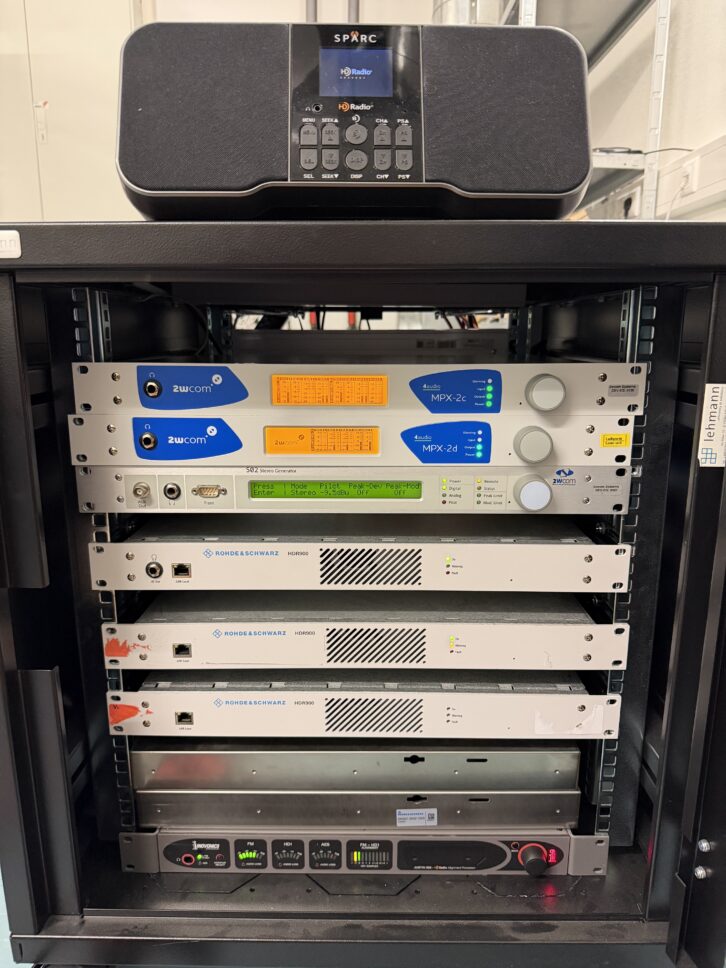
The hardware at the center of the test, 2wcom’s MPX-2c platform, is a two-channel MPX composite audio codec designed for use as an IP-based studio-to-transmitter link.
Cipriani explained that the architecture utilizes existing MPEG Transport Stream, or MPEG-TS, standards and Multi-Protocol Encapsulation, or MPE, to combine E2X and MPX packets into one data stream.
It drew interest from the GBS side.
“The wonderful thing about MPE is you can put anything in it,” Preece said.
With MPE, the HD Radio E2X packets receive the same transport protection mechanisms traditionally reserved for MPX, including RIST, SRT, dual streaming and forward error correction.
The hardware supports uncompressed MPX from 1.5 to 6.1 Mbps for maximum signal quality, as well as bandwidth-efficient compressed MPX such as MicroMPX, or uMPX, at around 320 kbps.
From a garage
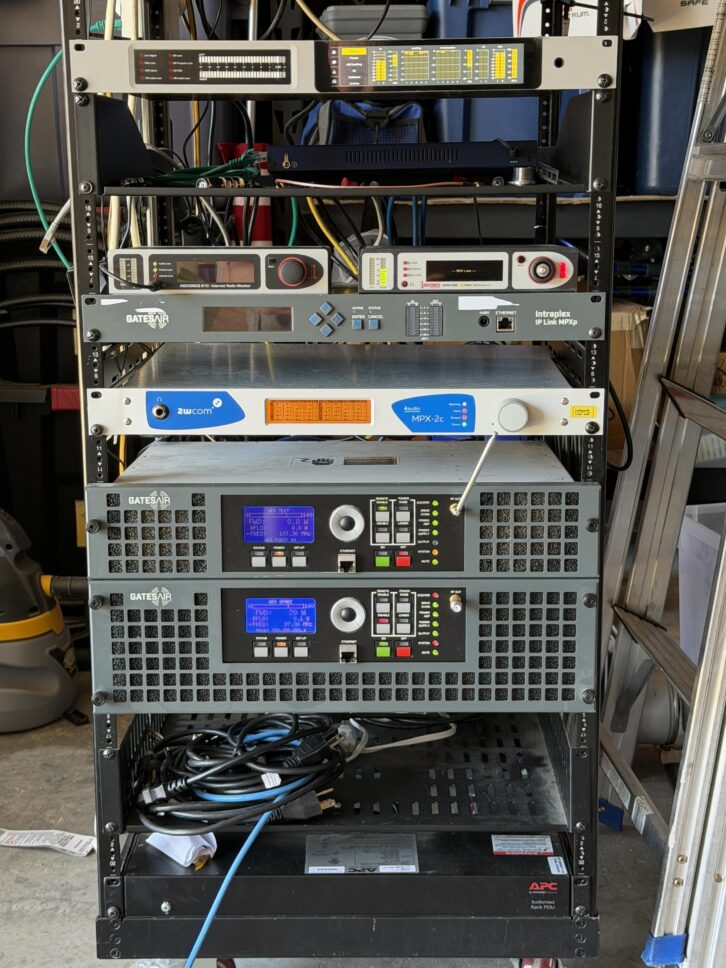
To put the stream into practice, the team established a 5,000-mile link from 2wcom’s headquarters in Germany to Preece’s home near Sacramento. The incoming stream fed two GatesAir transmitters acting as test booster nodes.
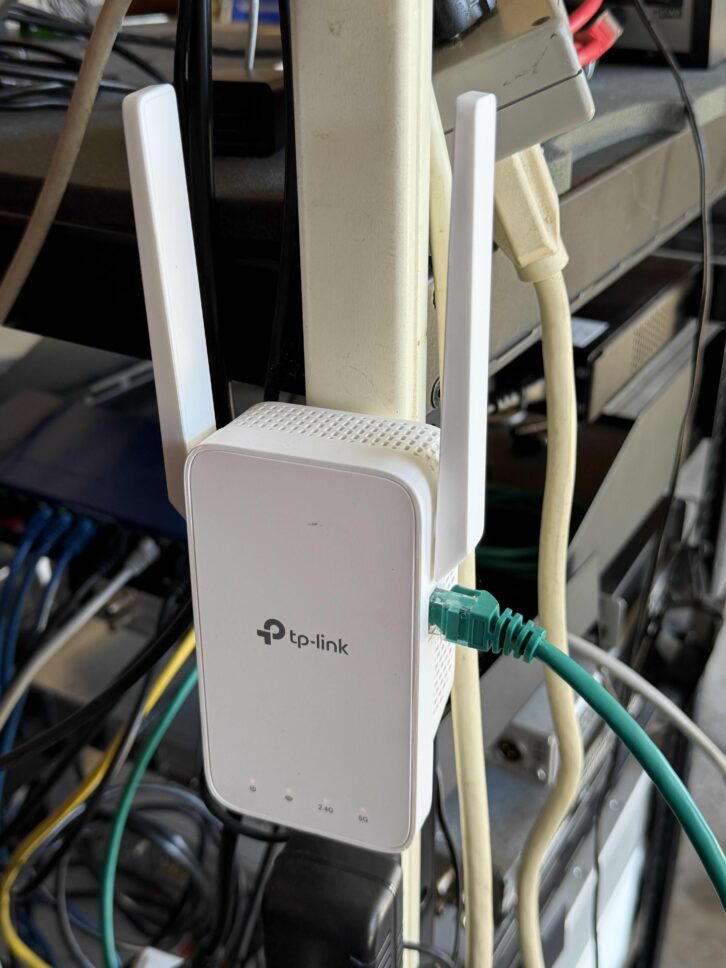
In an effort to simulate a poor, real-world connectivity situation, Preece connected the hardware using a standard consumer Wi-Fi-to-Ethernet adapter located on the far side of his house.
Over the course of several days, the connection logged approximately 28,000 dropped packets, but the RIST implementation recovered almost all of them. Only about 20 packets were completely lost over the transatlantic trip.
“Putting it all in an MPE stream makes it quite stable,” Preece said.
While encapsulating analog and digital streams together is not unprecedented, Preece said that the locked time alignment is what makes this approach stand out. “What’s really neat about the 2wcom implementation is how they are married from the start,” he said.
Cipriani clarified that the 2wcom stream alignment is relative, focusing strictly on stable delivery. It does not actually know when the analog and HD Radio audio are supposed to hit the airwaves to match a master station clock.
However, when paired with an external absolute time-alignment device — such as an Inovonics Justin 808 — the system can account for level alignment, analog-to-digital blend times and phase reversal.
The beauty of the architecture, Cipriani said, is that the relative alignment is preserved across every booster node in a GBS network layout. In the past, an engineer would have to install a separate time-alignment monitor at every remote site because independent network paths fluctuate randomly.
“You only have to synchronize the time alignment of one transmitter and we keep it time-aligned to all of the others,” Cipriani said.
While the delivery method has been proven using GatesAir and Rohde & Schwarz transmitters, the team said that integration with other major manufacturing platforms remains a work in progress.
Because Nautel transmitters use their own internal methods for handling and matching delivered signals, the MPE architecture has not yet undergone live field testing on that platform.
2wcom said that validating the solution for Nautel configurations is actively on its development roadmap.
Data overhead
All hardware solutions come with technical trade-offs, and Cipriani was open about the realities of MPE encapsulation.
The process introduces a 10% to 40% bandwidth penalty depending on the size of the packets being stuffed into the transport stream.
The smaller the packets that are inserted into the MPE, the worse percentage-wise the bandwidth overhead will be, Cipriani said.
But stations can choose what kind of codec they wish to use for compression at different bit depths and sample rates.
Engineers can further mitigate this overhead by using bandwidth-saving compression tools like MicroMPX, he explained.
“Microseconds matter,” Preece said. “It is a very precise science, and when it works, the listeners have no idea. That’s the best part. They have no clue what’s happening around them, they just hear a consistently listenable signal.”
In part two, we’ll look at how this transport method transitions from the garage to real-world field trials across the concrete canyons of New York City.
[Do you receive the Radio World SmartBrief newsletter each weekday morning? We invite you to sign up here.]