Waaaaayyyyy back when dinosaurs ruled the earth, I began studying for my amateur radio Novice Class license. My preparation manual started a sample exam with the question: What is a diode?
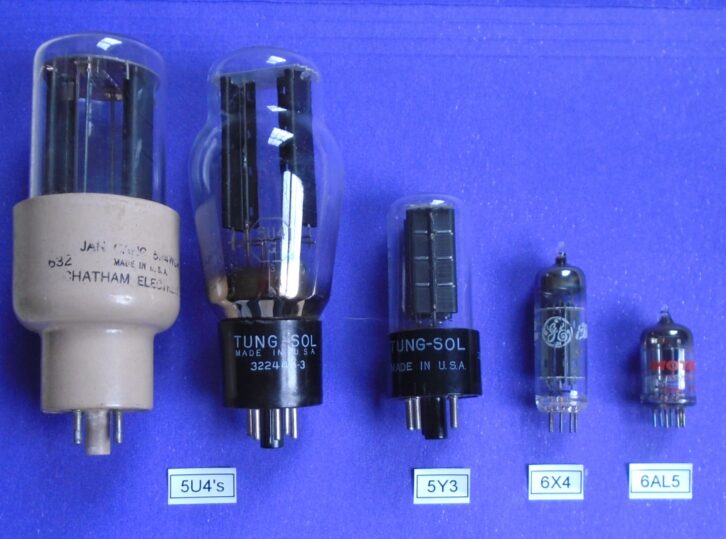
A diode, probably the fundamental base item of electronics, is a device that only conducts current in one polarity direction. BTW, I did get that question right on the test.
Hints of diodic action were noticed as early as 1873, but the first electronic appearance that counts was when Edison put a plate inside the glass envelope of one of his early lightbulb experiments (1880).
He noticed that current from the external wire connected to that plate flowed mainly in one direction. That thermionic emission discovery was refined into the Fleming Valve tube, leading to rectification, which enhanced early radio detection as well as solving the challenge of efficiently changing AC power to DC power.
Higher-power conversion needs were satisfied when mercury vapor was placed inside these early tubes. Soon dark transmitter rooms were illuminated with that mystical blueish refulgent radiance almost unique to broadcasting.
These tube diodes ran hot. They were not all that efficient, as they had notable IR (voltage) drop and, in the grand scheme, a short life.
No matter how useful they were, something better had to be out there.
Selenium was one of the first “solid-state” materials used as a tube substitute. But it is poisonous so the search for a safer solution continued.
On the road to the transistor, Bell Labs scientist Russell Ohl noted diodic action in a silicon junction, essentially leading to a recognition of the P-N junction, which is half of a transistor.
The diode, as we know it now, followed quickly, using germanium and silicon as the primary component of the junction.
These plain-jane diodes have two important survival criteria to be aware of: peak inverse voltage and power rating, the latter usually expressed as a maximum current.
Depending on the use, if we really want the diode to survive, we normally select a device that has at least twice the voltage and current ratings than are anticipated in the circuit.
Some readers will remember when the seminal germanium 1N34 appeared on our workbenches: a small-signal, very-low-power capable, glass-encased device with a low barrier voltage.
Barrier voltage is the fixed voltage drop introduced as the current flows through the diode, which for a germanium is about 0.3 volts. This diminutive value is useful to us as it permits very small signals to be detected and, in some applications, to protect what follows.
Many early transistor radio receivers had 1N34 type diodes protecting the input components, shunting high damaging signal voltages to ground.
Similarly, one of the earliest silicon diodes, the ubiquitous 1N4001, saw extensive use even with an elevated barrier voltage of 0.6 to 0.7 volts because of its relative higher power-handling capability.
As prices dropped, diodes found new and abundant applications in Boolean logic, controls, routing and switching such as video and telephone signals.
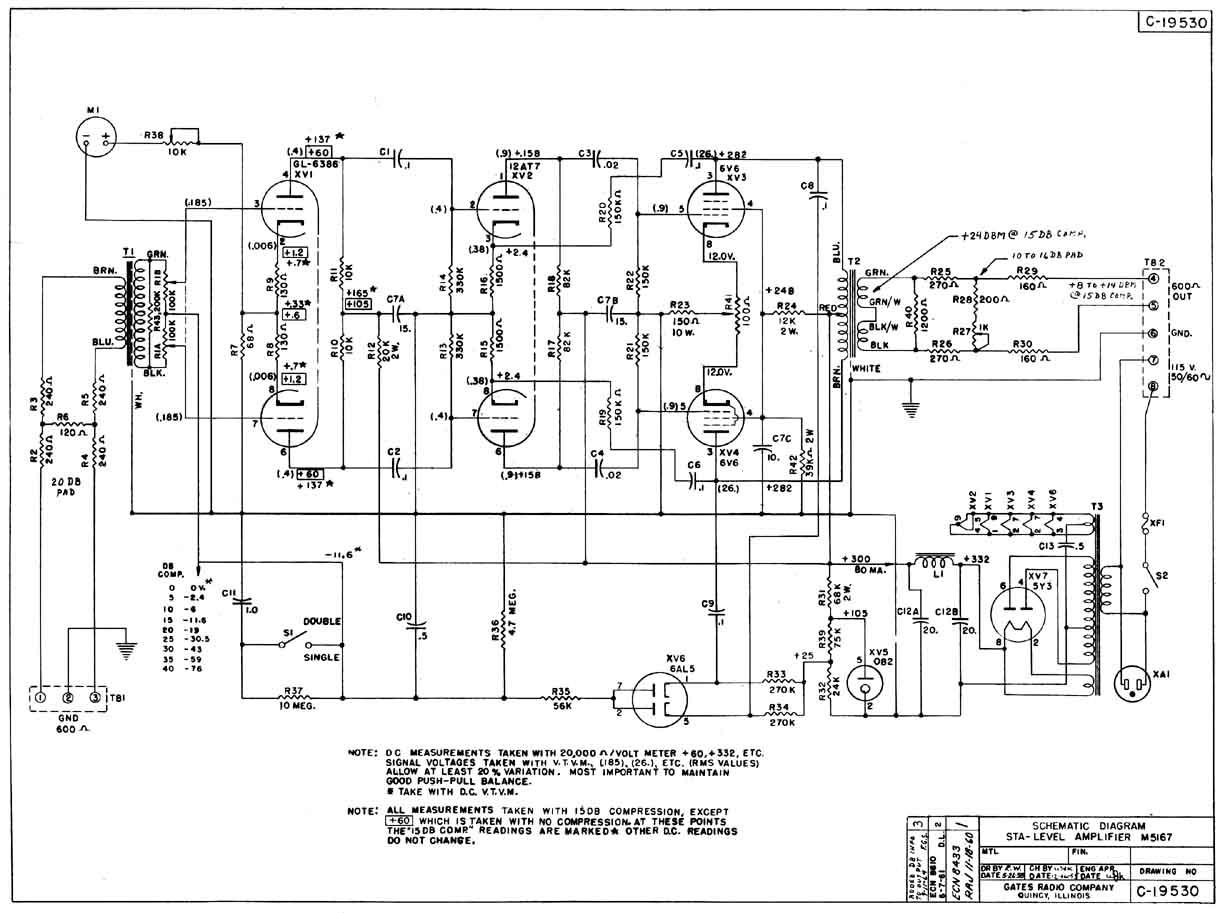
A unique application was to “dirty” the junction such that harmonic multiplication could occur. Look in your classic Marti STL-8 schematic and you’ll find a group of diodes multiplying 150 MHz to 950 MHz.
Fairly early on, diode researchers realized that this barrier voltage could be “stacked up” in increments to voltage regulate.
Series, say, four 1N4001s at 0.6 volts each and the drop would be 2.4 volts across the string.
Further refinement led to the Zener diode, with a long list of fixed voltage drops and power handling capability. Zeners today are available up to the hundreds of volts.
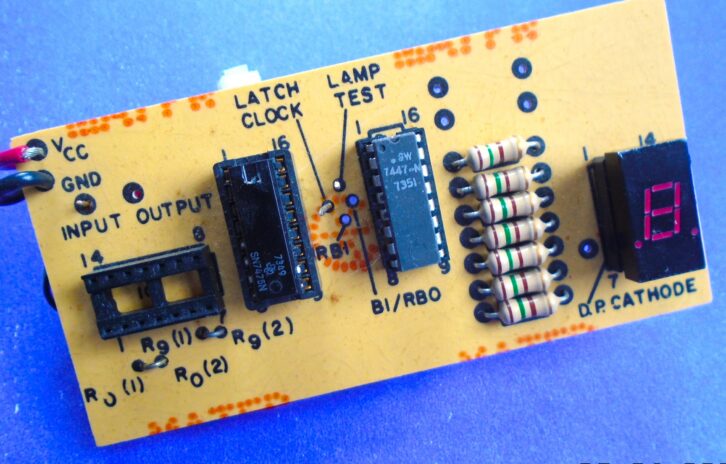
The legend is that Russians were the first to observe a visual light-emitting diode effect — by accident — during research work around 1920. Matters advanced from the legend to the real when a diode junction that made infrared light was accomplished by Texas Instruments in 1961; but the first workable visual LED (red) was by Nick Holonyak using gallium arsenide phosphide the next year.
Monsanto added to the color parade with yellow in 1978, and Japanese research contributed blue to the choices. As the color rainbow became complete, screen displays for TV and information presentation became a reality.
Where are we now? In 2026 diodes in various forms and applications are everywhere, working 24/7 to make our lives better or at least enhance our lives.
In front of me as I write, my new HP laptop is running MS Word with the text on a high-res diode display comprised of 1,000+ LEDs. Across the room in my office, an LED TV screen is displaying the nostalgia channel with Broderick Crawford driving the criminals to a big “10-4” arrest in his ’56 Buick. The red LED on my GE clock radio has just started signaling an alarm that reminds me of a scheduled conference call. Just beyond, the blue LED on my printer lets me know that the Wi-Fi link is operational. A diode is the heart of the AC-to-DC conversion in the battery charger for my cell phone.
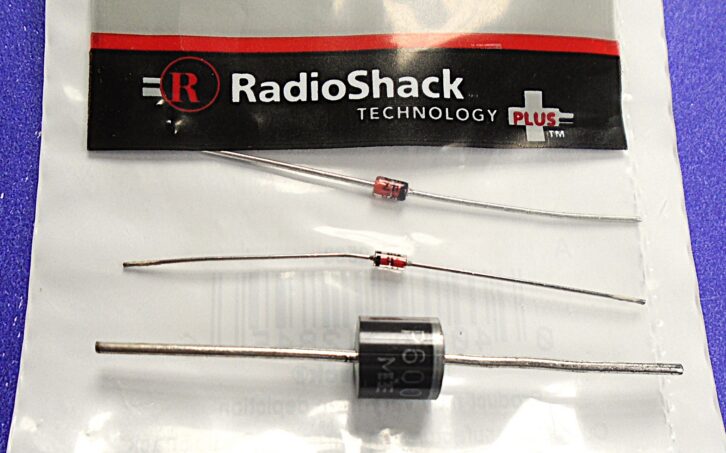
Out in the shop is a shelf accommodating a lifetime of diode collecting. I have panel LEDs in maybe 10 colors to segregate alarms and function indication. Zener diodes at all voltages and power handling levels are organized for selection. Regular pedestrian diodes? All types and values including maybe a dozen 1N914s left from the 100 that I bought for $7.50 from a surplus house closeout years ago.
That Novice license may have been valid for only one year, but in the intervening decades all these diode building block choices have served me and the industry well.
As I said, I never met a diode I didn’t like. What a tool.