The author is chairman of the DRM Consortium. Her commentaries appear regularly at radioworld.com.
The DRM Consortium members welcomed the Telecom Regulatory Authority of India’s recent recommendations on digital FM broadcasting.
Over the years TRAI has urged the government to issue a detailed policy framework for digital radio broadcasting in India. But the ministry wanted more evidence. Last fall, it passed the ball back into the TRAI’s court, asking that the regulatory authority come up with a recommendation for the digitization of the private FM sector, since the public broadcaster AIR was not part of the exercise.
In other words, TRAI was to recommend either the DRM global, open standard or the HD proprietary standard — mainly used in the U.S. — for digitizing private FM stations.
India, a vast country of 1.4 billion people, is broadcasting in mediumwave (MW, 526–1606 KHz), shortwave (SW, 6–22 MHz) and VHF-II (FM-band, 88–108 MHz) frequency bands. All India Radio (AIR) — the public service broadcaster — is the only broadcaster offering radio services in MW, SW and FM bands, effectively covering the whole of the sub-continent and almost 100% of the population.
AIR has already digitized 37 MW and two SW transmitters — which can potentially reach 900 million Indian listeners. Another four MW and two SW transmitters are ready for activation. Many on-air transmitters already operate in simulcast mode (that is analog and digital), with periods of pure digital transmission.
The public broadcaster, with its important FM radio network, has also conducted successful FM trials for the two digital radio contenders (DRM and HD/Xperi).
Indian private radio broadcasters are only transmitting in the FM frequency band (88-108 MHz) only and their coverage is limited to big metros and cities, with the third phase of allocating FM licenses to smaller places still unfinished.
Community radio stations are also broadcasting in the analog FM band. The FM sector is young in India (post-2000) and many popular, private broadcasters are often offshoots of big media houses. These stations mostly offer a mix of Bollywood and modern music, as well as discussions into social issues. They have an attractive presentation and are quite lucrative in the ad space. However, the high cost of the initial licenses and of the recurring annual fees to be paid to the government is a big issue for private broadcasters.
The prospect of investing in digital radio is not appealing to them, yet, (though it will enable more content, offering new revenue earning potential) unless the government offers financial concessions and incentives. In other words, digital yes, but not with our money.
Last year the technologically-neutral TRAI engaged in a serious and methodical consultation process of how to best digitize the private FM stations. This kicked off with a two-phase written submission process.
By the end of 2024, TRAI had received 43 comments and 13 counter comments which were discussed again in an open house-style meeting held in January 2025. The opinions on the advantages of each of the two radio standards were split, but DRM got the endorsement of seasoned technical experts and big Indian and international companies and organizations such as The Arab States Broadcasting Union (ASBU), HFCC, WorldDAB, RDS Forum, Free Stream Technologies, HT Media/Fever FM India, OptM India, Indian DX Club International, Inntot India, Ittiam Systems, Cambridge Consultants, CML Micro, Desay SV, Dolby, Elements Innovation UK, Fraunhofer IIS, RF2Digital, RFmondial and Starwaves.
Is DRM the Best Fit for India?
DRM, as the digital AM/FM successor, offers India a single, open and home-grown pathway to transform analog FM into a nationwide, efficient and affordable digital platform. DRM is also already in use in India and available in millions of cars — about 13 million by the end of 2025.
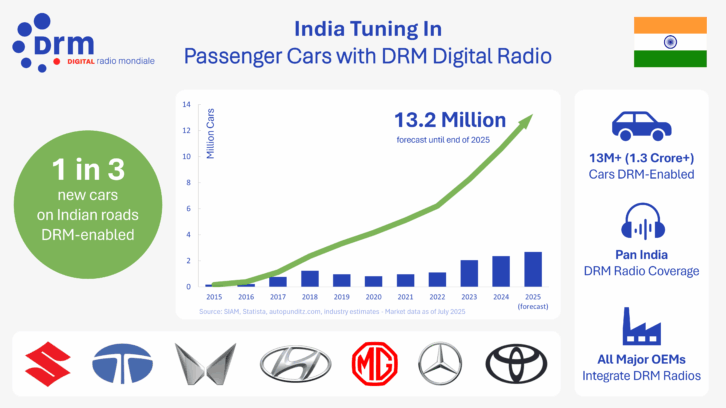
Without committing to one single digital option, TRAI clearly recommends a single standard (without naming it) for India. Of the two, DRM alone is already broadcast, received and manufactured in India.
[Related: “DRM Says It’s the Best Choice for Digital Radio in India”]
DRM also meets the other important TRAI requirement: simulcasting, to allow broadcasters to transition smoothly from analog to digital. DRM, as experienced in Indian trials, can deliver spectrum and energy advantages, as well as interference-free simulcasting options.
Importantly, DRM digital radio is scalable, both in terms of service offering and spectrum usage, as it utilizes unused spectrum or the white spaces between analog transmitters.
One DRM digital service offers up to four services (three audio and one multimedia service such as Journaline) on a single transmission frequency of 100kHz (one DRM block). In simulcast operation, DRM can deliver one analog and multiple digital audio and data services within 300 kHz of spectrum, offering high service density per channel.
The configuration can be scaled to include up to six DRM digital blocks, providing as many as 18 digital audio services and six data services within 800 kHz. The same infrastructure can support Single Frequency Networks (SFNs), allowing multiple transmitters to broadcast identical digital content over a single frequency — reducing interference and improving coverage. These configurations are unique to DRM and cannot be matched by other standards.
DRM is also the only digital radio standard that uses the most recent and efficient audio codec of the MPEG AAC family: xHE-AAC, supported natively by billions of mobile phones, tablets and PCs.
Therefore, with strong industry readiness and proven public-service integration, DRM is the only technology that satisfies both the letter and the spirit of the regulator’s roadmap.
[Related: “DRM Cites Receiver Growth in India”]
In the view of the Consortium, DRM fully meets TRAI’s recommendations and some of India’s specific requirements. For example, DRM technology allows the government to reach mobile phone users via broadcast for free and in crises, even when mobile networks are down, creating a reliable and resilient national disaster information system. It is the only standard that features Journaline text service for news distribution, educational and infotainment content and emergency warnings in all Indian languages.
DRM is made for India, as also expressed by Mr. Rajith Nair, the co-founder and CEO of Inntot Technologies, an award-winning Indian start-up company. Inntot is delivering solutions for more than one digital radio standard. Currently it is powering DRM SDR modules in about 1.8 million Indian cars. Mr. Nair said DRM is “India’s natural choice for the transition to digital radio broadcasting because it is open and sovereign — ensuring long-term independence and transparency. It is efficient and scalable, inclusive and accessible, proven and ready, as already deployed by All India Radio and supported by Indian industry.”
One great advantage is that DRM is an open technology without gatekeepers, delivering the lowest possible manufacturing cost with all IP royalties being low and published. And there is no dependence on commercial interests of a single company.
DRM is solid and unaffected, like other companies (Xperi) that, when confronted with a 16% drop in its quarterly revenue, has to make redundant 15% of its workforce. The importance of the indigenous investment and development of DRM solutions in India itself cannot be underestimated as this is aligned with the national policy expressed by the Indian Prime Minister of advancing the “Make in India 2.0” and “Digital India” efforts.
[Related: “Xperi Hopes to Monetize DTS AutoStage Data Soon”]
What next?
The Ministry is still considering the TRAI’s full recommendation. No new step has been announced so far. Those with a crystal ball might see several options. The Ministry either comes out with a decision soon, asks for more and wider consultations involving even private broadcasters or, worst of all, lets the market decide.
Why is that the worst? It’s because radio digitization has never been decided by any market anywhere in the world. The experts’ view is that such a step would delay the whole process, confuse and inhibit the market, invalidate a lot of investments made (especially those many millions of dollars invested by the car industry), demotivate listeners and undermine broadcasters and the Indians who have the DRM know-how and work towards its implementation.
The not-for-profit DRM Consortium remains confident in the process, and believes that the DRM standard is the best, most comprehensive solution for India, and that it will be recognized as such.
Adopting DRM as India’s single digital radio standard ensures a unified, secure and future-proof national broadcasting ecosystem, upholding India’s vision of a digitally-empowered, self-reliant nation.
[Also by this author: “China Goes for Digital Radio DRM“]
We have also published a commentary from the Xperi, advocating for the HD Radio digital radio standard in India. Read Xperi’s commentary here.