The author is chairman of the DRM Consortium. Her commentaries appear regularly at radioworld.com.
There is a very important digital radio story coming out of a country with a vast and complex media environment. China is one of the largest media markets in the world and it is quite tightly controlled and regulated.
While digital platforms are very popular with the Chinese, radio retains a unique and strong position. China National Radio, the nation’s official radio station, has eight channels, and broadcasts for a total of almost 200 hours per day via satellite. Every province, autonomous region and municipality has local broadcasting stations.
And at the end of July, China adopted as a national standard for radio the Digital Radio Mondiale digital broadcasting system in the medium and shortwave bands, as Radio World reported.
The national “Chinese DRM Standard in MF and HF Band” was published on July 29 and the official document covering both MF and HF refers to ETSI ES 201 980 Digital Radio Mondiale specification.
Why did China choose DRM?

Over the years research and testing were conducted on DRM, DAB, HD Radio and the FM digital audio broadcasting CDR system, independently developed by China. The decisive argument in favor of DRM appears to have been its capabilities in both the shortwave and mediumwave bands — unlike DAB or HD Radio.
The open-source DRM does not require any fee payment, also unlike HD Radio’s licensing fees.
Radio broadcasting holds great significance in China, with one of the longest history and tradition of being on air, as well as many professionals in the industry.
But the digitalization of radio has also become an urgent necessity.
Radio is also very important for reaching decision-makers and affluent individuals, as the car radio is very often their most useful commuter companion.
The medium is used for listening to high-quality music programs, receiving well-timed traffic announcements and staying up to date with the latest domestic and international news. For commuting professionals, news and finance programs are essential listening.
[Related: “DRM Consortium Reveals Band III Transmitter, In-Car Receiver”]
Radio also plays a key role in disseminating important safety messages and news updates during emergencies, such as earthquakes, providing real-time information to listeners when it matters the most. It is here that the DRM Emergency Warning Functionality also tipped the balance in favor of DRM.
The strategic goal of the Chinese in digitizing with DRM is enhancing AM radio with digital quality, which would provide emergency broadcasting, building an SFN network for domestic coverage. DRM is also seen as supporting the overall modernization of China’s broadcast infrastructure.
DRM receivers in Chinese autos
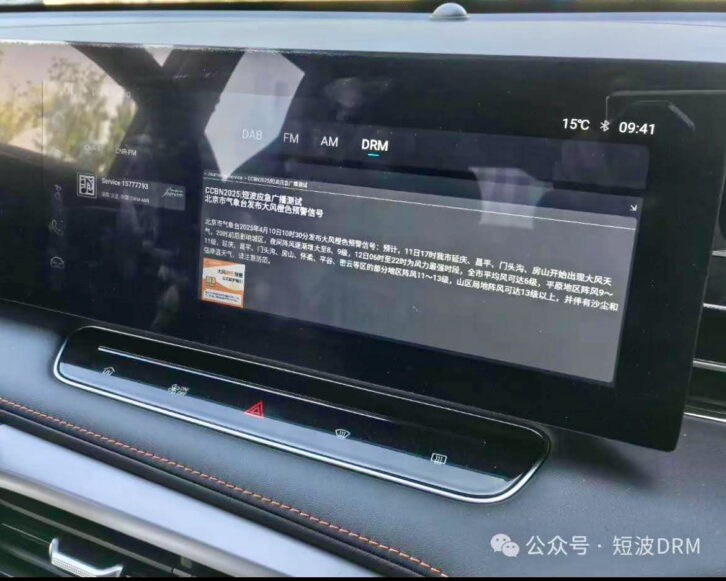
As China has around 30 domestic car manufacturers, a policy mandating DRM AM in cars was considered right from the start of the digitization process. And work started early on the National Mandatory Standard, “In-Vehicle Wireless Reception System”. In 2023, its National Radio and Television Administration issued a notice to “actively promote the installation of wireless broadcast receiving modules in all on-board terminal equipment of domestic and imported vehicles produced and sold domestically.”
Immediately, an increase in activity was observed on the ground. One year later, three ministries held a meeting in Beijing to promote the implementation of in-vehicle wireless reception modules as a basic function. A year ago, the consultation on the mandatory national standard of in-car digital reception was completed and received positive feedback from various related sectors.
This year the Standardization Administration of China officially approved the standard project plan, and the draft policy is almost finalized.
New vehicles in China are expected to support radio reception requirements. Some automakers are already adding DRM modules.
Market potential
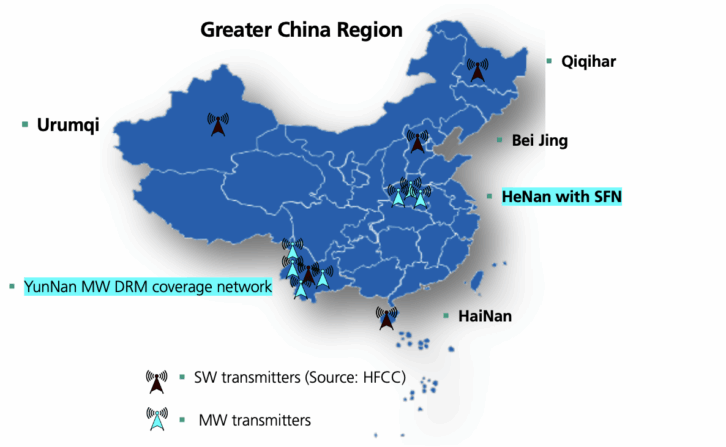
According to official Chinese data, there are approximately 2500 MW transmitters and more than 300 SW transmitters.
Its ambition is to digitally upgrade 600 transmission sites across the country, some with DRM, known to deliver excellent coverage. This will be reducing the number of low power transmitters as well. The budget allocated for this vast operation was approximately 5 billion in 2024.
The DRM upgrades include introducing SFN and Alternative Frequencies Service, as well as several different multimedia offerings, including Journaline and station logos. But EWF, a key reason for adopting the DRM global standard in China, will play a primary role. Emergency broadcast specifications for medium and shortwave DRM are under development now.
Fraunhofer IIS assisted some China broadcasters in deploying and upgrading the DRM head-ends and transmission chain, such as in the Henan and Yunnan Provinces.
With DRM mapped out in China and adopted by India, Indonesia, Pakistan and other Asian and African countries, the global DRM digital radio standard is coming of age as the primary digital terrestrial broadcasting solution for the Asia-Pacific region and for approximately 40% of the world’s population.
[Related: “When It Comes to International Security, Digital Radio Is Worth the Cost”]