Engineer Friend Weller has been busy in retirement with the LPFM he operates, KVWJ(LP), licensed to Alumni Records Inc.
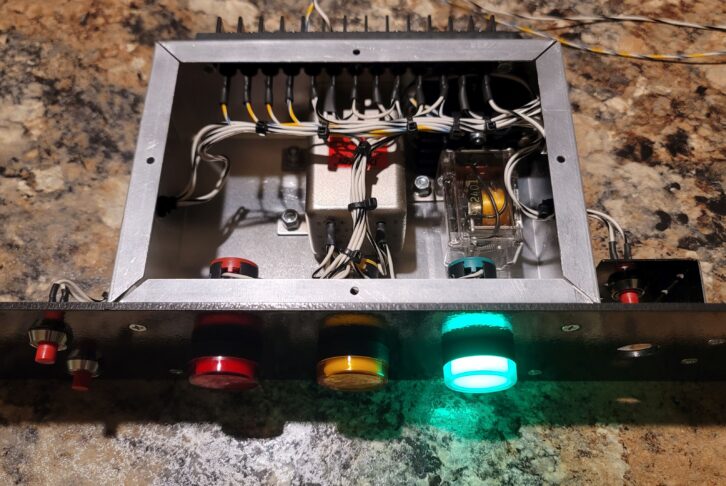
To help with maintenance at its transmission facility, Friend recently built a transmitter transfer-switch controller for less than $25 using mostly spare and salvaged parts.
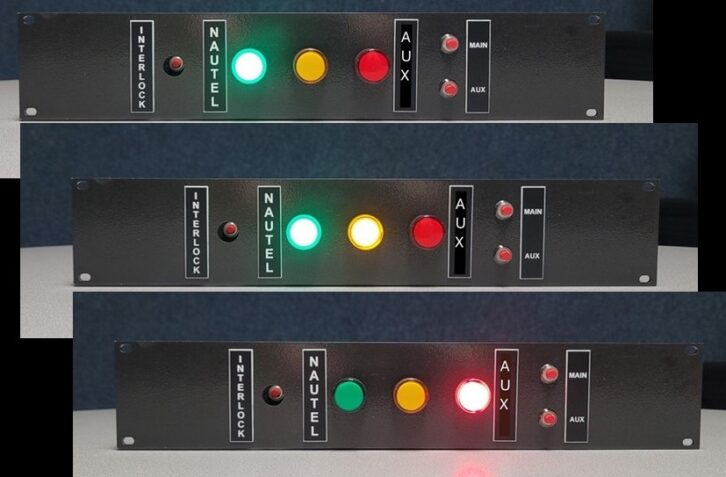
The front panel has three high-visibility LED indicators and pushbutton switches. The components inside include a four-port coax switch and a 3PDT relay.
The recessed front-panel interlock switch interrupts the fail-safes on the transmitters prior to switching. It also activates the yellow LED to give a visual indication that the interlocks have been opened, preventing hot switching. Only at that point can the transmitters be switched between the antenna and the dummy load.
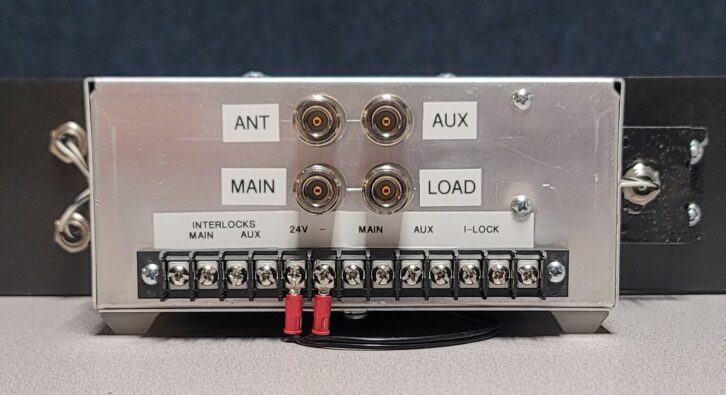
The rear terminals interconnect to the remote-control system as well to the fail-safe terminals on each of the transmitters.

See the accompanying schematic, which you can download here.
No rocket science here, Friend says — this is a project that demonstrates careful chassis planning and a lot of good, old-fashioned point-to-point wiring, all with an eye towards the credo of the radio broadcast engineer: If you can’t afford it, build it!
Perhaps this project will inspire other grassroots engineering efforts at stations with limited budgets. Share yours with us.
Gary’s streaming advice
When was the last time you consumed your station like a “regular person” would?
Broadcast radio consultant Gary Berkowitz asked that in his newsletter recently. Gary recommends that you pull your station up on your car dashboard and look at it. Forget the audio and the programming for a moment, just look at what your listeners are seeing.
Is it a blank album art square? Maybe a frozen “Now Playing” field? Worst of all, an internal placeholder from your traffic system that was never meant to be seen by listeners?
The visual presence of your station as viewed on dashboards, watches and smartphones will make an impression on listeners. Is it a good one?
Radio World readers have heard this gospel before in our coverage of reports from companies like Quu, Jacobs Media, Xperi and the NAB.
But Gary points out in radio, it’s still common to obsess about the audio but not pay attention to the visual output of stations and their streams.
Gary offers three things you can do this week:
- Kill the placeholders. Look at what your “Now Playing” field actually says during a stopset. Listeners should see a clean, formatted display.
- Get the art right. Every song should trigger a clean, high-resolution album art push. Blank squares or pixelated thumbnails tell listeners you don’t care.
- Gary reemphasizes: Go look at your presence on a car dashboard. Pull up your station on Android Auto or Apple CarPlay or today’s integrated infotainment systems to verify that the art is clean and the text readable.
To visit Gary’s website, click here.
Also, Quu has released its third annual report showing how radio station metadata displays in the 100 top-selling vehicles in the United States. Its dashboard photos reinforce just how crucial your visual presence is in 2026.
I love YouTube
The next time you find yourself with a plastic part in which threads have been stripped, don’t throw it away.
Visit YouTube to watch a helpful hint posted by a user called SkRolla, who points out that you can replace the factory-threaded bushing with a few turns of wire wrapped around a screw. You then heat the wire and press the screw into the plastic until all the wire is inside. After it cools you remove the screw, and the threads have been restored.
Watch the clip online, or at YouTube search “LexwMRlZmXQ.”
YouTube is rich with tips and hacks. Share your favorites with us.
Another resistor mnemonic
Jimmy Poole is a field engineer for K-Love, working in Arkansas, Oklahoma and Missouri. The first resistor color code mnemonic he learned was “Bad Beer Rots Our Young Guts But Vodka Goes Well.” It may have come from the Radio Shack electronics book for beginners he had as a teenager, or possibly a Forrest M. Mims book.
Our Paul McLane discovered a Wikipedia page that provides at least 60 more mnemonics, not to mention the outdated and inappropriate ones discussed earlier.
Just a few examples:
- Beach Bums Rarely Offer You Gatorade But Very Good Water
- Better Buy Resistors Or Your Grid Bias Voltages Go West
- Badly Burnt Resistors On Your Ground Bus Void General Warranty
(Does anyone remember “ELI the ICE Man”?)
Workbench submissions qualify for SBE recertification credit. Email [email protected].