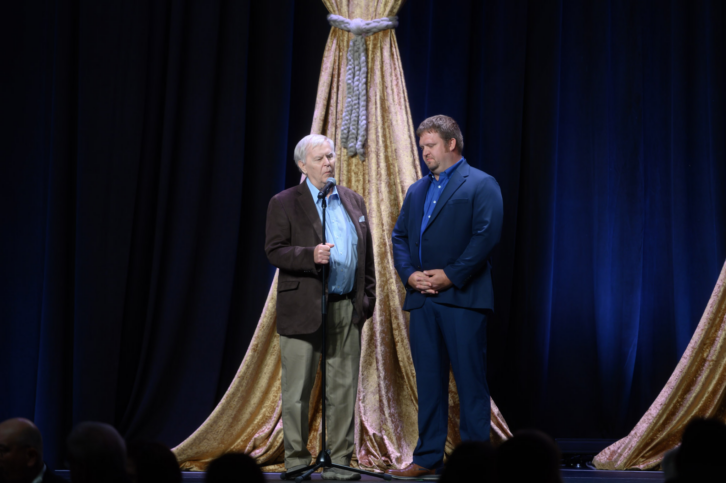
In September, Frank and Dave Hertel, principals of Hertel Engineering and frequent contributors to Workbench, were honored by the Kentucky Broadcasters Association with its Clarance Henson Technology Award.
Though based in Indiana, they’ve served a number of stations in the Bluegrass State over the years.
“Frank and Dave are not only well deserving of this honor but are also a great story of broadcast engineering legacy,” Chris Winkle, president/CEO of the KBA, told Radio World’s Nick Langan.
Frank, 81, earned his FCC license when he was 18 and specialized in electronics while serving in the Indiana National Guard. He continues to build and service radio and TV stations, performing bench service and field measurements while Dave does most of the field work.
Dave started going on service calls with his dad when he was five years old. His portfolio includes engineering for 100 kW Class C1 98.9 WSIP(FM) in Paintsville, Ky.
Serious fun
We featured Mr. Potato Head in the last issue, and now Play-Doh!
No, it’s not a second childhood for Workbench. Turns out that the fun stuff we played with as children has another useful quality: It traps dirt.
Tom McNew, executive director for Armor of God Catholic Radio, writes to tell us that Play-Doh brand modeling compound is great for getting schmutz out of crevices and spaces where fingers or rags can’t reach. In fact, so is Slime, the squishy, oozy non-toxic compound introduced by Mattel in 1976.
Where might you use this tip? I’m thinking of dirt magnets like console on/off switches, but Tom also uses Play-Doh in his truck to slurp up crumbs, dirt and dust. Silly Putty would probably work too.
Got unconventional cleaning ideas of your own? Share them with me at [email protected].
(Slime is a registered trademark owned by Paramount Global. Silly Putty belongs to Crayola, and Potato Head and Play-Doh are trademarks of Hasbro. Did you know that the scent of Play-Doh also is recognized by the U.S. Patent and Trademark Office as a registered trademark of the brand?)
Soldering reminder
Radio World’s daily morning SmartBrief newsletter recently reshared Karl Zuk’s 2024 article providing soldering tips for beginners.
Contributor Dan Slentz writes that when he teaches students how to solder, he tells them, “At some point you will drop the soldering pencil. Let it fall to the ground, don’t try to catch it!”
It’s human nature to grab what we drop in the moment, so train your brain by thinking about it ahead of time. Then with luck the brain will be prepared to react in time to stop your hand from making an unfortunate grab and getting singed.
(Do you receive the Radio World SmartBrief email each weekday morning? Here’s the link.)
No names, please
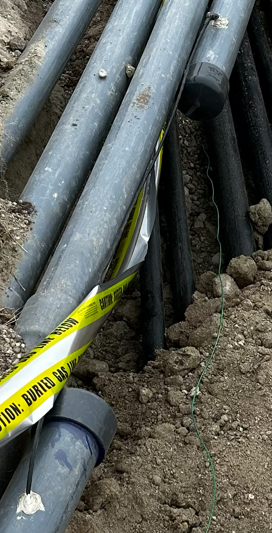
No identification is necessary, to protect the innocent, as they say.
While working on a system, a piece of conduit was damaged by a backhoe. The damaged piece was cut out, the conduit ends were capped, and the splicing wire was fed out of and back into holes that were drilled in the top of the surviving conduit and then caulked.
You can see these holes and the wire at the top and bottom of the accompanying photo.
Copper theft
Contributors Paul Sagi and Harold Hallikainen were discussing copper theft recently.
Harold related an instance during the construction of a three-tower AM in Morro Bay, Calif. Wooden reels of copper radial wire sat in the field, waiting to be taken out and plowed under. A couple of guys drove a station wagon onto the field, sticking the reels in the rear of the car.
Imagine their surprise when the weight caused the car to sink into the marshy ground! As they tried to get out, a sheriff drove by and arrested them. Bwomp-womp!
And Paul reports from Malaysia that several people were fried when they tried to remove the neutral (ground) conductor, thinking it would be safe. But this was the neutral bus at a substation. At the time, Malaysian houses were fed 415V not 240V.
Not just copper
Radio World recently featured a story by Kevin Curran about the retirement of the Electro-Voice 635A microphone.
Buc Fitch, P.E., recalls that two of his 635As were stolen off their stands when he was a neophyte engineer.
These days, Buc shrink wraps the output end of the mic where it feeds the connectorized cable. Applying two layers of heatshrink makes it very hard for someone to remove the mic from the cable without a knife or razor blade. The barrel of the 635A made it one of the easiest to secure, and no more theft.
Buc poses an interesting question to Workbench readers: What types of things are prone to theft at your studio facilities, and how have you resolved the issue? Drop your answer to me via email at [email protected].
One of the most obvious solutions is to lock the door of the production room or other unoccupied studio. This not only prevents theft but also keeps curious fingers off critical equipment.
A fun $15 gift
Reader Lawrence Cohen shares a sweet little radio that he bought for $15 from Amazon. If you’re looking for a small but solid gift, you can’t go wrong with this one. It’s the PRUNUS J-211 Portable AM/FM Radio.
In addition to USB-C charging, the radio is AA-battery powered and includes an LED flashlight, a back clip, lanyard and headphone jack.
Other Prunus models include weather radios, rechargeables, hand-crank models, Bluetooth and retro tabletop designs. Its website is www.prunustech.com. Prunus is based in China but according to its website, its chips are made in the United States.

Workbench submissions are encouraged and qualify for SBE recertification credit. Email [email protected].