Engineering consultant Frank Hertel outlines a method of measuring an inductor’s value using only an oscilloscope and a signal or function generator.
In his work Frank does repairs and also fabricates “one-of-a-kind” RF and audio devices. For tasks like winding custom inductors, he often must measure and verify these values.
Unfortunately, it seems there are no professional LCR meters that can measure inductor values in microhenries. This method provides an answer. The math is not complex; anyone with some engineering knowledge can manage it.
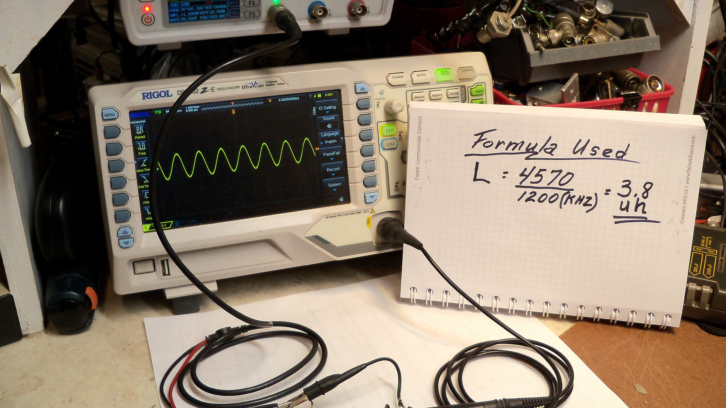
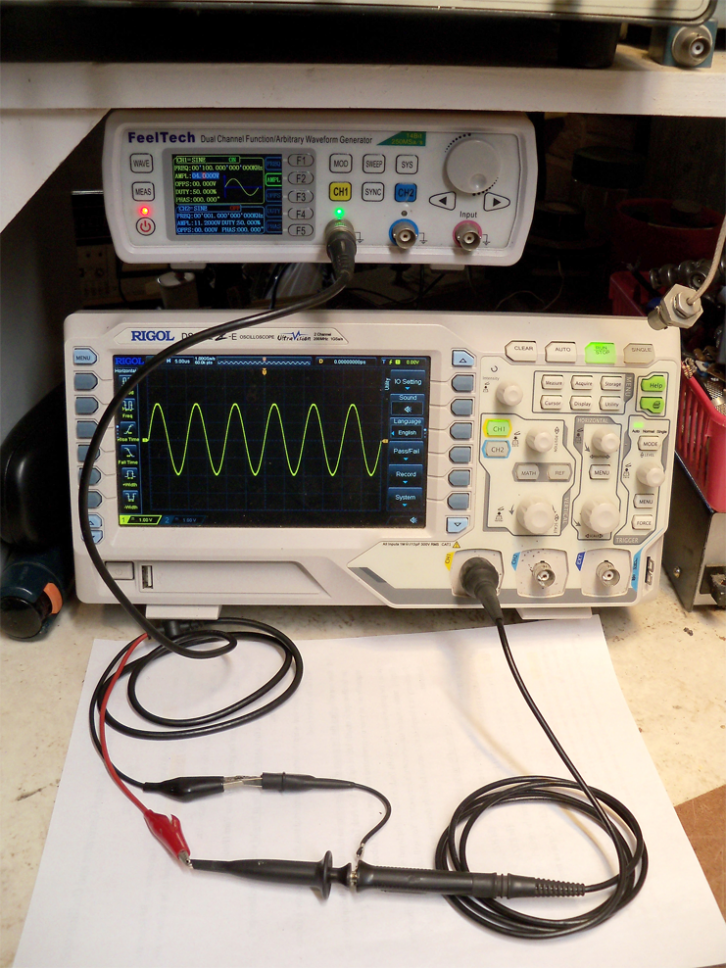
Fig. 1 shows the equipment layout. To begin, determine that the generator output impedance is truly 50 ohms. Set the generator frequency to 100 kHz, 4 volts peak-to-peak output. The setup assumes a 10x or “times ten” oscilloscope probe. Verify that a 1% 50-ohm resistor connected to the generator causes the level to fall to half the unterminated value.
Then connect the unknown inductor. Adjust the generator frequency to yield one half of the level of the unterminated level. You can expect that when the inductor is connected, the oscilloscope display will fall to a lower level.
Now adjust the frequency of the generator so that the signal displayed on the oscilloscope is exactly half of the 4 volt peak-to-peak signal that you originally set as your terminated reference voltage.
When the level of 2 volts peak-to-peak displays on the oscilloscope screen, make a note of the generator’s frequency.
Plug this frequency value into one of these math formulas (depending on whether you are calculating using Henries or microHenries):
Value in Henries:
L = 4.570 / Frequency (in Hz)
Value in microHenries:
L = 4570 / Frequency (in kHz)
If you have solved for microHenries but want the result in milliHenries, move the decimal point three steps to the left, adding zeroes as needed. For example 1.0 microHenry is equivalent to .001 milliHenries.
As mentioned, it’s important to note that the two constants used in the formulas only work with a generator that is known to have a 50-ohm output impedance.
Frank and his son Dave were honored recently with the Kentucky Broadcaster Association Clarance E. Henson Technology Award. Tips like this are an example of their good work.
More Play-Doh history
Archie Simpson commented on our discussion of Play-Doh (here, under “Serious Fun”) and how some people have discovered that it works as a cleaning compound.
What seems like a life hack actually is a return to the toy’s roots. According to multiple accounts, the substance that would become Play-Doh was first designed to remove soot that accumulated on expensive wallpaper near fireplaces.
According to an article in Smithsonian magazine, Kutol Products became the largest wallpaper cleaner manufacturer in the world in the early 20th century. “Fortunes began to change in the 1950s, though. With the transition from heating with dirtier coal to cleaner oil, gas and electricity, sooty buildup on wallpaper was no longer an issue in many households,” it wrote.
The magazine reported that Joseph McVicker was trying to turn Kutol around when his sister-in-law Kay Zufall, a nursery school teacher, read an article about how wallpaper cleaner could be used for modeling projects. She tested the material with children, who loved it, and she suggested its new name. As they used to say in baseball, “You could look it up.”
Archie also reminded me of the mnemonics that many of us learned early in our careers to remember certain technical concepts in the days before smartphones.
We’ve talked before about the very problematic “Bad Boys Rape Our Young Girls But Violet Goes Willingly,” a resistor color rhyme in which each first letter stands for a color. In some versions “rape” becomes “ravage.”
(According to Wikipedia, a short documentary released in 2022 titled “Violet Gave Willingly” centers on the misogyny that a woman encountered while studying electrical engineering in the 1970s.)
But how about “ELI the ICE man,” to remember the phase relationship between voltage and current in AC circuits? Do others come to mind? Email me at [email protected].
Conductive adhesive
IT Specialist Stephen Poole at Crawford Broadcasting has discovered a copper tape from a brand called Eterart.
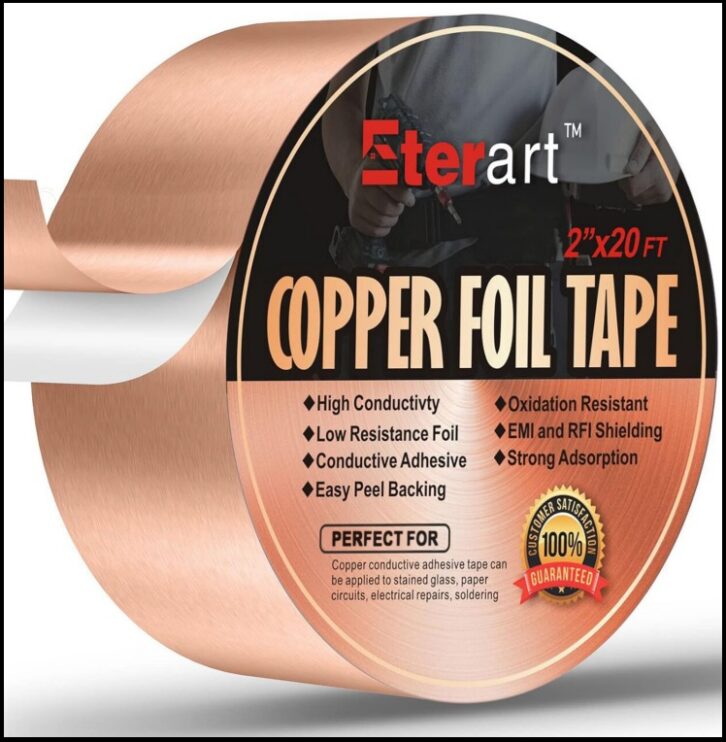
Although there are plenty of copper foil and copper tape brands, what caught Stephen’s eye is that the copper tape consisted of conductive adhesive.
Just overlapping the tape run ends ensures a good ground throughout. Stephen didn’t have a milli-ohm meter, so he can’t tell just how well the ground transits through the adhesive glue; but an ordinary multimeter shows 0 ohms from the copper on the right — the pickup switch cavity in his Les Paul — all the way to the output jack.
So there is such a thing as “conductive adhesive.”
Stephen paid less than $20 for a roll of 20 feet on Amazon.
Workbench submissions are encouraged and qualify for SBE recertification credit. Email [email protected].