This story is from the ebook “Global Radio Update.”
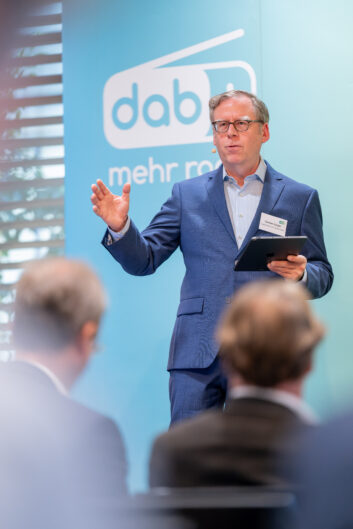
Germany’s transition to digital radio DAB+ is no longer simply a matter of improved sound quality or a broader choice of stations. It is increasingly becoming a test of how radio can remain universal, resilient and relevant in an era shaped by mobile networks, streaming platforms and hybrid media habits.
At the center of this development is Digitalradio Büro Deutschland, part of the Digital Radio Germany Association. The organization coordinates communication around DAB+ within a broad alliance of public broadcasters, commercial radio operators, receiver manufacturers and network providers.
Growing national and regional reach
The latest audience figures point to continued momentum for DAB+ in Germany. According to the ma 2026 Audio I report, digital terrestrial radio is extending its reach, with DAB+ now used by 34.5 percent of listeners in the widest listener circle, up from 32.9 percent in the previous survey.
The platform is particularly strong among 30- to 59-year-olds, where usage has risen to 41.7 percent.
Growth is also visible at the program level. Youth radio Deutschlandfunk Nova, distributed nationally via digital radio, has reached a new high of 225,000 listeners from Monday to Friday, an increase of around 19 percent on its previous best.
A digital proving ground
One of the most significant regional developments is taking place in Schleswig-Holstein, Germany’s northernmost federal state.
Under the campaign #SHhoertdigital, the state has begun a structured move away from costly parallel FM and DAB+ distribution. The aim is to end simulcast by 2031 and shift fully to DAB+ and IP reception.
This process brings together broadcasters, the state government, network operators and the media authority. The approach is seen as a national reference point for radio digitization.
The transition is already well underway. The station “Radio BOB! rockt Schleswig-Holstein” switched off 18 FM frequencies in April of 2025. At the same time, public broadcaster NDR ended analog distribution of N-JOY at Niebüll. Deutschlandfunk and Deutschlandfunk Kultur followed in June of 2025, switching off 16 transmission facilities across 12 sites. Klassik Radio ended analog broadcasting in the state in August, while delta radio closed 10 FM frequencies in November.
Early audience figures from 2026 suggest that the shift has not caused the loss of reach feared by some skeptics. Deutschlandfunk increased its widest listener base in Schleswig-Holstein by 8.7 percent to 436,000 people, while Deutschlandfunk Kultur rose by 3.2 percent to 191,000. Radio BOB! remained broadly stable in its four-week reach and it improved its average weekday hourly reach by 18.5 percent after moving fully to DAB+ and internet distribution.
From warning to active safety
A further development is giving DAB+ a new civic function.
Automatic Safety Alert, known as ASA, is designed to turn compatible DAB+ radios into emergency receivers when public warnings matter most.
In the event of a high-priority warning, compatible radios can wake automatically from standby, switch to the relevant alert and deliver the message even if mobile networks or internet connections are disrupted.
The system can also target affected regions precisely, rather than alarming an entire broadcast area, and can carry additional text and image information alongside the audio message.
This represents a significant step in the role of radio. Broadcasting has long been one of Germany’s trusted warning channels, but it has traditionally depended on listeners already having their receivers switched on.
ASA changes that. Building on the DAB+ Emergency Warning System, ASA turns radio from a passive warning medium into an active element of safety infrastructure.
The need for such a system was underlined by deadly floods on the Ahr, Erft and Wupper Rivers in 2021. In some areas, mobile networks and official digital communications failed, while elevated broadcast transmission sites proved less vulnerable.
The lesson was clear: Radio infrastructure can remain available in a crisis, but conventional receivers can only warn people who are already listening. ASA is intended to close that gap.
The system is already being tested in Germany. It was successfully trialed on the national warning days in 2024 and 2025, with Deutschlandfunk being the first broadcaster to plan regular operation from the 2026 warning day in September by installing a separate alert channel on its national multiplex.
More than 35 ASA-capable receiver models are already available on the German market, while a protected ASA certification mark has been introduced to help consumers identify devices that meet the required standard.
The next phase of resilience
The decisive question is no longer only technical.
ASA requires compatible receivers, broadcaster coordination, emergency power for transmission sites, protected signal paths and clear rules governing who is authorized to trigger alerts.
Implementation will require investment. Public broadcasters can finance only part of the necessary resilience measures through the license fee, while commercial broadcasters depend on support from state media authorities.
The argument is that civil protection is a public task.
Radio still matters in a hybrid world
Germany’s DAB+ story is broader than a platform migration. It raises a larger question: Can radio modernize without losing the qualities that have made it indispensable: universality, simplicity, trust and reach?
Schleswig-Holstein shows that the digital switchover can begin without a collapse in audience reach. National figures show that digital listening continues to grow. Strong radio brands will make it easier for listeners to follow them into the digital world. And with ASA, DAB+ is taking on a wider public role: not only as a way to hear more radio, but as a means of ensuring that citizens can still be reached when other systems fail.
The German case also highlights the importance of hybrid delivery. Listeners increasingly move between broadcast, apps, smart speakers, smartphones and connected cars. Schleswig-Holstein’s transition explicitly allows stations to remain available via DAB+, online services and apps. Broadcasting continues to be important: It remains one-to-many, free at the point of use and independent of individual data connections.