
A new report reveals that the decline in time that Europeans spend listening to the radio each day — a trend that began 18 years ago — is continuing among both older and younger audiences.
The European Broadcasting Union has published its latest annual Radio Trends Report about consumption across Europe. The report uses national radio audience measurement data.
It aims in particular to give an overview of the evolution of radio consumption between 2020 and 2025, though some of the data go much farther back.
EBU found that average listening time stands at 2 hours 10 minutes as of 2025, down 15 minutes from five years ago and four minutes from 2024.
“The year-on-year decline was sharper than in previous years, marking a return to a downward trend after a period of relative stability,” it stated.
Among young demographics, listening time stood at 1 hour 10 minutes, down 13 minutes from five years ago and down 3 minutes from the previous year.
“As with the overall population, this year-on-year decrease is larger than the previous year’s, marking the end of a period of plateaued consumption.”
The EBU found that “the vast majority” of people are still reached by radio every week. Weekly reach stood at 81.3% in 2025, down 2.7 percentage points from five years ago and 1.2 points from 2024.
But weekly reach among youth stood at 70.9%, a 5.9 percentage point decline compared to five years ago.
“The year-on-year drop of 2.1 percentage points was more pronounced than in the total population, confirming a widening gap between youth and overall reach.”
Looking at longer trends, EBU said European citizens have lost an hour of radio listening since 2003.
“The decrease started in 2008, when the daily consumption was still around 3 hours. Since then, the curve follows a steady declining trend reaching its lowest point in 2025.”
Data tracked since 2015 allows EBU to compare the listening time across various age groups.
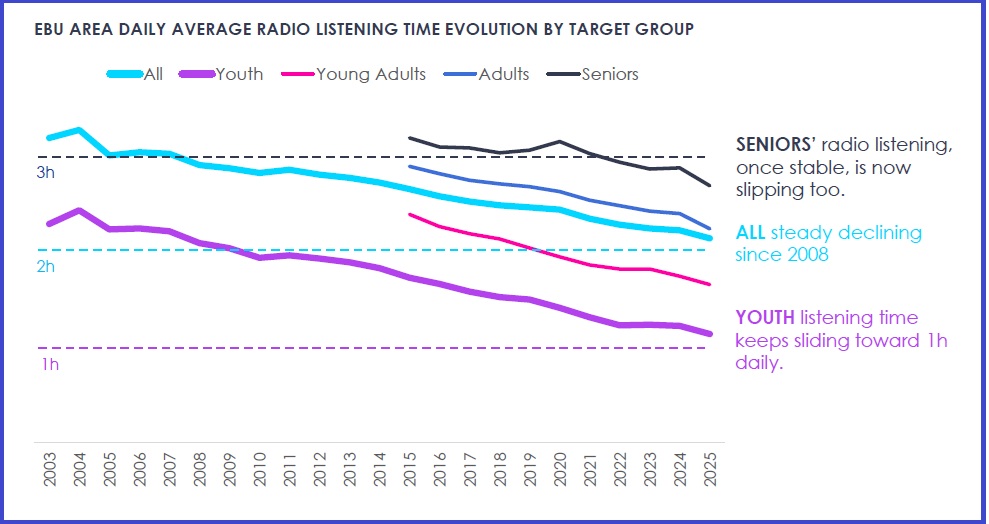
“Seniors (60+) whose listening had long been the most stable, have seen a decline in the past year. Their consumption held steady from 2015 to around 2020, but has since dropped,” EBU wrote.
“Between 2015 and 2025, seniors recorded a 16% decrease, still the most moderate among all groups.”
Adults (35–59) saw a 23% decline between 2015 and 2025, a trend close to that of the general population.
Youth (15–24) and young adults (25–34) recorded the steepest declines between 2015 and 2025, at 34% and 31% respectively.
“Since the early 2000s, daily listening time among youth has nearly halved.”
The EBU is an alliance of European public service media, with 113 member organizations in 56 countries and associates on other continents. The report also includes slides specifically about trends for listening to public service media.
You can access the public version for free by creating an account here. The EBU also publishes partner reports for TV and digital media trends.