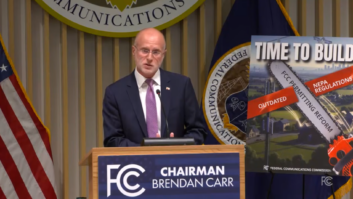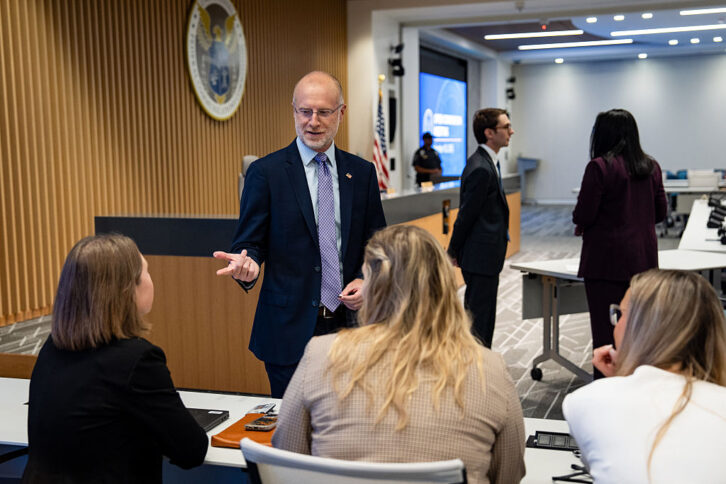
Saying that the FCC is “firing on all cylinders,” Chairman Brendan Carr has released the chairperson’s traditional summary of actions and accomplishments of the past 12 months.
“2025 was a historic year for the FCC and I am proud of all the wins we were able to achieve for the American people,” Carr said in a statement, thanking the FCC’s staff. “But this is just the beginning. The FCC is firing on all cylinders, and we will build on this momentum to deliver even more wins in 2026.”
Below are items from the announcement that are most relevant to Radio World readership; text is quoted directly, and links are from the original. A link to the full list is at the end:
Broadcast issues
The chairman headlined this section “Empowering Local Broadcasters.”
- “Approved Skydance’s acquisition of Paramount CBS. As specified in the FCC’s record, Skydance made written commitments to ensure that the new company’s programming embodies a diversity of viewpoints from across the political and ideological spectrum. Skydance also adopted measures that can root out the bias that has undermined trust in the national news media, and committed to enhancing local news and reporting.”
- “Sought public comment for the first time in more than 15 years on the relationship between the large, national programmers on the one hand and the many local broadcast television stations on the other.”
- “Opened the airwaves and unleashed new voices through grant of 84 construction permits for new noncommercial TV, FM, and low-power radio stations. Processed over 7,600 other broadcast licensing matters, including 887 license assignments and transfers, plus 714 license renewals.”
- “Approved the first new ownership combination of two full-power, top-four ranked, same-market television stations in over five years. Later approved another top-four television station ownership combination.”
- “Took action to support and accelerate the nation’s ongoing transition to Next Gen TV (also known as ATSC 3.0). This new technology represents the future of broadcasting and promises to modernize the nation’s free and local over-the-air television service, which serves as a vital source of local news and information for many Americans.”
- “Removed 98 broadcast rules and requirements that have been identified as obsolete, outdated or unnecessary, including rules dating back nearly 50 years ago for technologies that have been far surpassed in the media marketplace.”
- “Voted to remove 11 outdated and useless rule provisions, including obsolete regulations on telegraph, rabbit-ear broadcast receivers and telephone booths.”
- “Held broadcasters accountable to their public interest obligations and empowered them to serve the interests of local communities.”
Public Safety
- “Approved a proposal to allow prisons to jam contraband cellphones that have poured into prisons across the country and are being used to call in hits, coordinate violent gang activity and aid criminal enterprises.”
- “Fostered network resilience in the face of natural disasters. This included publishing Cross-Sector Best Practices for Hurricane Season as a result of meetings and roundtables with emergency management and public safety officials, telecom crews, broadcasters and other government representatives.”
- “Began the process of a ground-up re-examination of the national alert and warning systems, including the Emergency Alert System and Wireless Emergency Alerts.”
- “Moved forward with a proposal that would make the transition from legacy 911 to NG911 effective and reliable without creating new vulnerabilities in critical public safety networks.”
- “Proposed improvements to wireless 911 location accuracy rules, which reduce emergency response times and ultimately save lives by enabling 911 call centers and first responders to quickly identify the location of people who call 911 from wireless phones.”
Regulations and FCC Operations
- “Launched the most massive deregulatory initiative in FCC history, ‘In Re: Delete, Delete, Delete,’ which examines every rule, regulation or guidance document for unnecessary regulatory burdens.”
- “Eliminated or proposed elimination of 1,108 rules and regulations, 134,928 words and 312 pages of the Code of Federal Regulations in 2025.”
- “Ended the FCC’s promotion of DEI by (1) eliminating the FCC’s DEI advisory group and DEI task force, (2) rescinding the FCC’s equity action plan, (3) striking DEI from FCC strategic priorities as well as its annual budget and performance plans.”
- “Secured the commitment of three major U.S. wireless carriers, Verizon, T-Mobile and AT&T, to end DEI-related practices as specified in the FCC’s record and reaffirm their commitment to equal opportunity and nondiscrimination.”
- “Worked to close out inactive dockets and terminated a record 2,048 inactive proceedings, the largest number of dormant dockets ever terminated in a single proceeding.”
- “Cut more than $567 million in contract spending, between January and May 2025, generated more than $7.5 million in savings for the remainder of 2025, and produced more than $23.7 million in savings for 2026.”
- “Rescinded a costly, Biden-era regulatory overreach that could have increased the cost of internet service for Americans living in apartments by as much as 50 percent.”
- “Prevented California’s unlawful abuse of federal lifeline program, ensuring that states have safeguards in place to prevent abuse of the federal program and mechanisms that prevent federal dollars from flowing to ineligible people.”
- “Ended unlawful expansion of COVID spending program to fund school bus Wi-Fi and Wi-Fi Hotspots through E-Rate program.”
- “Led the FCC’s return to full-time in-person work, resulting in 92% of employees required to be back in the office.”
The chairman’s list also included sections about high-speed infrastructure, wireless, telecom works, the space economy, national security and consumer protection. You can read it in PDF form here.