Have you been taken aback by the amount of unusual propagation on the FM radio dial in the U.S. this summer?
Well, so has one LPFM operator in Georgia.
In fact, the station is petitioning the Federal Communications Commission to let it raise its transmitting power in response to all of the crazy FM propagation.
WFAG(LP) operates on 89.7 FM with 100 watts of ERP in Valdosta. “Supra 89.7” is licensed to the nonprofit Valdosta Alliance.
In a letter addressed to Chairman Brendan Carr, the alliance’s general manager, Paula Greer, said that the “serious, suspicious phenomenon of apparent ‘ducting’” or “illegal broadcasting” has been preventing the community project from maximizing its potential.
After it was granted a license in 2024, the alliance explained that it was forced to move from its original allotment at 103.7 FM due to interference from WRUF(FM) in Gainesville, Fla. and WULS(FM) in Douglas, Ga., after the FCC granted that modification of its license.
In April 2025, the station shifted to 89.7 FM. But now the LPFM has been suffering more interference than ever, Greer said.
Greer, in her letter, did acknowledge the presence of tropospheric ducting and E-Skip. And that’s what is happening, to be clear.
We’ve written about both. Read our primer on tropospheric ducting here. And here’s a recap of the E-Skip that occurred throughout North America in June. There’s been a lot more of it since.
Unusual signal propagation has been causing headaches for chief engineers not long after Edwin Armstrong first conducted his experiments from the Alpine Tower.
This is especially true in the summer, but in a location like the Georgia Sawgrass region, tropo is possible all year round. Located less than 60 miles from the Gulf Coast, the area sits in prime territory for tropospheric enhancement.
But Greer also suggested that some human form of “manipulation” might be at work here, intended to fake such a phenomenon.
Two stations in particular drew the ire of the alliance: WUSF(FM) in Tampa throughout 2025 and WGBH(FM) in Boston via E-Skip this year.
Greer said that the Southern New England public radio outlet has often supplanted Supra 89.7’s signal a little over a mile away from its transmitter site. She documented it in a video.
WGBH is about 1,030 miles from Valdosta. It may seem counterintuitive, but for a 100 kW grandfathered station on a frequency low in the band, Boston is the optimal distance to be a frequent E-Skip flyer in south Georgia.
Greer still has suspicions.
“No engineer consulted is capable of demonstrating that those sources of interference really come from those facilities mentioned above,” Greer wrote.
WUSF, meanwhile, makes its presence felt via tropo. At about 217 miles with Florida’s flat terrain, and running as a Class C1 with 69 kW ERP, there are more days than not where it can likely be heard on the fringes of Supra 89.7’s coverage area.
But in May 2025, the alliance even filed a petition to deny WUSF permission to operate with asymmetric power on its HD Radio sidebands.
The sidebands, of course, have nothing to do with the same-channel interference the LPFM reports suffering from. WUSF has been running asymmetric digital sidebands since 2012.
Greer then cited several comments on Facebook, including one from REC Network’s Michelle Bradley, explaining that Mother Nature is simply at work here.
“There’s nothing you can do about it,” Bradley wrote. “An LPFM station is simply not powerful enough to do much about it. This is just 100% nature.”
Short of defying physics, Greer asked the commission to grant a waiver allowing Supra 89.7 to raise its power to 250 watts ERP, presenting an engineering study showing that the proposed facility would comply with all contour requirements.
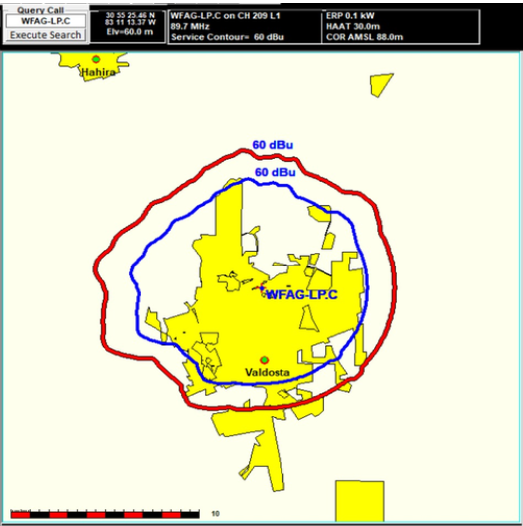
The current maximum ERP for LPFMs is 100 watts. Bradley, in the past, has proposed a “Simple 250” class for LPFMs, allowing stations to raise their power to 250 watts, with a height above average terrain of 30 meters.
The only precedent for the FCC to allow an LPFM to raise its power above legal limits, as Bradley explained on Facebook, was following Hurricane Katrina on the gulf coast. The commission granted WQRZ(LP) in Bay St. Louis, Miss., permission to operate with a 1,000-watt transmitter in September 2005.
[Do you receive the Radio World SmartBrief newsletter each weekday morning? We invite you to sign up here.]