Nick’s Signal Spot is a new feature in which Nick Langan explores RF signals, propagation, new equipment and related endeavors.
(New to the topic of E-Skip? Here’s a link to an explainer.)
This was the summer of E-Skip.
Now that the activity for the most part has died down, we can look back on what was a remarkable stretch for Sporadic-E propagation. It started to roar during a three-day stretch in June, and a period in mid-to-late July may have even exceeded it.
Rest assured, there were no conspiracies at work, causing it all.
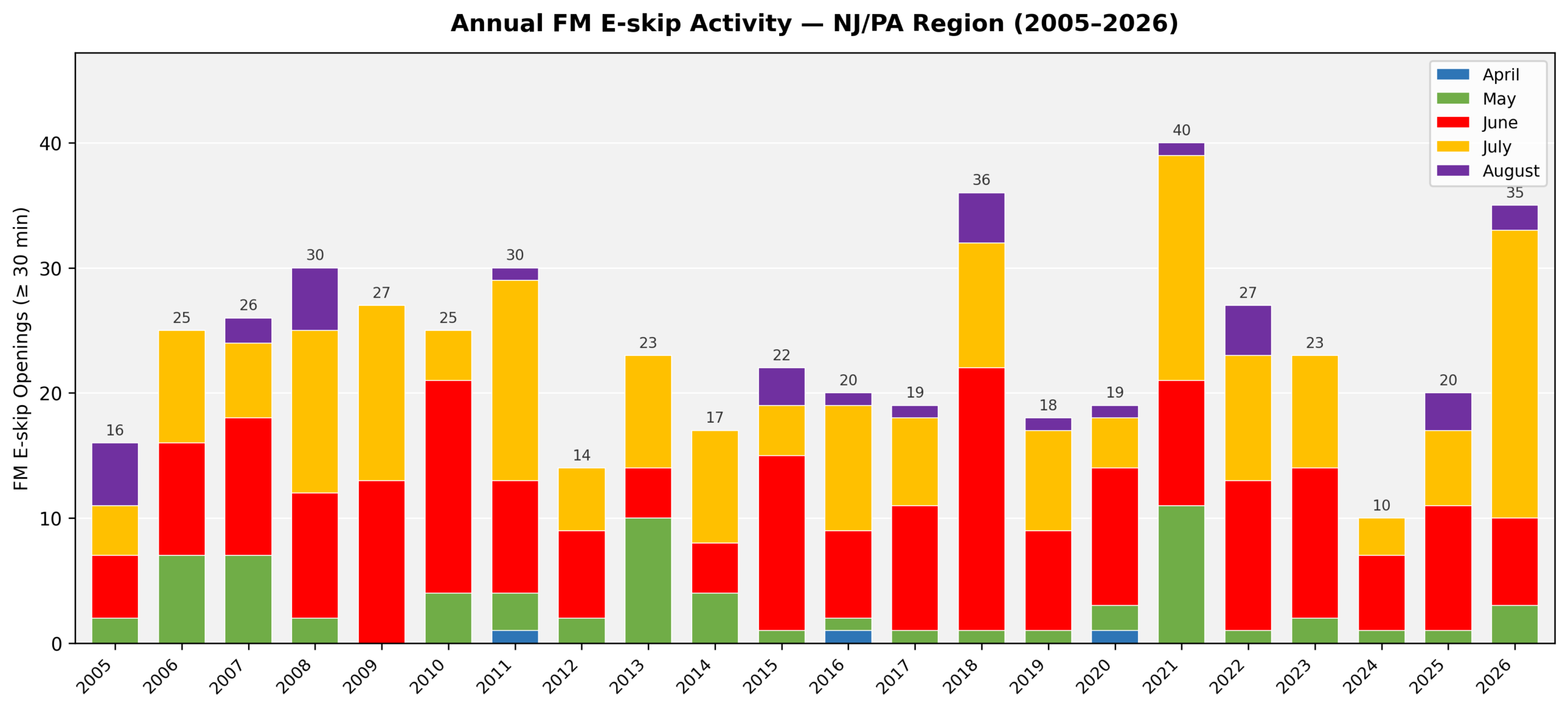
I’ve kept my own records of FM E-Skip, tracking openings continuously into the 88–108 MHz band for more than 30 minutes, since I started following this crazy hobby in 2005. It is a bit of an ode to Pat Dyer, WA5IYX, who dedicated his life to studying E-Skip propagation. He kept meticulous records from 1972 up until he died in 2016.
My records reflect activity for the northern Mid-Atlantic, namely New Jersey and eastern Pennsylvania, based on my own observations and reports from several local long-distance radio enthusiasts, or DXers. Your mileage may vary.
In terms of 30-minute openings — admittedly a subjective metric — I rank 2026 number three all-time, behind the extravagant 2021 season and 2018. Maybe we were due — 2024 was my worst all time. There is some season-to-season variation!
That 2026 was so bountiful seems to be the case both anecdotally amongst DXers and through a dataset Loyd Van Horn maintains, which we’ve written about.
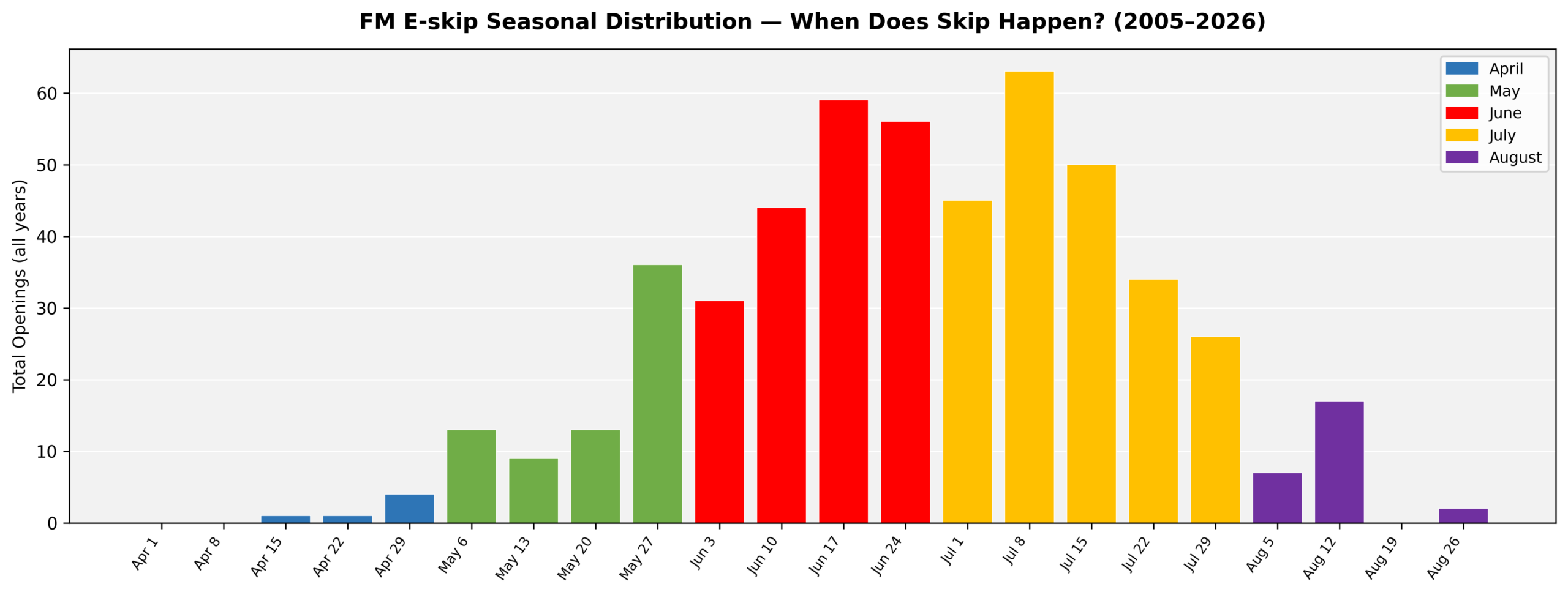
If you’re curious for what kind of seasonal curve FM openings have favored in that dataset, here’s a chart that plots the activity by specific calendar dates.
But for intense openings where the Maximum Usable Frequency (MUF) climbs, 2026 may have taken top honors.
And when it comes to E-skip, it’s all about the MUF.
Typically, an E-skip cloud is dense enough to reflect lower frequencies like 50 MHz, or the 6-meter amateur radio band, but it may not reach the U.S. FM broadcast band of 88–108 MHz.
As Andrew VK3FS explains, from time to time, the intensity of the Sporadic-E cloud ionization increases to the point where the MUF rises into the 2-meter amateur radio band, or even beyond.
Matt Sittel in Manhattan, Kan., experienced this firsthand during a major July 24 opening, using a setup of multiple AirSpy SDRs and laptops to capture full baseband recordings across all seven NWR channels.
He put together a terrific video chronicling the staggering 59 NWR receptions he made that day that is worth your time.
By aiming his antenna into a local signal null and cross-referencing audio against NWS text archives, Sittel logged a 596-mile skip to WXJ92 in Horse Cave, Ky., which is notably short for a frequency so far up in the VHF band.
Sittel’s sub-600-mile catch highlights that as the MUF rises, skip distances shrink.
On July 20, Mid-Atlantic DXer Michael Temme-Soifer captured an outstanding example during an intense short-hop opening near Princeton, N.J., logging 88.7 WIQR(FM) from Lexington, Va., at a distance of only 294 miles.
That kind of distance is not unheard of on 6 meters. But in my years observing, I’ve never seen a distance that short reported on the FM broadcast band prior.
Transatlantic openings even made brief appearances, with Ireland DXer Paul Logan’s reception of 88.5 WHCF in Bangor, Me., on July 29.
And Randy Zerr (KW4RZ) in Goldfield, Nev., said that 2026 was his best for double-hop E-Skip on FM. Check out his video of a bevy of catches from the Great Lakes and Pennsylvania on July 20.
Meanwhile, Rusty Kinner (WA8ZID) in Surprise, Ariz., wrote us to detail the success he had on six meters this season.
He had just under 300 contacts on 6 meters since June 1 and 106 unique grids. “Of those grids, 24 were new grids for me,” he said. “Contrast to 8 new grids in the summer of 2025 and 11 for the entire year before. I’d call it a banner summer!”
There was a 17-day stretch, he told us, with consecutive openings typically between 8 a.m. to noon local time. “I’d never seen such consistency before,” Kinner told us.
What a fun season for FM DX, and I’d love to hear your discoveries. Drop me an email.
E-Skip may be done for now, but now I look forward to tropospheric ducting in the fall. Let’s see what else 2026 has in store!
[Read the Signal Spot from Nick Langan for More DX-Related Stories]