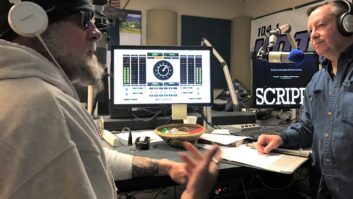
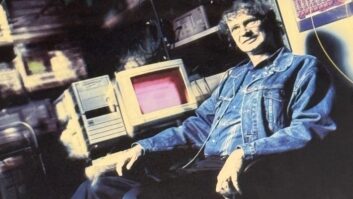
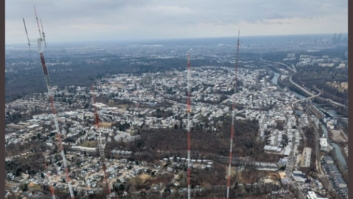
The life of a radio combo man is less regimented than you might think.
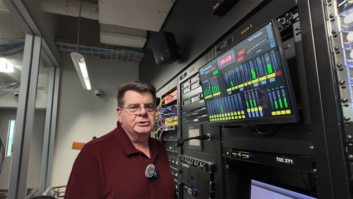
Perhaps that’s the secret ingredient behind the multitalented Chuck Bullett, who recently announced his retirement after almost five decades as a radio engineer, voiceover artist and even a go-to sound master for members of Metallica.
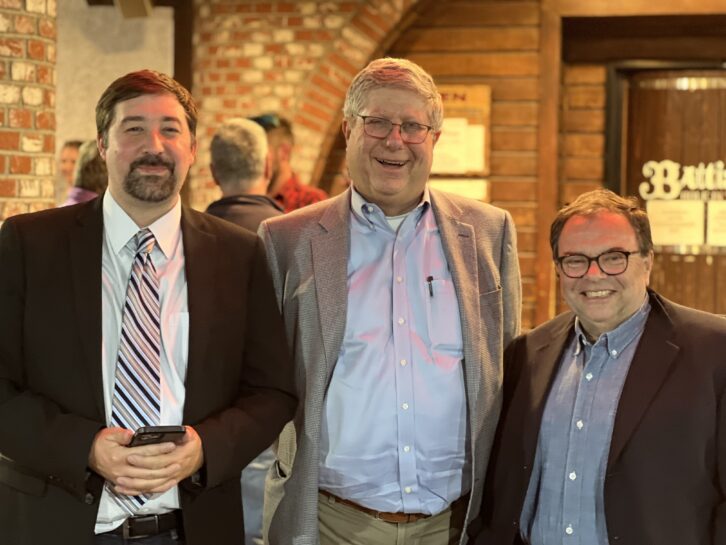
His wife Lisa recently consulted Google and offered her prognosis for what fuels her husband: attention deficit disorder. “She’s probably not wrong,” he surmised.
Or maybe it’s the scent of Maine’s pine trees. That’s where Bullett, 65, was born and where he plans to spend the lion’s share of his retirement years.
He grew up in Brunswick, part of the central Maine area that included the towns of Topsham and Bath that have proved fertile for radio talent.
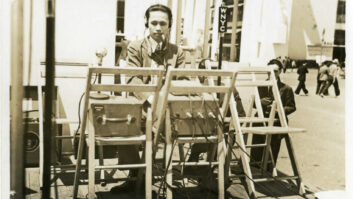
Bullett’s grandfather, Charles Sr., outfitted the family living room with a console radio that had both mediumwave and shortwave coverage.
The radio’s sound, Bullett recalled, was immaculate. “I was hooked,” he said.
On the air from Maine’s midcoast
Brunswick High School, which Bullett attended, had a 10-watt FM station, 91.9 WBHS. Its special radio advisors included Dale Arnold, the now retired play-by-play man for the Boston Bruins and WEEI host.
Arnold and his colleague Bruce Biette connected Bullett with Bob and Ginny Pappas, who owned WKXA(AM/FM) in Brunswick. They were in need of weekend sign-off operators.
At age 14, there was Bullett, spinning the hits that mattered in the summer of 1975 from 6 p.m. to sunset. He’d also take transmitter readings and perform power calculations.
“I was doing real radio,” he said.
How’d he pull that off when the legal working age was 15?
“I had a beard, a mature and developed voice and a Third Class Operator FCC permit.”
His father, Charles Jr., would come out at midnight to pick up the intrepid radio teenager and his bicycle from the WKXA studio, situated in an unlit, rural part of Brunswick.
Bullett would move on to Bath’s WJTO(AM) and WIGY(FM), hosting weekend shifts, running promotions and “whatever else they’d let me do.”
At 16, when 105.9 WIGY’s Gates FM20H3 transmitter would suffer a plate overload and go off the air, Bullett was the one who drove to reset the overloads and breakers.
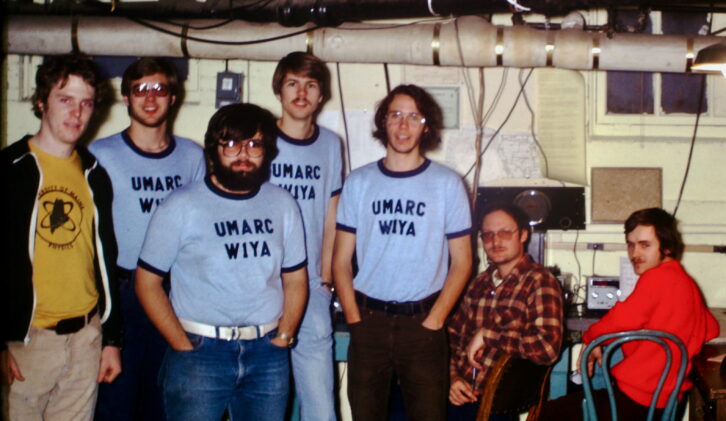
The three-phase power service was not very solid and the site did not have a generator. “There were a lot of teachable moments from such excursions in those days,” he said.
After a year attending the University of Maine while juggling a 40-hour a week workload at WLBZ(AM) in Bangor, Bullett went full throttle for a chase at a broadcast radio career.
Coming of age
His next stop was WGAN(AM/FM) in Portland, owned by the Guy Gannett family. Its sister outlets were CBS affiliate WGAN(TV) Channel 13 and the Portland Press Herald newspaper.
For Bullett, making it to the largest city in the state allowed him to sharpen his multi-faceted skillset.
John Hussey, WGAN’s chief engineer at the time, caught Bullett in the act of cleaning cart machine pinch rollers one day between his talk sets.
“He’d introduce me to the likes of Bill Suffa, Gary Cavell, Ron Rackley and Richard Mertz. It was a remarkable time,” Bullett said.
After Hussey departed, Bullett was WGAN’s chief for 15 years. He’d still be heard on-air too, but when WGAN began leaning into syndicated offerings, Bullett began exploring production.
“I never had a problem voicing a spec-spot for the sales department from notes on a napkin,” he said.
I’ve seen the future
In the late ‘90s, streaming would become the rage, and there was much intrigue over it being “the next big thing.”
A company called BroadcastAmerica.com set up shop in Portland, Me., a startup that had the same fervor, according to Bullett, as Mark Cuban’s Broadcast.com in Dallas-Fort Worth.
“I was attracted to a radio engineering opening they had like a mosquito to a flame,” Bullett said.
The company was streaming both radio and TV before anyone really knew what it meant. Most consumers were still using dial-up modems for connectivity at the time.
The venture ended in bankruptcy. “Consumer technology just wasn’t ready,” he said.
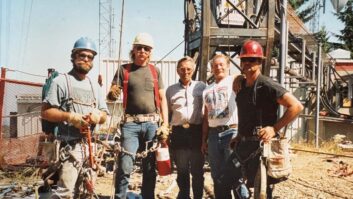
At that point, Bullett’s family had grown to four children. In need of an opportunity, Citadel had an opening to handle servicing its multiple stations in Maine and New Hampshire, which included 94.9 WHOM(FM) atop Mount Washington’s 6,300-foot summit.
“My solution was to go back to linear media and what I knew,” he said.
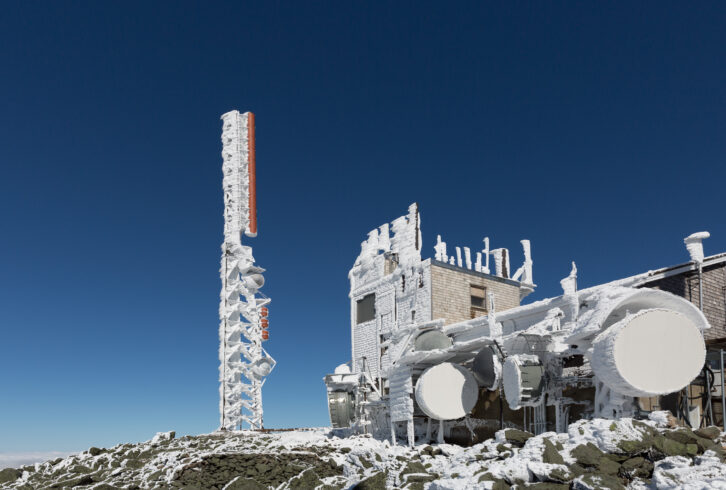
During Bullett’s time with Citadel, WHOM’s tower caught fire and burned down to the ground on a February afternoon in 2003. Investigators determined the fire started in the station’s generator house and quickly spread.
That experience, Bullett said, led to his “three layers of redundancy” approach, which he and principal Kirk Harnack discussed on a recent episode of “This Week in Radio Tech.”
But the five years of travel and handling 14 stations across the two New England states had taken its toll. Bullett’s family life and marriage suffered.
He opted for a studio integration position in Orlando with brothers Larry and Erick Lamoray. Among their clients for studio packages was the team formerly known as the Washington Redskins and its Red Zebra radio group.
Bullett would sign on to work as Red Zebra’s director of technology, building out the team’s new radio network, as well as placing a number of its stations in new facilities, bringing noted D.C.-area engineer Tom Shedlick onboard.
But with the on the field product of the football team struggling, owner Daniel Snyder deemed the radio division expendable.
“One day most of the managers, some airstaff and myself were escorted to the door,” Bullett said.
In 2007, Cumulus purchased Susquehanna Broadcasting. VP of Engineering Gary Kline needed a chief engineer in the San Francisco Bay Area. Kline and Cumulus’ leadership team met with Bullett, who was still in D.C.
“I couldn’t get the airplane tickets to San Francisco in my hands fast enough,” he said.
Bay Area blast
Cumulus’ San Francisco stations at the time included KNBR(AM) and KTCT(AM), along with rockers KFOG(FM) and KSAN(FM).
Automation at the time for the four-station group was crashing daily, Bullett said, and some time, love and care was necessary. Bullett later oversaw the consolidation of KGO(AM) and KSFO(AM) into the group.
Meanwhile, the combo man was alive and well in him, too. He’d end up gaining voiceover work for several premium car dealerships across the Bay Area.
“You never really lose it,” he said.
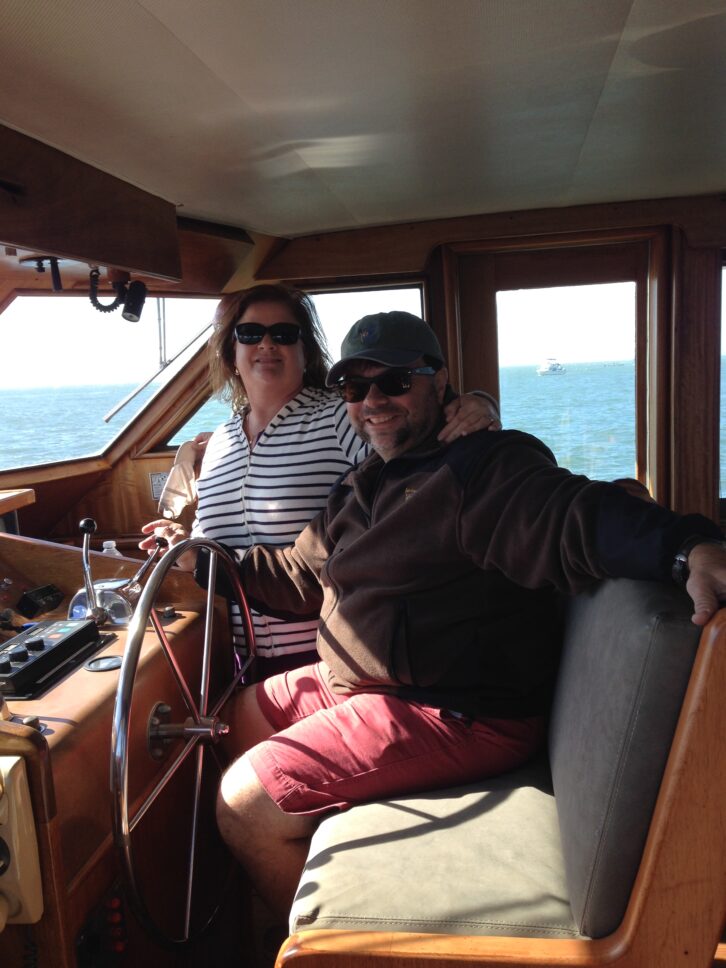
Bullett also took full advantage of the locally accessible maritime waters. An avid sailor, he is a credentialed U.S. Coast Guard Merchant Captain and he’d work the waters of the San Francisco Bay while also holding a volunteer leadership position in a nonprofit yacht club.
He found the time to moonlight to engineer Bob Coburn’s syndicated “RockLine” show, which featured Bay Area staples like Bonnie Raitt, Carlos Santana and Huey Lewis.
ISDN lines were magic to folks not familiar with radio.
“We had a bank of them, and great studios, which gave Coburn in Los Angeles and his producers in New York the confidence we could get their guests on air,” Bullett said.
Soon Metallica, with their recording studios based in San Francisco, would call for help when they wanted to drop a new album.
Bullett happened to have a pair of his own Telos Zephyrs, and as a result, he’d spend time helping Metallica’s team by taking over recording consoles and reconfiguring rooms for mix-minus and front of house, plugging them right into his remote case.
In 2008, one of Bullet’s memorable moments was coaching Dave Grohl and Taylor Hawkins of the Foo Fighters to conduct an interview with Metallica’s members in front of a live studio audience.
Grohl and Hawkins idolized Metallica.
“We crammed about 125 superfans into the studios and turned it into a live space,” Bullett recalled.
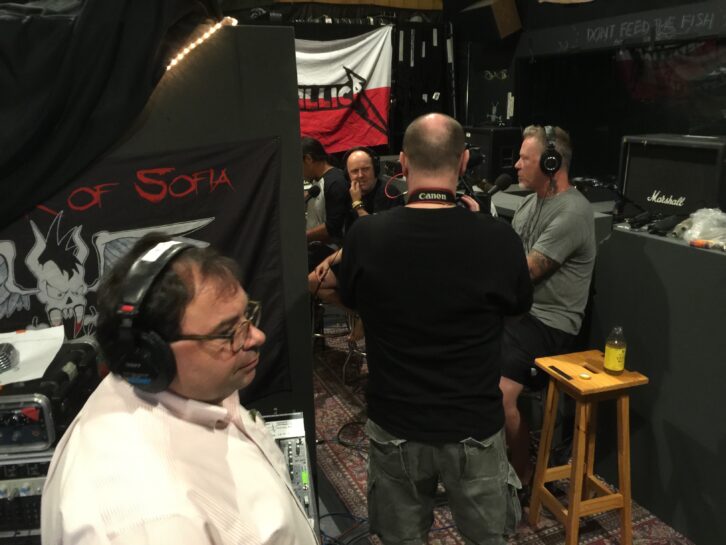
It was an intense four days of planning and work that was conducted in secrecy until the day of the event.
The “Death Magnetic” two-hour show would be delivered via satellite to some 500 stations nationwide.
San Francisco shuffle
Bullett moved to CBS Radio in San Francisco in 2012 to help fill a void left by the passing of his friend Phil Lerza, a Bay Area engineering legend.
In 2019, Bullett would leave what became Entercom to join Bonneville’s San Francisco stations for its director of technology role. The company was embarking on a buildout involving 20 studios.
COVID-19 hit, and Bullett described it as a rough time for everyone involved. All of the staff, except engineering, was working from home.
But the studio move — without the remote airstaff — would be completed.
Eventually, he said, revenue cuts resulted in Bonneville’s elimination of the DTO position in all of its markets and Bullett was laid off after 18 months on the job.
He made a call to Entercom’s — now Audacy — San Francisco operations manager, Tim Jordan. “It was like a country song played backwards: I very quickly got my old job, my truck and all my old friends back,” Bullett said.
He handled the director of technology role from the beginning of 2021 until the end of August 2025, when he officially retired.
The way life should be
Bullett is returning to where it all started for him, back across the Piscataquis River Bridge back into Maine.
In addition to being closer to his children and grandchildren, it offers prime access to some of his hobbies, including, of course, sailing.
Bullett and his wife purchased their year-round home in Portland; they also own property in Austin, Texas, which they can head to during the height of a Maine winter.
Readers, he suggested, should search out Bullett (W1AEK) on the amateur radio bands, as he hopes to engage with the hobby more fully.
Maybe a slower pace for Bullett’s life is overdue. But in an era where side hustles are the rage, how did he manage to master everything from voiceover artistry to the intricacies of AM directional arrays?
“I’ve never really been happy unless I was juggling three to five tasking items at once,” Bullett said.
Maybe it is ADD, as Lisa concluded.
Or maybe it’s just the long, successful career of a radio combo man.
[Do you receive the Radio World SmartBrief newsletter each weekday morning? We invite you to sign up here.]