The author writes occasionally here about restoring vintage electronics.
Vintage equipment relies on many components to run properly. Let’s focus today on what capacitors do in this process.
A capacitor is a device used to store an electric charge, usually consisting of one or more pairs of conductors separated by an insulator.
Let’s discuss three types: paper capacitors, electrolytic capacitors and polyester film capacitors. (There are others like tiny mica capacitors that are less relevant for this discussion.)
Let’s look first at the paper capacitors, sometimes called paper/wax or wax capacitors.
These are usually tube-shaped with metal leads coming out of the left and right ends (axial) and wrapped in wax. These were in common use up to the early 1960s.
If you’re restoring equipment with these capacitors, replace them. Wax capacitors do not last 50 or more years, especially if the unit had been used frequently. They break down due to mechanical stress, heat and age.
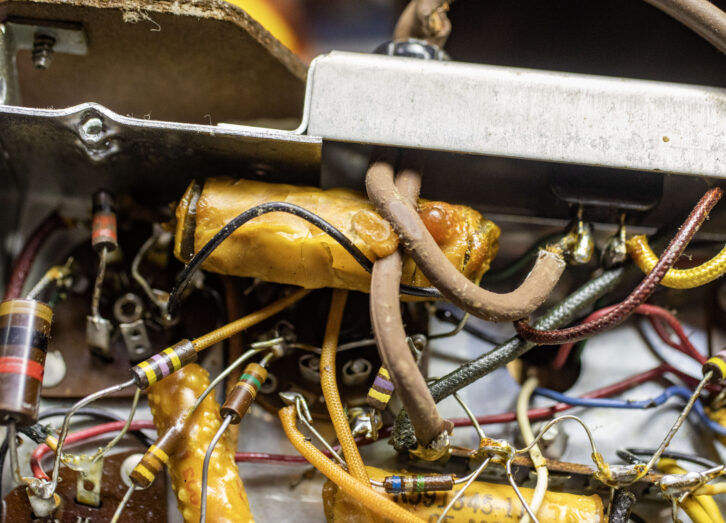
Their role is to store an electrical charge, but because of their age they are no longer capable of that. The most visible signs of capacitor failure are a bulging top or sides, fluid leaking and a bubbling of the wax coating (Fig. 1).
As mentioned, these should be replaced. You can look at the schematic, or if you’re fortunate enough, the printing may still be visible on the paper sleeve.
Note the microfarad size and voltage. One of the most common capacitors used in vintage radios is the .05 microfarad 400 Volt capacitor. You are looking for the microfarad value and the voltage. You never want to go much smaller than its microfarad rating and never go smaller in the voltage capacity.
Modern replacements are normally polyester film capacitors. It may be difficult to find .05 microfarad capacitors. With my limited math skills, I use a .047 microfarad 600 volt capacitor. A .047mf capacitor is extremely close to a .05 and is a suitable replacement.
When installing a polyester film capacitor, the polarity does not matter. There is no positive or negative lead.
The next type of capacitor is the electrolytic. This is a polarized capacitor with a cathode or positive plate, and a negative or anode plate.
These types normally are made of metal that forms an insulating oxide layer through anodization. This oxide layer acts as the dielectric of the capacitor.
Inside, a gel, solid or liquid electrolyte covers the surface of this oxide layer, serving as a cathode or positive plate of the capacitor.
Because these capacitors are polarized, they must be connected in the correct direction in the circuit to function properly.
Electrolytics can have a much higher voltage to capacitance per volume than any other type of capacitors. To make it even more complicated, there are three different types of electrolytic capacitors: tantalum, niobium, and aluminum.
Because they have these very large capacitance values, they are great for low-flow signals, allowing them to pass and for storing larger amounts of energy. They’re often used in power supplies, or for noise filtering.
Two potential negatives of larger electrolytic capacitors are that they are more prone to leaking because of the higher storage value, and they should be discharged before removing them from the circuit.
I like to think of it as an insect. The bigger the bug or the larger the capacitor, the more energy it stores and the larger shock (bite) you could get.
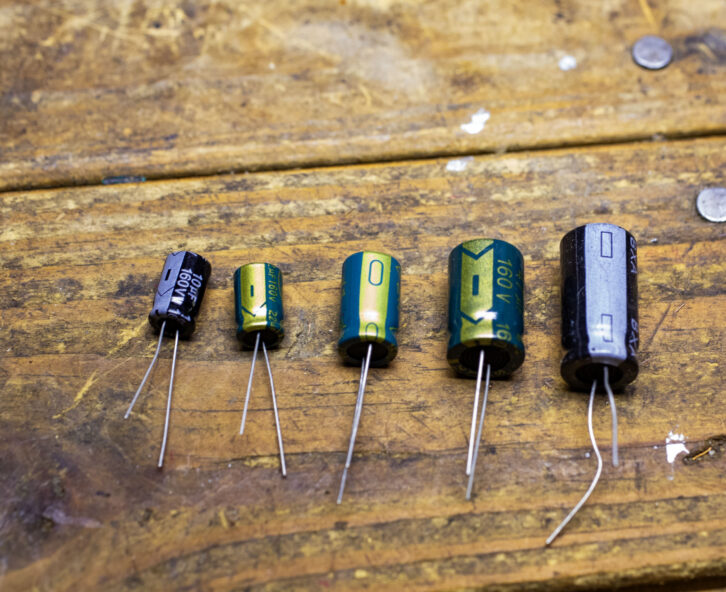
Values of electrolytic capacitors have also changed over the years. I commonly see 50 microfarad capacitors in vintage units. That size is not readily available anymore. The most common sizes of electrolytic capacitors are 10, 22, 33, 47 and 100 microfarads (Fig. 2). You can get them in other sizes too, but these are the most common.
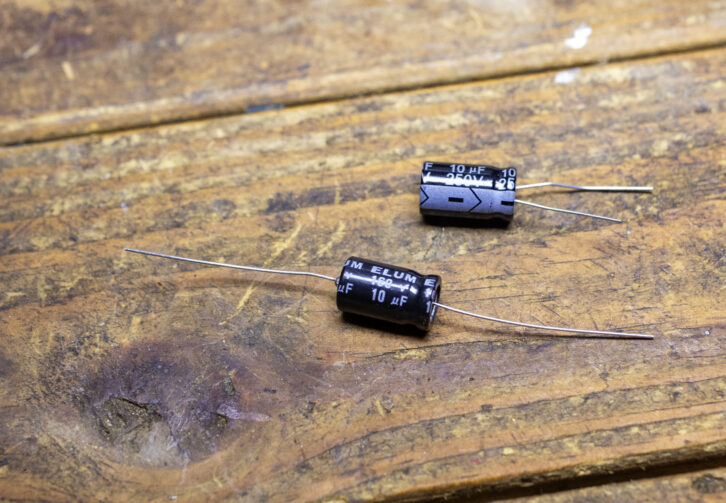
The electrolytics come in two styles: axial with a lead on each end (like a car axle) and radial with both leads coming out of the bottom (Fig. 3).
Following the schematic, or removing the old electrolytic cap, take note of which is the positive and which is the negative. They are labeled on the capacitor itself. The negative lead on a radial capacitor is always a little bit shorter than the longer positive lead.
Also look for the minus or arrow band noting the negative side. If you reverse the polarity of an electrolytic capacitor, it probably will rupture.
The third type we’ll mention here are film or polyester film capacitors. This type is used most often when replacing wax capacitors.
These more modern units will last much longer and are known for their reliability as well as stability. A colleague of mine says if you’re working on a unit before 1970, replace all the capacitors.
Is there any other way of determining if a capacitor is bad if it passes the visual inspection? You can test the capacitor using, strangely enough, a capacitor tester. You will be given a value of what the capacitor’s rating is as well as is ESR.
ESR stands for Equivalent Series Resistance. This measures the internal resistance. Low ESR is good, and the high ESR is bad, meaning the capacitor should be replaced. When looking at the value of a tested capacitor, if the value is too high or too low and the ER is high, replace the capacitor.
When working with combo units (example: two 50 mf capacitors in one), test the leads and see what the value is of each capacitor. The simplest replacement is to combine the negative leads on the two 47 microfarad electrolytic capacitors and solder one positive lead to one wire and the second positive lead to the other wire.
If the electrolytic capacitor was in a metal can, some people prefer to hollow out the old capacitors and put new ones inside the same container. That’s a lot of extra work, though, and rarely will people see inside the unit anyway.
I hope this bit of information doesn’t overload your capacity. I’m a little resistant to talk about resistors — that’s another article!
Chuck Gloman is an associate professor and chair of the TV/Film Department at DeSales University. Reach him at [email protected].