It’s the story of a cultural anthropologist turned streaming broadcaster. The nonprofit that Kenneth Routon launched celebrates how the inherent imperfections in live radio can bring you a taste of life somewhere else like no other medium can.
Radio Is a Foreign Country is a New Orleans-based internet radio station. The archive and much of the production work are based there, while the actual streaming infrastructure comes from service providers.
Routon, its founder, told us that the project launched originally as a series of homemade mixtapes. The first episodes went up in 2018, some of them on PRX, built around regions and themes.
Its SoundCloud collection grew, and in 2021 Routon incorporated Radio Is a Foreign Country as a nonprofit. That April, it began streaming around the clock.
Since then, the project has collaborated with private collectors, archives, field recordists, sound artists and small independent labels to produce 170 curated mixtapes of ceremonial, folk and pop music from around the world. The mixtapes have accumulated about 500,000 plays across streaming platforms, and the station gets about 12,000 listeners a week.
Guest transmissions have also become a focal point, Routon told us, and the project includes shortwave, AM and FM recordings.
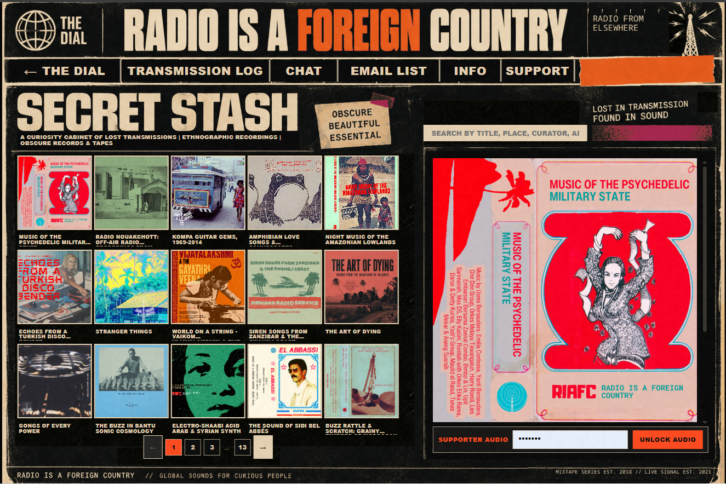
The nonprofit recently relaunched and right on its homepage offers “The Dial,” which allows listeners to tune in the main Radio Is a Foreign Country stream, along with approximately 270 special streaming stations, including ShortWaveMusic, a collection of 500 shortwave radio recordings.
We asked Routon about his motivations and why he feels radio is such an apt medium for ethnography.
“A lot of the project is basically a series of rabbit holes,” he told us.
Shortwave vibes
Routon came to New Orleans to teach at the University of New Orleans. Earlier in his career, after college, he lived outside of Mexico City. Out of boredom, he told us, he began recording snippets of radio stations, from songs to conversation.
“I’d listen to those tapes,” he said, “and they were fragmented, with some recordings cut off before another would abruptly begin, and I grew to love them.”
Routon eventually lost those tapes, but the idea stayed with him. Later, he came across Alan Bishop’s “Sublime Frequencies” radio collages: folk and pop styles cut against DJ banter, commercials, plays and other “sound anomalies” recorded in places like Morocco, India, Sumatra, Cambodia and North Korea.
“Then my wife gave me a shortwave radio,” Routon said. “That was the click.”
Feature, not a bug
Radio Is a Foreign Country is curated by humans, Routon said. Programming is drawn from a library he built but it has gone beyond his own collection.
“The station only works because other people keep handing me worlds,” he said.
He said he’s welcomed recordings from collectors, musicians, field recordists, researchers, labels and curious people who happen to have recordings sitting around. There are too many regular contributors to list here.
The stream can feel random as material is often randomized from its archive. “And I like that disorientation,” Routon added. But nothing enters the library unless it was intentionally selected first.
Listeners may hear bits of signal interference, DJs talking over advertisements, and announcements that did not go as scripted, all drawn from what Routon describes as the project’s core: the actual mixtapes. As a result, what you hear may not be optimally processed, but that is a feature, Routon said, not a bug.
“I’m less interested in radio as a pristine historical artifact than in those accidental moments when you suddenly feel like you’re somewhere else,” he told us.
Collaboration
The philosophy led to a partnership with Radio Garden, the popular directory that allows users to explore streaming radio stations by panning around a map of the world.
“You can move around the globe and suddenly hear a station from a place you’ve never been,” Routon said. “That’s very close to what attracted me to radio in the first place.”
But rather than simply dropping Radio Is a Foreign Country on the map as a pin, Radio Garden invited the nonprofit to build station playlists within the platform itself.
Those include Rare Tongues, focusing on stations broadcasting in lesser-known languages, and Musical Roots, highlighting stations connected to places that shaped musical traditions.
“So the relationship goes both ways,” Routon explained. “Radio Garden gives people a geographical way into radio, we help them follow some of the less obvious paths through that world.”
Routon also invites additional submissions from collectors, sound artists and field recordists, particularly material that some archivists might overlook.
“I’m especially interested in off-air recordings, field tapes, regional cassettes, forgotten broadcasts, radio fictions and odd documents, particularly things that industrial curation would never touch,” he said.
Radio as ethnography
There’s no cost to take a listen to the Radio Is a Foreign Country stream, and it is sustained by listener contributions.
For Routon, the result today is an extension of his studies, treating radio as a field site that might otherwise be overlooked due to the prominence of commercial, state and religious stations.
“You hear the DJ make a mistake. Someone laughs in the studio. A phone rings. A commercial comes on. Somebody calls in. You hear the weather, the time, a local business, a song that was popular in that particular place,” Routon said. “Those details can tell you an enormous amount.”
The improvisation, if you will, is what draws Routon to the medium.
“I’m trained to be careful with context, but radio is messy in a way that careful framing sometimes isn’t,” he said. “Not a single culture under glass, but the shock of the real when two distant signals occupy the same minute.
“Radio works because the signal comes from somewhere you are not, and then it sits in your kitchen.”
Radio World welcomes letters to the editor on this or any story. Email [email protected].