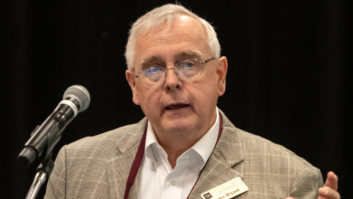
Howard Robertson is CEO/founder of Spotset Media Network.
I just stood there staring … at my 80-year-old father.

“Paw Paw” looked like he had peacefully slipped away. But I knew he was still alive. The hospice nurse led me to another room and instructed me to talk privately to him and, among other things, reassure him that I would take care of my mother and the family.
Then she looked at me and said, “He needs that. He can definitely hear you and understand.” I did. He died hours later.
They say hearing is the last thing we lose. Ironically, hearing, recognizing and responding to their mother’s voice is one of the very first things newborns can do.
In the realm of advertising, word-of-mouth was the original form of message communication. It is one of the myriad reasons we love radio. Audio, be it the music or the message, is a straight shot to the head, heart, mind, memory and feelings.
From a sensory perspective, sound is second only to smell in its power to transport your brain to another time, place or experience.
I have spent more than 53 years in advertising and media, including years selling television after being trained on Madison Avenue. For about a third of my career, I was a media seller with experience in both radio and television. I sold TV, profitably. But I love radio, personally.
Sight, sound, motion and emotion were the qualitative highlights of television messaging we always touted. I know television’s strengths.
I also know what radio does, that no other medium can quite duplicate. Every week, radio reaches and affects more adults, more frequently and for longer periods of time than any other media. Most radio listening occurs Monday through Friday, from 6 a.m. to 7 p.m., during a commute, at work or during other daytime activities.
Radio’s primetime is really… mind time.
It is mind time because it includes the times of day when, among average adults, logical reasoning, speed, accuracy and executive function are highest, including some of the best times for insight and creative brainstorming.
Television’s primetime describes the value of an inventory block. Radio’s primetime describes the listener’s state of mind. Network TV primetime is prime totally in the networks’ own self-interest. It is a three-hour time block at night, when adult audiences are anything but primed. Maybe they are tired after working all day, drowsy after dinner or possibly cynical and depressed after watching the news.
But for the networks, it is the prime time to charge advertisers enormous spot costs so the networks can receive ROI for the super-high production and talent costs of primetime shows.
It is a safe bet that, whatever the product, the product seller usually knows the most about it … inside and out, top to bottom. My experience selling television taught me how that medium works.
My experience with radio taught me something else: Radio does not simply deliver impressions. It creates relationships.
In a recent article, consultant and radio executive John Shomby said, “Radio has always owned right now.” So very true.
TV, Digital, Out of Home and other media messaging must rely on faulty memories and the fickleness of the future.
Radio makes an immediate impact with the power of right now. It can make people take U-turns while driving in immediate response to what their favorite DJ just recommended. I have watched trusted radio personalities move listeners to call, visit, donate, vote and buy — not eventually, but while the message was still in the air.
That ability to inspire immediate response is not an abstract media theory. It is behavior that radio professionals, advertisers and listeners have witnessed for generations. Plus, radio listeners are typically in a more receptive frame of mind while most listening takes place.
Think about it. Wouldn’t you be more likely to remember and respond to the personality of a trusted, relatable voice of someone who knows something about you, blended in with great music, than to a random “hey you” cattle call from a bad television ad or an algorithm?
The effectiveness of this stuff called advertising should be more about response and results than merely reach and rates. Why are responses and results from radio advertising so much better?
Consider the source. Radio has always been there for us and never led us wrong.
The same Memphis stations my grandparents, parents, my brother and I listened to during the 1960s, provided music as well as information about marches, demonstrations and everything else happening around the Civil Rights movement.
Those stations are still going strong. My adult children listened to them growing up. They were there with vital, truthful information in 2020 during the years of pandemic, police, protests and politics. Plus, they are still here so I can expose my granddaughter to the real music of Soul and R&B while her parents school her on New Jack Swing and Classic Hip Hop.
That is five (!) generations of relationships with radio.
Network primetime television shows typically do not have relationships with their audiences that go that deep. Algorithms do not have that history. They do not share memories of where a community has been, what it has endured or how its voice has evolved. Local radio does.
So, if you are a media planner or buyer who does not present local radio to your brand clients as a viable, results-driven advertising opportunity, you are doing them a disservice — because advertisers need that, and consumers can definitely hear and understand.
[Related: “Think Radio Is Dead?”]