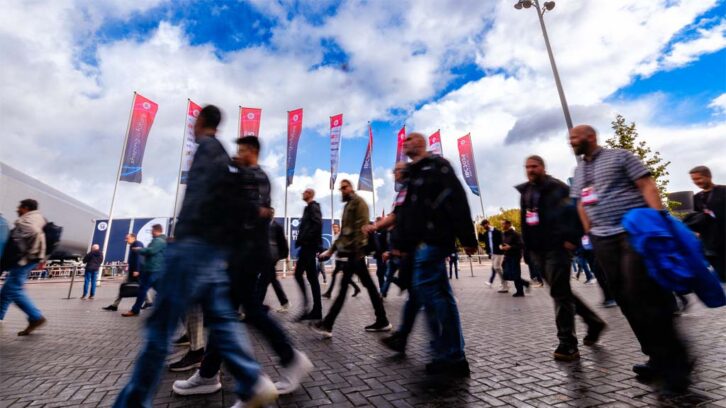
The IBC2026 convention will return to RAI Amsterdam on Sept. 11–14. CEO Michael Crimp has said that the show comes “at a defining moment for the global media and entertainment industry.”
We asked IBC Director Steve Connolly to preview the show for us.
Radio World: What themes will be featured of particular interest to radio and audio professionals?

Steve Connolly: Audio professionals attending IBC2026 will find plenty of content focused on practical innovation and real-world implementation. Across the industry, organizations are moving beyond exploring new technologies to understanding how they can be deployed at scale and integrated into everyday operations. Whether the conversation is about AI, cloud infrastructure, virtualized production, metadata or audience engagement, the emphasis at IBC is increasingly on practical application and measurable outcomes.
Visitors will also find a strong community of audio technology exhibitors covering everything from AoIP networking and mixing to remote contribution, processing, monitoring and transmission. Companies such as Calrec, SSL, Yamaha, Genelec, Sennheiser, DHD, Comrex, Sonifex, Telos Alliance and many others reflect the breadth of innovation taking place across professional audio and broadcast radio.
RW: Can you point to sample sessions or presentations?
Steve Connolly: The full conference program will be announced closer to the event, but there are already some highlights that will be of particular interest to radio and audio professionals.
WorldDAB will once again host its dedicated session in Room E102 on the Sunday afternoon, alongside exhibiting throughout the show, showcasing Automatic Safety Alerts (ASA) and hosting stakeholder meetings during IBC2026.
Across the conference, attendees can expect practical discussions around AI implementation, audience engagement, security and content authenticity, evolving business models, and the changing relationship between content creation and technology.
These are challenges shared across the wider media industry, and increasingly they are equally relevant for radio broadcasters navigating digital transformation.
Future Tech will also be a key destination. Following its successful launch last year, it has expanded significantly for 2026, bringing together start-ups, researchers, broadcasters and technology providers to explore emerging technologies and practical innovation.
The Accelerator Media Innovation Program will once again demonstrate collaborative proof-of-concepts tackling real operational challenges.
One project likely to resonate strongly with audio professionals is “Crystal Clear: Boosting Speech Intelligibility in Media,” which brings together the BBC, ITV, Channel 4, Sky, Fraunhofer Institute and the IET to establish a more consistent way of measuring and improving dialogue intelligibility across broadcast and streaming.
By combining AI-based analysis with structured human listening assessments, the project explores how speech clarity can be measured more consistently and embedded into production and distribution workflows.
It’s the latest in a series of audio-focused Accelerator projects over the years, an area where Shure has played a significant role in driving innovation over recent cycles.
RW: In the United States, radio infrastructures and workflows have been affected dramatically by the cloud, virtualization, cuts in human resources, a reduction of studio footprints, the growth of AI and software-based services, and the growing role of visual metadata. What’s happening in Europe?
Steve Connolly: Many of these same technology trends are evident across Europe too, but the conversation has broadened beyond technology alone.
One of the clearest messages emerging from across the industry is that radio continues to demonstrate remarkable resilience. Recent European Broadcasting Union research shows that radio remains a genuine mass medium across Europe, even as listening habits evolve and audiences consume content across a growing range of connected platforms.
The challenge for broadcasters is less about preserving radio’s relevance and more about ensuring it remains easy to discover and engage with wherever audiences choose to listen.
That helps explain why podcasts, metadata and connected car experiences have become such important areas of focus. As listening increasingly takes place through digital dashboards and connected interfaces, broadcasters are investing in richer metadata and hybrid broadcast/IP services to improve discoverability while retaining the scale, reliability and efficiency of broadcast delivery.
We’re also seeing an important shift in how radio infrastructure is viewed. In markets such as France, digital radio is increasingly being discussed in the context of national resilience and trusted public communications, recognizing the role resilient broadcast networks can play during emergencies or when other communications infrastructure is unavailable.
RW: Last year you spoke about AI being viewed as an enabler of human efficiency. How has the role of AI evolved further in media ecosystems?
Steve Connolly: Over the past year we’ve seen the conversation move decisively from experimentation to implementation.
In radio, AI is increasingly being deployed as a practical production and editorial tool rather than an end in itself. Broadcasters are using it to automate repetitive tasks such as transcription, metadata generation, translation, content summarization and newsroom workflows.

We’re also seeing AI reshape how audiences discover radio. As listening increasingly takes place through connected devices and digital interfaces, broadcasters are using AI to surface relevant local content and improve contextual recommendations. The focus isn’t simply on personalization for its own sake, but on making trusted radio services easier to find and engage with across a much wider range of listening environments.
Perhaps the biggest shift, though, is that the industry has become much clearer about where AI should (and shouldn’t) add value.
Across Europe there is growing recognition that radio’s greatest strengths remain its trusted voices, local relevance and ability to build genuine human connection. The most successful applications of AI are those that preserve the editorial judgement and authenticity that audiences value most.
RW: Are there technical papers that would be of particular interest?
Steve Connolly: The IBC Technical Papers remain one of the defining elements of the conference, bringing together researchers, engineers and practitioners to present peer-reviewed work exploring the technologies shaping the future of media.
One session that will be of particular interest is the “Audio, Access Services and User Experience Technical Papers” session, taking place on Friday lunchtime. While the individual papers are still being finalized, the session will explore research and innovation in areas directly relevant to radio and professional audio.
More broadly, radio and audio professionals can expect peer-reviewed research covering themes such as AI, media workflows, networking, production technologies, audio innovation and other developments that increasingly span the wider media ecosystem.
RW: What else should we know?
Steve Connolly: IBC has always been about bringing the industry together to tackle the challenges that no single organization can solve alone, and I think that’s particularly true for radio today.
One of the greatest strengths of IBC is the opportunity to learn from adjacent sectors across the wider media and entertainment ecosystem, where many of the same challenges — and increasingly many of the same solutions — are emerging.
That’s part of the reason we’ve introduced several new initiatives, like the Braindate Lounge and Future Tech Ignite, to spark ideas, new business opportunities and cross-industry knowledge sharing at the show.
We want visitors to leave the show with new connections, and fresh, practical insight that can help shape the next generation of services and listener experiences.