What does the “X-Band” look like today?
In 1993 the FCC authorized the extension of the AM band’s upper end to include 1605 to 1705 kHz, adding 10 more broadcasting slots to the band. Our James Careless recounted its roots in 2016.
The commission’s intent was to selectively open those frequencies to existing stations that most significantly contributed to congestion and interference in the standard AM band, easing interference on the one hand and providing better protection to ones that migrated.
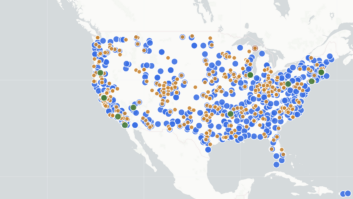
In the U.S., we currently count 49 active licenses for extended band AM stations. That’s according to data from my RadioLand project. Note, format and slogan data should not be taken as gospel. Please feel free to send me an email if you spot something out of sort on the map below.
Having trouble viewing the map? Open the interactive map in full screen.
This map does not include Part 15 stations that operate in the extended band, nor Travelers’ Information Stations.
Officially, the extended band ends at 1700 kHz, as we asked in our Tuesday trivia question this week.
1705–1800 kHz is allocated to the fixed, mobile and radiolocation services on a co-primary basis, as our friends at REC Networks explained.
The bands 1715–1725 and 1740–1750 kHz are allocated on a primary basis and the bands 1705–1715 and 1725–1740 kHz on a secondary basis to the aeronautical radionavigation service (radiobeacons).
[Read the Signal Spot from Nick Langan for DX-Related Stories]