Nick’s Signal Spot is a new feature in which Nick Langan explores RF signals, propagation, new equipment and related endeavors.
FM broadcast signals can travel long distances under the right conditions.
We’ve touched on E-skip several times in this space, particularly how double-hop sporadic-E makes transatlantic receptions possible. Receptions like these have been documented by long-distant radio enthusiasts such as Ireland’s Paul Logan catching North American signals, and the reverse accomplished by Bryce Foster on Cape Cod and Larry Horlick in Newfoundland.
Now, another operator, this time in Spain, has joined those ranks. Mauricio Molano, a retired 47-year radio veteran and DXer since age 15, recently shared his loggings with us.
“This year, sporadic-E made a dream of mine come true, something that seemed impossible until the arrival of software-defined radios,” Molano wrote of a transatlantic FM reception. “SDRs allow us not only to listen to the radio, but to visually monitor the signals populating the spectrum.”
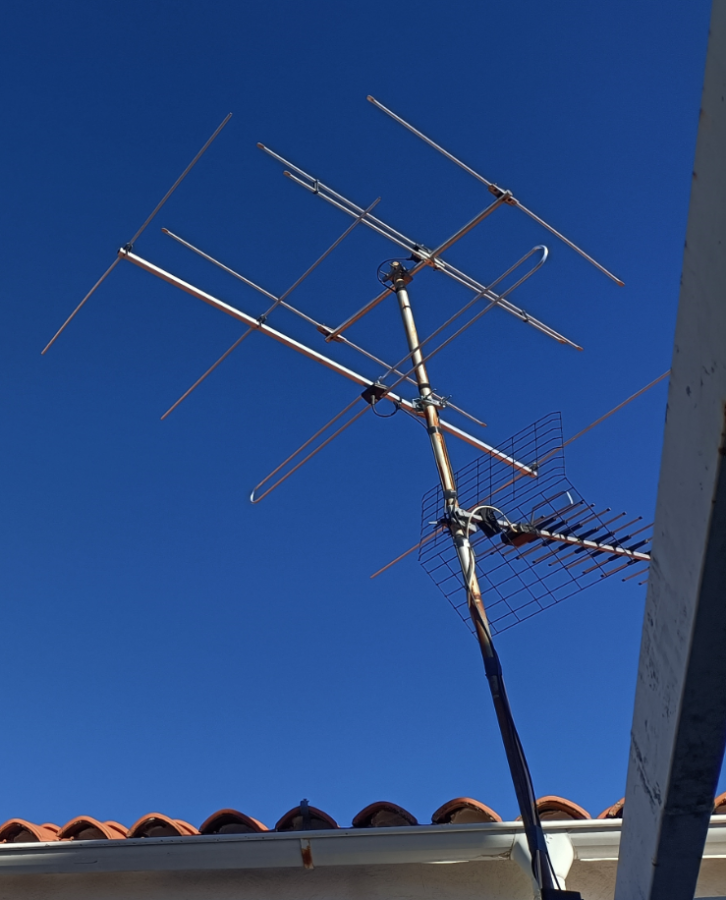
Molano logged the stations using a four-element Yagi pointed toward Newfoundland and a three-element Yagi aimed toward the Canary Islands and the West African coast.
His E-skip season began in late May with an African opening that brought in signals from Togo for the first time. But on July 19, atmospheric conditions aligned for transatlantic FM propagation into Spain, bringing in stations from the Carolinas, more than 3,700 miles away.
Operating remotely from Aldea del Cano in the Cáceres province, he observed an E-skip opening to the Azores.
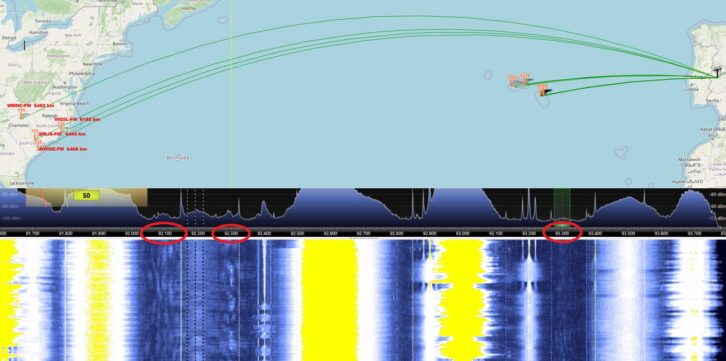
That’s normal from his location, what we’d deem as single-hop E-skip. But Molano also observed unusual effects to those signals that could be observed visually with the SDR. Some DXers call this a “barber-polling” effect that can be observed on the waveform.
The best part of SDR DXing in 2026? You can hit record and review the evidence afterward.
This event occurred during the height of the World Cup, so Molano went to watch the Spain vs. Argentina match, he kept his SDRplay RSPduo recording with a 7 MHz slice of spectrum.
The next day, he went to review and explained what he heard.
“I tuned to 93.3 first. Fading was severe, with short, strong spikes. A presenter gave a phone number and website in English. I ruled out the U.K. and Ireland based on programming formats, leaving North America. Then on 92.3, a clear station ID came through: “92.3 The River.” Cross-referencing online audio confirmed it was WQSL(FM) in Jacksonville, North Carolina at 3,841 miles away.”
Watch a video of his catch below:
We’ve also mentioned several times the importance of recording your DX. Sometimes, that can create what seems like a mountain of an audio backlog.
But in this case, Molano found some gems.
Over the following days, he reviewed the recorded spectrum and identified four U.S. stations across North and South Carolina:
| Frequency | Call Sign | Station Name / Format | Location | Distance |
| 88.1 | WRJA | ETV Radio / SCETV | Sumter, S.C. | 4,004 miles |
| 92.1 | WMNC | Big Ways Country | Morganton, N.C. | 4,015 miles |
| 92.3 | WQSL | 92.3 The River | Jacksonville, N.C. | 3,841 miles |
| 93.3 | WWWZ | Z93 JAMZ | Summerville, S.C. | 4,019 miles |
The reception on 93.3 was confirmed by Justin Tucker, the regional director of engineering for the Cumulus Media in Charleston. Molano shared with us the confirmation.
“Quite impressive E-skip for sure… I can confirm you did receive our station WWWZ-FM Charleston, South Carolina. The clip you recorded appears to be at 9 minutes and 36 seconds into our air signal skimmer file from 19 Jul 1930Z to 1945Z, right after our commercial break.”
The 2026 E-skip season was one to remember for many DXers, and for Molano, it produced four logs that will resonate for the rest of his DXing days.
[Read the Signal Spot from Nick Langan for More DX-Related Stories]