A current Radio World ebook focuses on trends in the design and use of consoles and control surfaces.
Here’s a sampling of opinion from around the radio industry on the topic. You can find much more in the free ebook here.
Looking forward
Mike Sprysenski, CPBE, is the disaster response and problem management lead for the iHeartMedia Broadcast Operations Center, and former iHeart regional engineering lead for central Florida.
“One of the most important trends is to move away from the traditional console with faders and knobs to an all-digital virtual surface that is driven by software,” he said.
“You are no longer limited to physical restraints of a traditional console. You are only limited by your imagination.”
At iHeartMedia, “When COVID hit in March of 2020, our focus became very quickly how can we continue to produce live shows that were not in the studio with talent for shows in multiple locations.”
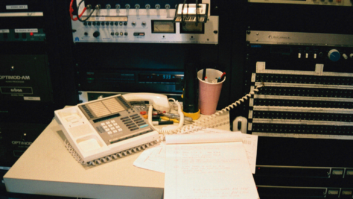
Now when you do build a studio, he said, it now may require only a day or two of work thanks to AoIP, software and design advances. That’s quite a change from his first console installation in the 1970s, of a Ward-Beck model, that involved huge amounts of audio, phone and control cable as well as soldering to “Christmas trees.”
He defines a radio console today as any device, physical or virtual, that can mix the necessary audio sources needed to produce content necessary for a show, in some cases including video content.
In today’s designs, Sprysenski is a fan of built-in scripting functions. “With the touch of one button, they can change the entire look and feel of the studio to personalize it for each talent or station.”
Not only does this give the talent a tremendous amount of flexibility to customize a studio for each show, he said, but it can help save a tremendous amount of time and money for companies as they plan to upgrade their facilities. One studio can be used for any of the stations.
iHeartMedia has been using software for years to control surfaces remotely, and he said the trend is moving fast to eliminate the traditional console.
“In fact, with cloud-based automation systems, you no longer are limited in working from only one location but can broadcast from anywhere in the world.”
He expects analog consoles will continue to be available in the immediate future because they are usually more affordable for stations on a budget.
“But as consoles turn into virtual surfaces, the cost of moving from analog to digital will get cheaper. The other thing that will drive the life of analog consoles will be cost and availability of components and those companies that will be around to manufacture them. … You are lucky these days if the companies are still around or the components to repair them are available after 10 years,” he said.
“But I believe at some point in the near future, the traditional console with knobs and faders will go away. There will always be a need to mix audio sources, but with advancement of software and especially AI, that could end up being something completely different that we haven’t thought of yet.”
That might even include the talent interacting with the console — and with each other — via VR headset or glasses, “where you and even your co-hosts are all sitting in the same ‘studio’ even though they are spread out across the country or even globe.”
Yearning for simplicity
John Lackness is sales coordinator and “road warrior” for Radio Gearheads, an equipment dealer and services company.
“I travel the highways and byways of the U.S. meeting with customers at conventions, answering questions and helping them plan upcoming projects,” he said. “I burn a lot of processed dinosaurs and get to see stations and some pretty cool stuff along the way.”
Based on his time in the field, Lackness said, “My personal feeling is that stations want simplicity. I get feedback saying that some consoles have become so stuffed full of ‘things’ that it is easy to get lost. … Glass surfaces for remotes or remote studios have been a great addition, though because you are emulating the studio, there’s no big learning curve.”
We asked Lackness what the surfaces of the future might look like.
“Will we ‘need’ a physical console? Sure, there’s a lot of sentimental ‘I want to be able to touch knobs’ with us old farts, but the new guys? They’re so used to using virtual products that it will be more common in the not-so-distant future, and physical consoles will be less common,” he said.
“Will it be in my lifetime? Hard to say, but it is just another part of radio evolution. I can remember when the first slide faders came out and people were saying that they would never catch on, or there would be too much failure. All this is just progression. Just like life. It just goes on.”
Lackness notes that cloud-based workflows continue to grow in radio.
“The biggest concern, in my opinion, is outages. There has to be some sort of mirrored system to seamlessly fail over to, in case a Cloudflare issue happens again. In the future, though, we might start looking at those outages in the same way we think about electricity — it goes out and we just deal with it.”
Meanwhile he sees users in smaller to medium-sized facilities choosing consoles that are simple to install and operate.
“Manufacturers have done a good job at addressing the shrinking infrastructure in medium and small markets, like the Angry Audio Rave,” he said.
“In large markets, consolidation of stations in one building will still mean a lot of infrastructure that can handle onsite users as well as those who work from home studios, such as what Telos Axia products have done so well for years.”
Even where consoles are simpler and affordable, Lackness advises colleagues not to treat them are throwaway units.
“Stations need to find a console that will fit their amount of use. I would not put an A/V mixer into a top 50 market station and expect it to do everything you think it should do and last a long time. Heavy use with a console like that equals nightmare,” he said.
“This is where careful planning of the use of a console comes into play. Utilize a console that is meant for broadcast use. A mixer becomes a throwaway when you don’t use it for its intended use in the first place.”
Going “soft”
Fritz Golman is director of video systems and automation for engineering services company RadioDNA.
“Keep in mind that I am answering from a video production and computer perspective, and not that of a ‘typical’ board user,” he said.
“But we see the whole idea of a ‘soft’ control surface, one that is completely reconfigurable depending upon application, as the key in our audio/video environment.
“Although we often use devices that have still have physical controls, buttons, etc., the programming behind them and on-button legends are ‘soft.’ We still like the physical hard button as compared to touchscreens for many applications, although touchscreens do have their place. And the fact that many devices are available through retail, at low cost, means that a quick replacement, in the case of damage for example, is an Amazon delivery away.”
Even with boards that don’t support scripting directly, RadioDNA has utilized scripting engines that “read” board controls and provide the desired interactions that an integrated board might do internally.
“But even more importantly, generic products are widely available, and that’s really where we’re at when it comes to wide application and importance. Plus they’re usually a lot less expensive than manufacturers’ dedicated surfaces.”
A key evolution has been the integration of functionality that relates to video and social media.
“Traditional consoles or control surfaces need a lot of capability beyond just basic audio level control, selection and routing. Even a few buttons that support programmable scripting, preferably with soft legends, is an entry point,” he said.
“We see that a ‘side car’ video station is where this is going, as attempting to cram all the capabilities in an audio board position likely isn’t feasible and would probably overtax the board operator, too.”
How has the evolution of consoles into control surfaces changed the way engineers design around them?
“From our perspective, it’s the PC. More network connectivity becomes the critical element. Pulling ‘just enough’ wire to a position is a sure formula for frustration. Don’t count on WiFi, it generally won’t support satisfying video, although as compression technology advances, it becomes more capable to handle it in certain circumstances.”
He said RadioDNA now can provide a totally software-based, cloud-capable environment. “The PC, display or tablet becomes the user front end, and the control surface is the tactile, human interface.”
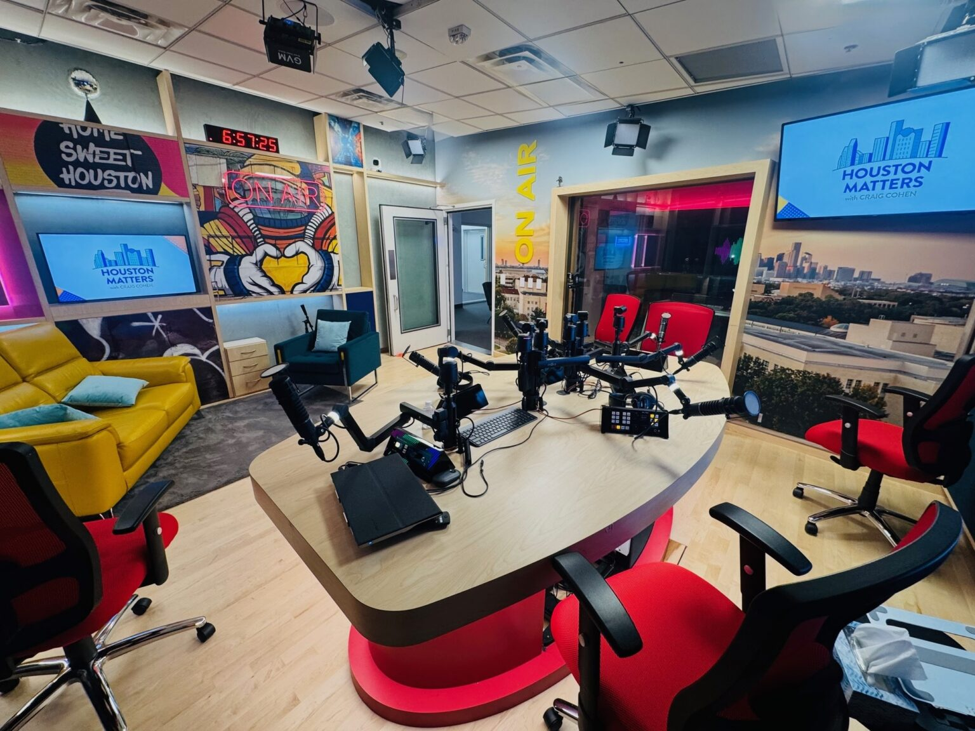
Asked to provide examples of recent relevant projects, Golman pointed to Houston Public Media and Good Karma Sports ESPN/Chicago.
“Both are top-tier broadcast radio stations. They both have top-tier video production environments and strong social media operations, and utilize secondary control positions,” he said.
“Although both have automation functionality, they treat their productions somewhat differently. HPM has two live, local talk shows across three hours per day while ESPN/Chicago has three live, local talk shows, along with a network show, across 12 hours per day.”
Both use Wheatstone products and both utilize secondary video production positions that are run from workstations with “soft” control panels as the human-interface controls for the video systems.
“HPM has a more traditional news slant and is highly produced. ESPN/Chicago is more free-form talk and 95% of its video is hands-free.”
At your fingertips
Control surfaces and consoles of the future are going to have to contend with the multi-platform nature of modern radio broadcasting, said Dave Miska, studio operations manager for WBEZ Chicago and Vocalo Radio Chicago, who is also an instructor and contract engineer for WRRG(FM) at Triton College Radio in River Grove, Ill.
“As evidenced during the pandemic, we had to adapt to Zoom and Google Meet as a method of bringing in guests, and sometimes hosts, to radio. There may have to be features like starting live video for example.
“With smaller staffs, putting these controls in front of the operator will be key to success. It’s no longer just the over the air signal or stream. There’s YouTube, Instagram, Facebook Live etc. That cat is out of the bag for good, so flexibility is number one.”
Miska said AoIP has provided the flexibility to call up numerous sources that older analog consoles couldn’t.
“The ability to automatically create mix-minuses instantly assists the operator in speedily getting remote sources on the air without the manual patching of the old days.”
Everything is now at the staff’s fingertips.
“Often, engineers are forced to deal with shrinking studio space, and these consoles can take up a smaller footprint by using fewer faders, but having the selectability on a source knob with an easy-to-read display. It helps keep the workspace to a minimum with ever-decreasing traditional studio budgets.”
Miska said the ability to configure sources only needed for each studio allows a central network type approach.
“With WheatNet for example, you can customize each control surface, but use one network to do it. It’s simpler for maintenance, and studios can be swapped as needs change quite quickly. You can also create operator profiles to minimize source confusion. The smaller approach can make things more efficient.”
What will the console of the future look like, if we use one at all?
“I think the traditional console will be around for a while, but I could see a scenario where video controls or webstreams will be integrated into the console,” he replied.
“Again, smaller plants and fewer employees will put the onus on the operator to run all aspects of the broadcast. I can see where changes in workflow may change a bit, but the console is still the master control. You need that central point in live broadcasting.”