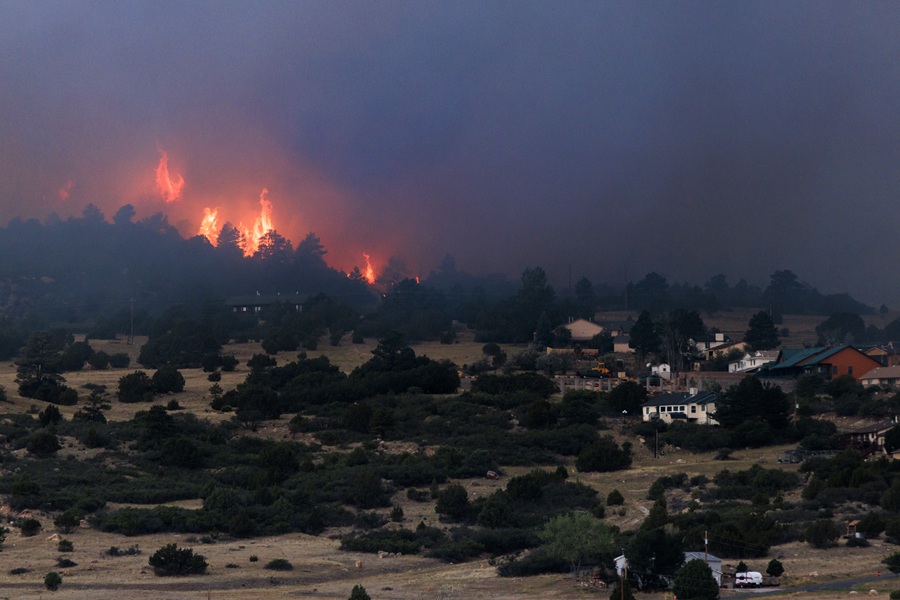
The Aspen Acres wildfire in Colorado came within several hundred feet of the Camp Jackson tower site this summer. Engineer Michael Baldauf, who was displaced from his nearby home, helps maintain the broadcast site there.
Fire is going to burn through every forest, it’s just a question of when. Which means that a transmitter site in a forest is probably going to face the challenges of nature sooner or later.
Here are some lessons learned at Camp Jackson.
The site has hosted various stations and had several owners. Today there are FM antennas on the 210-foot tower serving four broadcasters, as well as some federal government communications.
On June 29, high winds and probably a tree blown into a power line started a fire about 7 miles north of the Camp Jackson site.
Because the winds were blowing west to east, the areas to the south appeared to be safe from this small fire. Firefighting resources would be more than enough to protect this area.
Or so we thought until about three hours later when the fire had exploded and evacuation orders came out.
By July 2 it was obvious that the fire would burn through the area. Power was down — it would be off for three weeks — and we had no access to the transmitter site.
I made sure that the Emergency Operations Center had my contact information in case something needed to be done at the site. I also told them where the key to the building was hidden.
After about 10 days, Vertical Bridge, which owns the tower, called to tell me they had ordered the propane tank at the site to be refilled. They asked if I could go up and get everything back on the air.
There were a few challenges with that:
- No one was allowed yet to access the site because the fire was still in the immediate area, so there would be no propane or access for me.
- There have been at least two electrical upgrades in the building over the years that did not include the transfer switch; so there is no connection between the generator and the electrical system.
- To my knowledge, the generator hadn’t run since the 1980s (and it didn’t run very well then). Over the years, none of the stations or owners expressed interest in maintaining redundancy for the site.
So I could not comply with VB’s request initially.
About a week later, once the fire was no longer a direct threat to the site, I requested a visit from the sheriff’s office, which typically controls access in this situation.
One of their staff took me up to the site.
The trip was like a scene in a movie. We passed water tankers, helicopters, fire trucks from many states, bulldozers — whatever could be used to fight fires. In the town of Rye, fire crews were using the high school as their base, but otherwise the town’s homes, stores and schools were empty.

We drove for miles through a patchwork of burning and burnt forest as well as untouched areas. Approaching the site, I was relieved to discover that the reports of Camp Jackson being protected were true.
At the site, I turned off all circuit breakers in the building so that when power was eventually restored everything could be brought back on under a watchful eye. We only stayed for a few minutes.
In late July the evacuation of some areas near the transmitter site was lifted, though it was still considered an active fire zone.
I texted a local electric utility employee who has worked with me at the site for many years and asked to be informed when they would get permission to restore power to the area.
Two days later the text came. The fire had not threatened the site since my visit, so the process of restarting everything was fairly straightforward.
Internet service from the local ISP to the site was still a few days’ wait, but stations that had recently migrated to Starlink were up and running. A layer of ash and fire retardant on many surfaces was the worst part. Things could’ve been much worse.
Into the month of September, the Aspen Acres Fire was still not fully extinguished, and there were occasional spot fires above the transmitter site. The area affected by the fire had grown to more than 102,000 acres. At least 850 structures and 319 homes had been destroyed.
A bright spot from this experience is that bulldozers from the Forest Service needed to use our transmitter site road for access and to build a fire line. In doing so they improved it significantly.
Having a transmitter site atop a mountain boosts the range of an FM station, but a broadcaster shouldn’t count on being able to keep it on the air for almost a month without power or access. This is a strong argument for having a backup site elsewhere to assure operational resilience.
Personally, I was not able to get to my house for about a month. My home didn’t burn, but many of my neighbors lost theirs.
Once back home I got busy cutting down charred trees, dealing with insurance adjusters, and trying to save the unburned plants around my home that didn’t get watered for a month.
It’s a surreal experience — all the creatures are gone, no birds, frogs, crickets … only the sound of the wind.