The author is executive vice president of technology of StreamGuys.

As broadcasters expand beyond over-the-air transmissions into pure-play streams and global distribution, metadata has evolved from a simple descriptive tag into a critical operational asset, one that underpins reliability, monetization and user experience.
Metadata provides information about other data: a song title, an artist name. But its modern application goes much further.
Today, metadata carries structural information, downstream signaling events and even loudness or dynamic range data so playback stays consistent across devices.
The synchronous advantage: HLS and MPEG-DASH
The industry is shifting from legacy protocols (SHOUTcast/Icecast) to standards-based formats like HLS and MPEG-DASH.
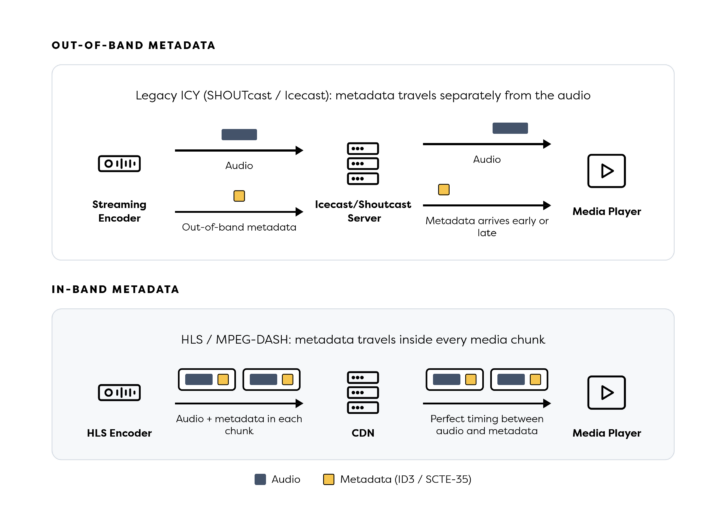
Legacy protocols deliver metadata asynchronously, meaning title and artist information can arrive out of sync with the audio due to network latency. HLS and MPEG-DASH fix this by embedding metadata directly within each media chunk, so data arrives precisely on time.
This is not just a technical improvement; it is a move toward unified workflows built on standard web infrastructure that increase resiliency and reduce operating costs.
One of the biggest limitations of legacy workflows is that metadata traditionally traveled separately from the audio itself. That asynchronous delivery often caused title, artist or program information to appear too early, too late or inconsistently across devices due to network latency.
Listeners might hear one song while seeing information for another, creating a fragmented user experience that broadcasters largely accepted as unavoidable in earlier streaming environments.
HLS and MPEG-DASH fundamentally change that relationship by embedding metadata directly within each media segment. Because the stream is divided into smaller synchronized chunks, every segment carries the exact metadata associated with that precise moment in playback.
The result is dramatically improved timing accuracy for song titles, album art, ad triggers and other signaling events. Broadcasters gain tighter control over the listening experience, while audiences receive synchronized visual and audio information regardless of platform or device.
This synchronization also unlocks far more sophisticated downstream workflows. Modern metadata is no longer limited to basic artist-and-title information. It now acts as a control layer for the entire streaming operation, carrying timing instructions, automation triggers, rights-management signals and playback parameters throughout the distribution chain.
Metadata effectively becomes the operational backbone that connects automation systems, encoders, CDN infrastructure, mobile apps, smart speakers, dashboards and analytics platforms into a single coordinated ecosystem.
Equally important, HLS and MPEG-DASH are built on open, standards-based web infrastructure. Because the specifications are widely published and universally understood, broadcasters are no longer locked into proprietary workflows tied to a single vendor. An HLS stream generated by one encoder manufacturer can be delivered, monitored, monetized and played back across a broad ecosystem of compatible platforms and applications.
That interoperability simplifies migrations, improves resiliency and allows broadcasters to evolve their infrastructure without rebuilding entire workflows around proprietary technologies.
The move toward standards-based streaming also reduces operational complexity and cost.
Developers, hardware vendors, CDN providers and application platforms are all working from the same technical playbook. That consistency accelerates integration, simplifies troubleshooting and creates greater flexibility when adding new partners or services.
For broadcasters operating across multiple distribution channels, standardized metadata workflows provide a more scalable foundation for future digital growth.
Five operational use cases for metadata
The operational power of metadata shows up clearly in five use cases that turn a standard audio feed into something far more valuable.
- Broadcast-to-Podcast: Automated Content Lifecycle
Metadata makes it possible to automatically segment live content into on-demand episodes or clips. Broadcaster’s automation systems insert ID3 tags to mark the start and end of segments. Servers monitor the stream for those markers in real time, extract the segments as standalone files and publish them to podcast platforms. A single live stream becomes a library of on-demand content with no manual intervention.
- Ad Insertion: Personalized Monetization
Server-Side Ad Insertion (SSAI) depends on metadata. Using ID3 or SCTE-35 markers, broadcasters signal ad break opportunities directly within the stream. From there, content can be targeted by geo-location, time of day, device type and first-party listener data. Sales teams can sell inventory against specific breaks. Remnant inventory opens to programmatic marketplaces. The server removes simulcast ads and stitches in targeted content, keeping the listening experience at broadcast quality.
- Source Switching: Resilience and Compliance
Metadata also provides the intelligence for failover and stream management. If a primary source fails and an expected metadata trigger does not arrive, the broadcast system can transition to alternate content. During sports blackouts or other rights-restricted programming, metadata triggers can be used to automatically switch streams or insert alternative content. The listener never notices.
- Royalty Reporting: Accuracy and Compliance
For any broadcaster streaming music, royalty reporting is not optional. It is a legal obligation. Organizations like SoundExchange in the U.S., PPL in the UK and collecting societies worldwide require detailed logs of what was played, when it was played and how many listeners were tuned in. Metadata is the foundation that makes accurate reporting possible at scale.
- Visual Identity and Global Reach
With in-car displays and smart TVs, the visual side of audio streaming carries real weight.
Modern protocols support album art and station logos delivered as synchronized metadata, reinforcing brand presence on every screen the listener touches.
For broadcasters distributing globally, UTF-8 encoding within metadata is non-negotiable. It allows error-free display of international alphabets and emoji across devices and regions. Get the encoding wrong and you get garbled text that immediately signals a lack of polish and erodes listener trust.
Together, these five examples show that metadata is the engine behind automation, monetization, compliance, brand presence and listener experience. When the same metadata format is used end-to-end, infrastructure gets simpler and streams become more valuable.
A standards-based future
For a detailed look at these implementations, including text encoding, master clock synchronization and ID3 formatting, industry professionals should reference the NRSC-G304: Metadata for Streaming Audio Handbook.
The handbook reflects the industry’s growing consensus around standards-based streaming metadata and provides practical guidance for implementing reliable, interoperable workflows across modern broadcast environments.
The value of a standards-based approach extends far beyond technical compliance. When broadcasters adopt common metadata frameworks, every component in the streaming chain — automation systems, encoders, players, ad platforms, analytics tools and connected devices — can communicate more reliably and consistently. Standardization improves interoperability between vendors, simplifies system integration and protects broadcasters from being locked into proprietary ecosystems that limit flexibility and innovation.Standards-based metadata strengthens the operational layer around playback. Synchronized timing supported by master clocks and structured metadata delivery ensures that now-playing information, ad markers and program boundaries align precisely with the audio, so downstream systems (players, ad insertion, logging, royalty reporting) behave predictably across distribution paths.
As radio broadcasters continue expanding into streaming-first distribution, these capabilities become essential for maintaining audience trust and delivering premium digital experiences at scale.
Metadata is no longer just “data about data.” It is the infrastructure layer powering personalization, monetization, automation, compliance and audience engagement across the entire streaming ecosystem.
Content may still be king, but in modern streaming workflows, metadata is the operational intelligence that keeps the kingdom running.