The author of this commentary is broadcast sales engineer for Burk Technology.

Radio engineering teams in 2026 face a familiar but increasingly complex challenge: managing growing networks of broadcast facilities with fewer on-site personnel.
As station groups continue to expand their geographic footprints while trimming engineering staff, remote control systems are being called on to improve operating efficiency and reduce maintenance costs in tandem with their traditional role of keeping stations on the air.
The modern broadcast plant blends legacy hardware, for example diesel generators that may remain in service for decades, with an ever-expanding catalog of IP-based devices. Transmitters, modulation monitors, audio processors, STLs and IRDs now commonly appear as network-connected endpoints.
While each device can typically be accessed individually over IP, logging into dozens of interfaces to check status or diagnose performance issues is both inefficient and impractical. A consolidated, well-designed remote-control architecture saves significant time and expense by funneling these disparate systems into a unified operational view.
Centralized monitoring is now common practice for radio groups. Site visits are limited to periodic maintenance needs, with schedules informed by automated site reports and system alerts.
Long-term performance trends can be recognized before they become outages. Critical alarms are triaged by centralized monitoring personnel who assess severity and determine dispatch priority.
This approach ensures that the expense of dispatching engineering resources is reserved for the most revenue-sensitive failures, while lower-priority issues are deferred for scheduled service.
Models
Although the objectives for centralized monitoring are relatively consistent across the industry, operational models vary.
Traditional network operations centers, or NOCs, remain vital for many organizations. These are highly visible, purpose-built facilities with around-the-clock staff, large wall displays and multiple monitoring workstations. Some even maintain redundant NOCs separated geographically to ensure continuity during disasters.
In parallel, a more distributed model has taken hold, influenced heavily by the operational constraints of the pandemic era.
In a distributed or virtual NOC environment, operators may work from individual workspaces or home offices while retaining access to the corporation’s complete set of transmitter sites. This arrangement supports flexible staffing, load sharing and built-in redundancy without the cost of additional physical facilities.
Burk Technology provides one widely adopted approach to this architecture, combining distributed intelligence with centralized management.
At each remote site, smart controllers such as the ARC Plus Touch and ARC Solo automate monitoring and command execution. These hardware platforms contribute to overall resilience by ensuring that essential operations continue even when network connectivity is interrupted.
For system-wide management, software platforms like Burk’s AutoPilot and Arcadia aggregate site data and provide operators with a unified interface. This separation allows the edge hardware to maintain reliability while centralized software can evolve in virtualized or cloud-based computing environments.
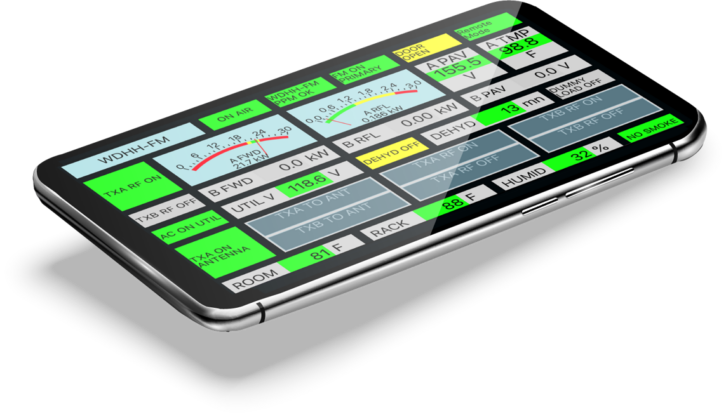
The Arcadia NOC system supports both traditional centralized NOC facilities and distributed NOCs. It offers the same capabilities to operators whether they are seated in front of a large wall-mounted display or logged in from a remote location.
Topologies
Connectivity is the backbone of all modern remote-control systems, and 2026 offers radio organizations an unusually broad array of networking options.
Almost all communication paths now utilize IP. Even “plain old telephone service” is now often delivered over IP. Infrastructure may combine private IP networks, public internet links, RF connections, fiber and cellular backhaul. Choices can depend on geography, corporate IT policy and budget.
Regardless of topology, proper security is essential. Firewalls must shield remote sites from the public internet, and VPN interconnections provide a valuable method for linking sites securely while preventing external intrusion.
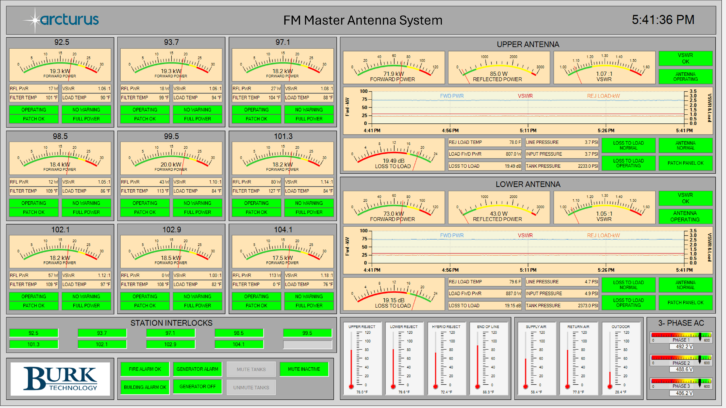
Mobile access adds another layer of complexity. Engineers and station managers need reliable site access from smartphones and laptops. Extending VPN capability to these devices is increasingly common. Protocols such as Transport Layer Security (TLS) may be used when access must traverse the public internet.
Burk’s Arcadia system, for example, provides secure mobile access to large site inventories through a single encrypted TLS link.
SNMP has solidified its role in broadcast remote control and monitoring, with virtually all modern transmitters providing this capability. Other remote site equipment including codecs, mod monitors, audio processors, IRDs and STLs also increasingly support SNMP.
SNMP vastly simplifies remote site wiring, utilizing the remote site LAN for connectivity and eliminating the need for the copper wires formerly required for GPIO control.
On the other hand, SNMP is a verbose protocol. When used for communication from remote sites back to central monitoring stations, SNMP can place an unnecessary burden on network capacity.
This shortcoming can be overcome by restricting SNMP communication to the local-area network within the remote site. Burk’s Warp Engine then converts both SNMP and GPIO data into a bandwidth-efficient format for streamlined backhaul to the central monitoring system.
A number of other factors contribute to remote control’s effectiveness. System usability, for example, can be enhanced through customization.
For a market cluster or single facility, engineers using AutoPilot may construct a simple one-screen interface with drill-down elements for detailed device views. Larger groups may incorporate regional dashboards and a high-level national overview for top-tier operations staff.
Modern platforms should allow extensive interface configuration — meters, buttons, virtual widgets, color-coded states and more. The best systems allow engineers themselves to create and modify these control views without relying on third-party programmers or ongoing vendor intervention.
Alarm handling is another area where distributed intelligence provides strong operational benefits.
Because alarms originate directly at the site controller, events can trigger immediate local actions even if wide-area connectivity is impaired. Alarm delays, re-arm setting and alarm roll-up logic prevent nuisance notifications or alarm floods from cascading out of a single root cause. Systems can be configured to automatically switch to backup devices upon failure or log specific parameters at the time an alarm occurs for later analysis. Targeted alarm routing ensures that urgent issues wake up the right people while less critical conditions are deferred until morning.
Logging continues to be essential for historical analysis and predictive maintenance. An ARC Plus unit can store approximately a month of data locally, depending on the number of channels and sample rates. Centralized systems such as AutoPilot can transfer logs to a long-term storage database, enabling performance comparisons over time. Historical data becomes invaluable when diagnosing subtle changes in device behavior that might otherwise go unnoticed — slow power declines, creeping VSWR trends or intermittent remote-site conditions.
As broadcasters face sustained pressure to do more with less, the role of remote control and monitoring systems has become central to engineering strategy.
The technologies described above provide the visibility, automation and resiliency required to maintain operational excellence in a cost-constrained environment.
For more on this topic, see the free ebook “Trends in Remote Control & Facility Management.”