How can public media newsrooms serve people well when our society seems so polarized?
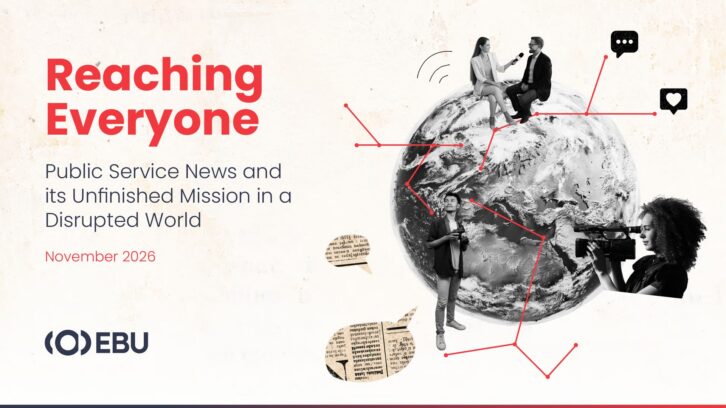
That question is the focus of a report out this month commissioned by the European Broadcasting Union, an organization that represents public service media on that continent.
The report was introduced during the EBU News Assembly in Cyprus this month. It was based on interviews with news leaders and experts, a survey of newsrooms at 29 organizations, and 14 case studies.
It highlights four pressures on newsrooms of public service broadcasters: hyper-partisanship; disengagement among younger people; reliance on platforms whose algorithms privilege emotivity over accuracy; and the greater speed and sophistication of bad actors relative to PSM.
What can be done? The report advocates for “people-first approaches” — encouraging deeper audience listening, providing more transparency about how journalism works, partnering with trusted creators and collaborating more across national borders.
EBU’s Director General Noel Curran said public service media “are the biggest producers of content in Europe and the most trusted source of news.” But the report said that “closing the gap with younger audiences is imperative,” and found that “indifference is as much a challenge as hostility.”
Key findings
Here is how EBU summarizes the key findings, quoted directly from its summary:
- Transparency builds trust: Trust is earned, especially among skeptical audiences, by explaining how stories are made and decisions taken. Half of the teams questioned run “open-door” explanations of editorial decisions.
- Platforms and AI are changing access to audiences: Algorithms favor emotive over accurate content, and AI search reduces traffic to news sites. The report highlights work on public interest technology, including platforms designed to encourage evidence-based debate.
- Listening beats profiling: Malicious actors use advanced audience targeting, while newsrooms rely mainly on surveys and demographic data. The report points to the need for a deeper, more nuanced understanding of underserved and hard-to-reach groups through sophisticated audience research that goes beyond simple demographics.
- Public service media have a security role: PSM have a duty to inform audiences about hybrid threats such as sabotage, cyber-attacks and disinformation, and the report calls for closer cross-border cooperation and pattern-tracking.
The report is available here.