What does geotargeting look and sound like?
The first such installation went on the air last month at KADD(FM), “La Mejor 93.5,” licensed to Logandale, Nev., as a Class C FM.
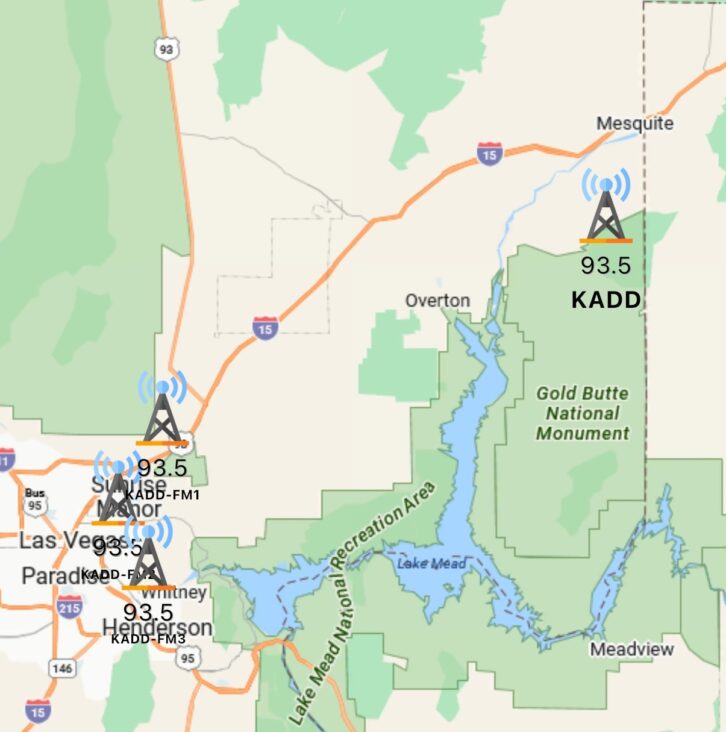
The Regional Mexican-formatted station transmits its primary signal on Mount Diablo, in Bunkersville, Nev., south of Mesquite, along with sister station 94.5 KXLI(FM), licensed to Moapa.
GeoBroadcast Solutions is the designer of the ZoneCasting-based geotargeting system that KADD’s owner Radio Activo selected. ZoneCasting allows stations to air unique content on synchronized boosters, such as advertisements, with an aim to unlock localized revenue streams.
KADD’s 93 kW signal provides a fringe, “rimshot” coverage to the Las Vegas market, with its transmitter approximately 70 miles northeast of the strip. St. George, Utah is served better by its primary signal, within its projected 60 dB contour area, but the peaks of the Pine Valley Mountains cause terrain shadowing.
As a result, KADD became a natural candidate for the concept of single-frequency network boosters. Since last year, the station has operated five such boosters through GBS’ MaxxCasting to enhance its signal in both Las Vegas and St. George.
But through the work of GBS and an experienced engineering team, the opportunity to originate programming on the boosters — through the FCC’s recent geotargeting approval — was what the partners said was the next step toward shipping a technology they felt is long overdue for radio.
[Related: “Bouvard: Advertiser Interest in Geotargeting Grows”]
Through the commission’s green light, FM stations can originate content on synchronized boosters for no more than three minutes per hour. Though the commission did not endorse one particular vendor, in practice, the rules regulate the use of GBS’ ZoneCasting system.
Booster zones
Three of the KADD boosters are in the Las Vegas metropolitan area, with a 350-watt booster licensed to Henderson, a 275-watt booster licensed to Las Vegas and a 55-watt booster licensed to North Las Vegas.

All three boosters and the main transmitter can either support identical or “zoned” content.

The same is true for its two St. George, Utah boosters, which operate with 2.5 kW.
“While each booster has a dedicated audio feed, MaxxCasting and Zonecasting are designed to operate boosters in clusters to cover a specific area,” the ZoneCasting project team said.
As a result, the three Las Vegas boosters function as a single zone, the main transmitter its own zone and the two St. George boosters a third zone.
How much content?
The GBS team said that programming that differs from the primary signal has been broadcast in each GeoCasting zone since the launch for up to the limit of three minutes per hour.
The daily amount varies based on programming and advertising demand.

All of the transmitters involved are tied together with IP codecs that use specialized SFN software and GPS synchronization, the team said. For the KADD deployment, 2wcom codecs were used.
Special content that is sent to the boosters is managed at the main studio through KADD’s automation. The main programming runs continuously, and zoned content plays from separate playlists triggered during ZoneCasting breaks.
The team said the workflow is much like satellite-fed automation, and that most automation systems can be configured in such a manner. “The network runs continuously, and local breaks are inserted for news, weather or commercials,” the team said.
The main feed substitutes for the network, and zoned playlists act as the local breaks.
It takes a village
The licensing, tower and antenna installations, electrical, HVAC, broadcast equipment and system testing portions of the project required many hands.
Paul Littelton, GBS’ chief technology officer, and Vern Egli, GBS’ director of infrastructure deployment, led the project. John McGuire, Bert Goldman and Jeremy Preece provided significant engineering contributions. The ZoneCasting team said there were approximately nine technicians and engineers involved.
Broadcast Electronics ETX transmitters were used for all of the KADD boosters, while 2wcom MPX-2c IP codecs were chosen to distribute MPX audio.
2wcom told Radio World that the GPS module supplies the 1pps timing signal used by the SFN software to properly control the delivery time of the signals at each transmitter site.

Antennas were supplied by Propagation Systems Inc., while Jampro and Comtech provided filters and combiners, where needed.
IP-based connectivity
The booster sites required off-air receivers with IP audio streaming capability, the team said, to provide remote confidence monitoring.
Typically, fiber- or wired-based IP connections are selected to link the studio to the booster sites. In some of its installations, GBS has used point-to-point or wireless IP providers. Depending on the station, redundant IP connections may be installed to increase reliability.
ZoneCasting equipment has IP-based remote monitoring via integrated web GUIs or SNMP, with alerts when parameters are out of tolerance levels. Audio is also monitored for each site using off-air receivers with IP connectivity.
GBS also operates a network operations center that uses software hosted in AWS to track devices across the network.
“Both the GBS technical team and station operators can access system data to ensure compliance,” the company said.
Keep on score
The number one question for those intrigued with ZoneCasting has been self-interference — or keeping booster audio in sync across a “zone” and with the primary signal. That’s been a chief focus of the project team.
The team worked with NPR Labs and Towson University to study listener reactions to interference under different conditions, including mono, stereo, HD Radio, varying audio delays and desirable to undesirable ratios of competing signals.
It’s the foundation of a metric GBS called “Keep On Score” — or when interference becomes too much for a listener.
GBS said it designs its networks so that approximately 90% of listeners stay tuned in during transition zones.
It said those transition zones typically account for “less than 5%” of a station’s coverage.

GBS also explained that ZoneCasting has been tested over several years in a variation of environments. That includes the terrain-shielded area of San Jose, Calif., and flatter areas like Milwaukee along Lake Michigan, interior Central Florida and Jackson, Miss.
ZoneCasting has also been tested in Bangalore, India, as Radio World has covered.
Results from the tests were independently reviewed by Roberson and Associates, a Chicago-based consulting firm with experience in SFNs for Motorola, AT&T, Bell Labs and Nokia.
GBS said the caliber of engineers involved in studying, gathering and reviewing data, as well as the FCC’s own review in order to approve ZoneCasting, “provides a level of scientific method and rigor not typically found in radio RF system design.”
A template for more?
Because of the terrain and spacing between Las Vegas and St. George and where KADD transmits its primary signal from, the geography offers a fairly ideal setup for SFNs to offer different programming across zones, without interference ramifications.
[Related: “Letter: Self-Interference Remains a ZoneCasting Concern”]
But what about a flatter environment, such as metropolitan Boston or Chicago?
GBS said it has deployments with rigorous testing in both terrain-heavy and flat areas, which were central to the FCC’s approval.
Successful SFN design, the team explained, depends on managing RF levels at the receiver so the capture effect transitions cleanly between transmitters.
Terrain, large buildings, bodies of water, proximity to the nearest tower, antenna design and RF signal levels all can factor into the site’s design.
ZoneCasting, the team said, is a tool that can be adopted based on a station’s goal in their market, especially in areas where Nielsen’s PPM is used to measure listenership.
“Advertisers demand targeting, and radio is the last traditional medium to adopt it,” the team said.
Ed. note: KADD’s owner, Radio Activo, currently has an ongoing legal case with American Tower, who provides power for the Mount Diablo site, and site owner Insite Wireless, which Inside Radio details.
Radio World welcomes letters to the editor on this or any story. Email [email protected].